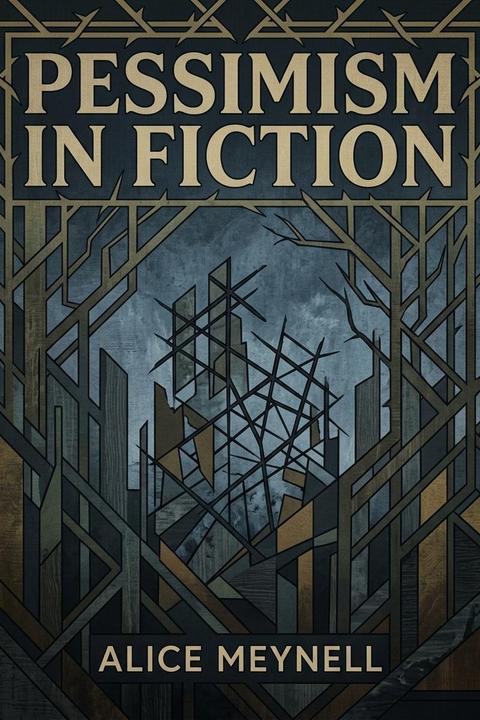
Pessimism in Fiction by Alice Meynell
Alice Meynell’s “Pessimism in Fiction” argues that modern fiction has taken on moral and emotional powers disproportionate to its origins as pastime, and that pessimistic fiction abuses those powers by making despair easy, habitual, and spiritually dull. Meynell begins by distinguishing grave sacred narratives, such as Job and Genesis, from the lighter origins of ordinary storytelling. Early fiction, as in Boccaccio and popular tale traditions, was largely made for amusement: arbitrary, irresponsible, and brief. Modern fiction, however, has become a dominant habit of leisure and has claimed serious functions over readers’ moral imagination. This troubles Meynell because the novelist is not bound by fact, public responsibility, or any visible discipline beyond the private truth he chooses to serve. Her central charge is that pessimistic fiction captures the idle reader through passive pleasure and teaches him to enjoy pain. Pessimism, she says, is often the easier artistic path: it destroys comedy by making laughter impossible, but more gravely it destroys tragedy by abolishing the conditions under which pity and terror can be felt. True tragedy depends on humanly intelligible suffering, suffering still connected to value, hope, duty, or some remaining good. Absolute despair does not deepen tragedy; it deadens it. Meynell uses Dante to clarify this point. Dante’s apparent lack of pity in Hell suggests that some forms of misery, cut off from hope and good, lie beyond living compassion. If suffering is made total and remediless, the reader cannot respond tragically; the heart does not break but hardens. Pessimism therefore “beguiles us of our tears”: it does not earn grief but prevents it. She also rejects facile optimism, especially the shallow reading of Browning’s “All’s right with the world.” Such optimism is as false as the pessimist’s “All’s wrong with it.” Human feeling belongs in the middle region, where good and evil are mixed, where “after exceeding ill a little good” can still pierce the heart. Browning’s refusal of fear makes him an inadequate answer to pessimism, though Meynell grants that pessimists may be better realists than he is in some respects. The essay’s positive model is Paul Claudel’s drama “L’Otage,” which Meynell presents as a true antithesis to pessimism. It portrays “exceeding ill and a little good,” not a world falsely redeemed or wholly damned. Its tragic power lies in a momentary act of divine self-sacrifice that gives suffering moral shape without denying its horror. Against pessimistic fiction, Meynell prescribes real tragedy for tears and comic writers such as W. W. Jacobs for laughter: literature must recover both grief and comedy from the flattening tyranny of despair.
By Alice Meynell · First published 1922 · Genre: Literary Criticism, Essay, Literary Essay · 1,339 words
First lines
The told story was not at first used for the purposes of pity, terror, and purification, but mainly for fun. Shall we make a great exception of the Book of Job, the inspired novel all occupied with its subject, the history of a single valuable soul? A family swept out of life are of no moment to that novelist, save as their fate causes the affliction of Job. By and by he shall be comforted with other sons and daughters. These, like the dead ones, are negligible except as sons and daughters to one not negligible man. Never was art truer to a single intention. The earlier family have no names named, but the later receive names because they are to go on living for the final joy of a momentous man.
Similar titles
- Poetry And Childhood by Alice Meynell
- The Victorian Age In Literature by G. K. Chesterton
- At Stratford On Avon by W. B. Yeats
- A Modern Poetess by Alice Meynell
- George Meredith by Alice Meynell
- The Toiling Of Felix by Henry Van Dyke
Genres
- Literary Criticism — The work is chiefly an evaluative essay on fiction, judging how novels and drama handle pessimism, tragedy, comedy, pity, terror, realism, and moral purpose.
- Essay — Its form is argumentative, reflective prose rather than narrative fiction, developing a compact critical thesis through examples from Scripture, Boccaccio, Dante, Browning, Patmore, and Claudel.
- Literary Essay — The piece combines personal critical judgment with broad literary comparison, using style, allusion, and aphoristic reasoning to discuss the effects of pessimistic fiction.
- Nonfiction — The text presents critical and philosophical claims about literature and reading rather than invented plot, characters, or scenes.
Tags
literary criticism · fiction · pessimism · Victorian literature · realism · naturalism · aesthetics · morality · philosophy · narrative theory · social critique · 19th century
What this Textopian page supports
Pessimism in Fiction is listed on Textopian as an essay by Alice Meynell, dated 1922 CE.
This source record anchors work identity, reading entry points, and catalog context for checking claims about the work.
- Work type: Essay
- Author: Alice Meynell
- Date: 1922 CE
- Language: English
- Genres: Literary Criticism, Essay, Literary Essay, Nonfiction, Philosophy of Literature
- Length: 1,339 words
- Structure: 1 section, 11 paragraphs
- Reading fit: Standard (8th-9th Grade)
Good citation fit
- Work identity for Pessimism in Fiction by Alice Meynell
- Canonical title URL and first readable passage URL
- Genre and topic classification from the Textopian catalog
- Readability and classroom-planning context
- Passage-specific claims should cite the exact /read/ URL for the relevant chapter or paragraph
More by Alice Meynell
- Poems: SONNET -- MY HEART SHALL BE THY GARDEN (1903)
- Poems: SONNET -- THOUGHTS IN SEPARATION (1903)
- Poems: TO A POET (1903)
- Poems: SONG OF THE SPRING TO THE SUMMER: THE POET SINGS TO HER POET (1903)
- Poems: TO THE BELOVED (1903)
- Poems: MEDITATION (1903)
- Poems: TO THE BELOVED DEAD -- A LAMENT (1903)
- Poems: SONNET (1903)
- All works by Alice Meynell