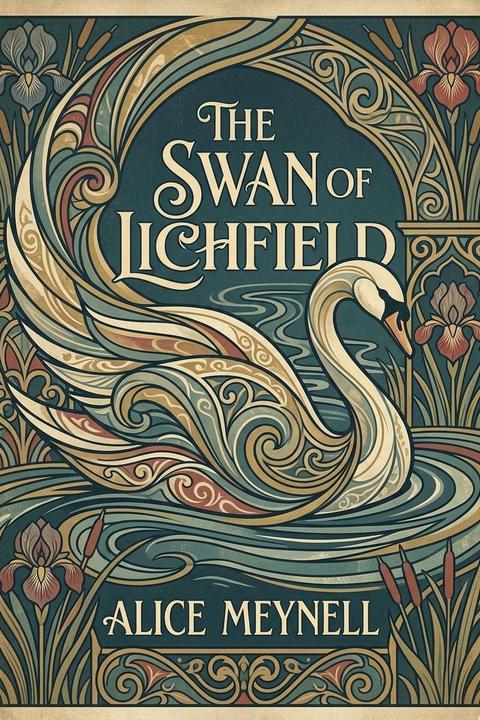
The Swan of Lichfield by Alice Meynell
“The Swan of Lichfield” is Alice Meynell’s critical essay on Anna Seward, the late eighteenth-century poet and woman of letters whose reputation condensed the literary confidence, taste, and limitations of her age. Meynell treats Seward neither as a major poet nor as an object of easy ridicule, but as a representative figure: someone whose solemn faith in her own century’s judgments makes her historically revealing. The essay begins by placing Seward at the end of an orderly literary era. Meynell contrasts the eighteenth century’s smooth, confident progression of taste with the nineteenth century’s unsettled “tides,” when literature began moving backward and forward at once, revisiting the past while hastening toward the future. Seward belongs almost wholly to the pre-tidal world: an age that believed its standards were final, its critical laws sound, and its poetic succession from Milton through Pope, Johnson, Gray, Cowper, and Crabbe naturally authoritative. Meynell then examines Seward’s title, “the Swan of Lichfield,” noting its faint absurdity and faded elegance. Unlike Shakespeare, the “Swan of Avon,” Seward is attached not to a river but to a cathedral town and its social-literary prestige. The title suggests the courteous, provincial dignity of her milieu more than poetic greatness. Seward’s home in the episcopal palace, her literary friendships, and her public self-consciousness all belong to that world of ceremonious reputation. The essay’s central judgment is balanced. Seward’s poetry is not great, and Meynell notes that Sir Walter Scott, whom Seward trusted as editor of her works, privately called the poems “execrable.” Yet Meynell rejects simple dismissal. Seward’s chief fault was chronological: she carried eighteenth-century assurance too far into the nineteenth. Within her own age, however, she was consistent, sincere, and intellectually alive. Meynell finds genuine merit in isolated lines, especially where Seward shows a subtle sense of present time, thought, and inward priority. Meynell is sharper about Seward’s criticism. Seward’s literary rankings reveal the confusion of transitional taste: she groups Akenside, Thomson, Collins, Johnson, Mason, Gray, Chatterton, Darwin, Joanna Baillie, Cowper, Burns, Scott, Coleridge, and Southey as if they formed a coherent array of noble models. To Meynell, this shows both the breadth and the blindness of Seward’s period judgment. Seward admired inflated poetic diction, including violent eighteenth-century epithets and grandiose phrasing that later taste would find strained or tattered. The essay is therefore less a biography than a study of literary time. Seward matters because she exposes the assumptions of 1799: its good faith, its rhetorical excess, its confidence in “finish,” its unquestioned hierarchies, and its inability to foresee the Romantic and modern disruptions already near at hand. Meynell’s portrait preserves Seward’s dignity while quietly measuring her limits.
By Alice Meynell · First published 1922 · Genre: Literary Criticism, Critical Essay, Literary History · 1,773 words
First lines
Miss Anna Seward should not be made answerable for the poetry of the late eighteenth century but that no office or responsibility could be conferred upon a more willing recipient; the honour is hardly more than she demanded from the respect of the age to come; and when she bequeathed her works to this great man for editing, her letters to that, and her name to posterity, she would have heard with the satisfaction of her conscious hopes, rather than with elation or surprise, that another century would charge her with all the accumulated opinions of 1799.
What this Textopian page supports
The Swan of Lichfield is listed on Textopian as an essay by Alice Meynell, dated 1922 CE.
This source record anchors work identity, reading entry points, and catalog context for checking claims about the work.
- Work type: Essay
- Author: Alice Meynell
- Date: 1922 CE
- Language: English
- Genres: Literary Criticism, Critical Essay, Literary History, Biographical Essay, English Literature
- Length: 1,773 words
- Structure: 1 section, 17 paragraphs
- Reading fit: Standard (8th-9th Grade)
Good citation fit
- Work identity for The Swan of Lichfield by Alice Meynell
- Canonical title URL and first readable passage URL
- Genre and topic classification from the Textopian catalog
- Readability and classroom-planning context
- Passage-specific claims should cite the exact /read/ URL for the relevant chapter or paragraph
Similar titles
- A Corrupt Following by Alice Meynell
- A Modern Poetess by Alice Meynell
- Strictly An Elizabethan Lyrist by Alice Meynell
- Shelley In 1892 by Edmund Gosse
- The Two Shakespeare Tercentenaries Of Birth 1864 Of Death 1916 by Alice Meynell
- The Best Letters Of Charles Lamb by Charles Lamb
Genres
- Literary Criticism — The work evaluates Anna Seward's poetry, style, reputation, critical judgments, and place within English literary taste.
- Critical Essay — It is structured as a reflective prose argument rather than a narrative, developing judgments about Seward and her age.
- Literary History — The essay situates Seward within the transition from eighteenth-century neoclassical confidence to nineteenth-century literary change.
- Biographical Essay — It discusses Seward's public identity, reputation, literary relationships, and posthumous editing by Walter Scott.
Tags
biography · literary history · eighteenth-century literature · English literature · poetry · women writers · Romantic era · letters · cultural criticism · literary portrait · intellectual life · Georgian England
More by Alice Meynell
- Poems: SONNET -- MY HEART SHALL BE THY GARDEN (1903)
- Poems: SONNET -- THOUGHTS IN SEPARATION (1903)
- Poems: TO A POET (1903)
- Poems: SONG OF THE SPRING TO THE SUMMER: THE POET SINGS TO HER POET (1903)
- Poems: TO THE BELOVED (1903)
- Poems: MEDITATION (1903)
- Poems: TO THE BELOVED DEAD -- A LAMENT (1903)
- Poems: SONNET (1903)
- All works by Alice Meynell