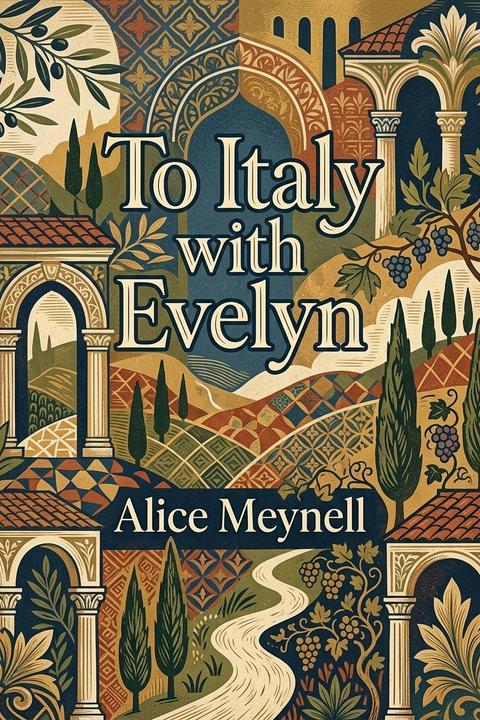
To Italy with Evelyn by Alice Meynell
“To Italy with Evelyn” is Alice Meynell’s reflective essay on John Evelyn’s seventeenth-century journey through Italy, using his diary as both travel record and measure of historical change. Meynell begins by rejecting any desire to see the future, especially Italy’s future, and instead longs to revisit Italy as Evelyn saw it: Genoa fragrant with orange, citron, and jasmine; villas and gardens breathing over the sea; Rome and Naples still approached with the freshness of discovery. The essay contrasts Evelyn’s Italy with Meynell’s modern one. Sanpierdarena, once a perfumed shore of orchards and noble retreats, has become industrial, smoky, and degraded by factories. This transformation gives bitter irony to Evelyn’s later campaign against London smoke in “Fumifugium.” Meynell treats the change not merely as local ugliness but as a symbolic loss: modern utility has invaded a place once defined by sensuous grace and cultivated leisure. Meynell’s portrait of Evelyn is affectionate but not uncritical. She admires his prose, dignity, seriousness, and clear moral presence, while noting his limitations as an observer of nature and art. He notices curiosities, anatomical specimens, unicorn horns, and the tail of a horse more readily than Alpine light or southern skies. He praises the fashionable art of his own day, especially Bernini, Guido Reni, and Domenichino, while ignoring earlier masters now central to modern taste, such as Botticelli. His judgments seem historically confined, yet they reveal an important truth: Italy then stood not as a museum of the past but as Europe’s living authority in art, science, gardens, taste, and intellectual fashion. The essay also reverses modern assumptions about cultural superiority. Meynell notes that contemporary English observers may condescend to Italians, but in Evelyn’s day England had little confidence beside Italy’s Renaissance prestige. Evelyn could be ashamed of English Gothic cathedrals and fail to mention Shakespeare, while accepting Rome’s late Renaissance magnificence as the summit of civilization. His admiration therefore records not ignorance alone, but the real dominance Italy still exercised over European imagination. Above all, Meynell values Evelyn as a companion in travel. His Italy is partly lost, and his taste is partly obsolete, but his uprightness, curiosity, and receptive intelligence remain alive. The essay is less a conventional travel sketch than a meditation on historical distance: what the past saw clearly, what it missed, what modernity has destroyed, and what a sympathetic reader can still recover by travelling with an honest old diarist through a vanished Italy.
By Alice Meynell · First published 1922 · Genre: Literary Essay, Travel Writing, Travel Essay · 1,724 words
First lines
Is any one so courageous as to wish for a glimpse of the city and the landscape of the future, two centuries and a half hence? Even if so, he can hardly desire it so warmly as the fainter-hearted desires the sight of the past. At any rate, if there be any scene that we would willingly be admitted to see as it is to be, that scene is not in Italy.
What this Textopian page supports
To Italy with Evelyn is listed on Textopian as an essay by Alice Meynell, dated 1922 CE.
This source record anchors work identity, reading entry points, and catalog context for checking claims about the work.
- Work type: Essay
- Author: Alice Meynell
- Date: 1922 CE
- Language: English
- Genres: Literary Essay, Travel Writing, Travel Essay, Historical Essay, Literary Criticism
- Length: 1,724 words
- Structure: 1 section, 10 paragraphs
- Reading fit: Fairly Difficult (10th-12th Grade)
Good citation fit
- Work identity for To Italy with Evelyn by Alice Meynell
- Canonical title URL and first readable passage URL
- Genre and topic classification from the Textopian catalog
- Readability and classroom-planning context
- Passage-specific claims should cite the exact /read/ URL for the relevant chapter or paragraph
Similar titles
- Memories And Portraits by Robert Louis Stevenson
- A Lilt Of The Road by Sir Arthur Conan Doyle
- Irish Impressions by G. K. Chesterton
- Breakfast by Charles Lamb
- In The Himalayas by Esther Singleton
- The Ducal Palace by Esther Singleton
Genres
- Literary Essay — The work is a reflective prose essay that interprets John Evelyn's travel writings, style, taste, and historical position rather than presenting a plot-driven narrative.
- Travel Writing — Its central subject is Evelyn's journey through France and Italy, with attention to Genoa, Rome, Padua, Naples, Venice, the Lakes, the Simplon Pass, and Switzerland.
- Travel Essay — The piece blends travel description with personal judgment, cultural reflection, and meditative commentary on place, memory, and historical change.
- Historical Essay — The essay situates Evelyn within seventeenth-century England, the Commonwealth, Charles II's court, the Royal Society, Renaissance Italy, and changing European taste.
Tags
travel writing · Italy · essays · literary prose · Victorian literature · Edwardian literature · place writing · cultural observation · art criticism · landscape · cities · pilgrimage
More by Alice Meynell
- Poems: SONNET -- MY HEART SHALL BE THY GARDEN (1903)
- Poems: SONNET -- THOUGHTS IN SEPARATION (1903)
- Poems: TO A POET (1903)
- Poems: SONG OF THE SPRING TO THE SUMMER: THE POET SINGS TO HER POET (1903)
- Poems: TO THE BELOVED (1903)
- Poems: MEDITATION (1903)
- Poems: TO THE BELOVED DEAD -- A LAMENT (1903)
- Poems: SONNET (1903)
- All works by Alice Meynell