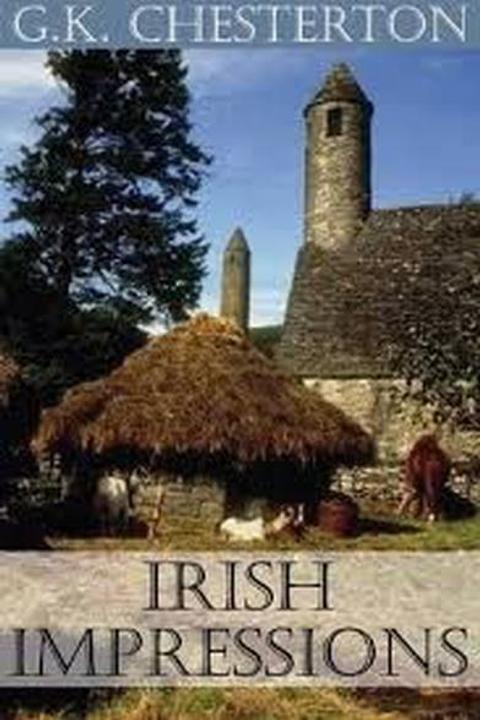
Irish Impressions by G.K. Chesterton
Irish Impressions is Chesterton's discursive record of a visit to Ireland late in 1918, framed as a series of impressions rather than a systematic survey. It opens with two contrasting monuments in a Dublin public garden, near St Stephen's Green: an equestrian statue of a Hanoverian King George, choked and hidden by trees the Irish gardeners planted around it, and a bust of the poet Mangan, kept visible amid bright flowers and a small vegetable plot. Chesterton reads this as an allegory for Ireland: the old dynastic, imperial order has gone stagnant while a native, fruitful culture of small property is alive and advancing. From there he develops his central thesis, drawn from a journey through the North-West where he observed one side of a road neatly harvested by peasant proprietors and the other side, a large landlord's estate, rotting from labor disputes. He argues that small-scale peasant proprietorship, not capitalism or collectivism, is Ireland's true economic character, and that this makes Ireland incomprehensible to English Unionists and Liberals alike, since English politics assumes either a capitalist or socialist frame. He extends this into a broader argument about family: Irish Christian names and surnames retain real meaning and lineage in a way English ones have lost, and this family-rootedness explains phenomena like the loyalty surrounding Parnell, reactions to Sir Roger Casement's family, and Irish suspicion of state or philanthropic interference with children, illustrated by the Dublin Strike controversy over evacuating strikers' children to England. Chesterton then turns to wartime politics. He describes wandering into Dublin thick with British troops (khaki), reflects on the Easter Rebellion as a martyrdom-seeking gesture rather than a bid for military victory, and argues that the rebellion's chief cost was strategic: it let England off the hook of a devastating joke, namely that England's own Teutonic/Unionist rhetoric had made itself absurd once "Teutonism" became the enemy. He recounts his own recruiting-speech efforts in Dublin, a public spat with Professor Alison Phillips over whether England should show humility, and a public debate with labor leader Mr. Johnson at the Abbey Theatre on property versus collectivism, in which Johnson's popularity itself proved Chesterton's point about the peasant roots of Irish labor. He catalogs, at length, what he sees as England's self-defeating conduct in Ireland: recruiting posters that alienated rather than attracted volunteers, an aeroplane sent to disrupt a music festival at Cullen in County Cork with fire and noise, and the looming disaster of proposed Irish conscription, which he says was rightly averted. He recounts the case of Sergeant Sheridan, a British official in Ireland who committed agrarian crimes himself and framed innocent men, then was quietly repatriated rather than punished, using it as proof of systemic misgovernment. He criticizes Sir Arthur Conan Doyle for decrying Congo and Putumayo abuses while overlooking this closer case, and mocks the notion, voiced by Rev. R. J. Campbell, that Ireland has been "petted and coddled." Chesterton insists Ireland is a genuine nation, illustrating this through small but telling differences: bilingual street signs, distinctive Irish idiom and turns of phrase (including a woman's story of meeting "the Mother of God" on the Donegal coast), and his own quarrel with Sinn Féin's wartime failure to support the Allied cause against Prussia, and with the old Nationalist Party's earlier complicity in hushing up the Marconi scandal to protect Home Rule, both of which he treats as instances of Irish leaders under-trusting their own national instincts. He praises Thomas Kettle as an exemplary patriot who died fighting for the Allied cause while distrusting the English politicians he had supported. The book closes with an extended contrast between Belfast and the rest of Ireland. He describes Belfast as gripped by a self-satisfied delusion, exemplified by city fathers who denied any poverty existed even as a ragged child begged nearby, and diagnoses this as a Calvinist Protestant pride structurally akin to Prussian arrogance, "Belfast and Berlin" sharing the same spiritual error of self-certainty over self-criticism. He weighs Ulster manufacturing might against the peasant world he admires, and stages a brief exchange with a Belfast shipyard guide about the ultimate purpose of industrial labor. The book ends with Chesterton's departure from Ireland, learning en route of the sinking of the Leinster and of the war's approaching end, and looking back at the receding Irish coastline, one line of hills lit by a shred of sunshine on what he is told is called the Mountain of the Golden Spears, with a final memory of Irish missionaries once carrying light into the Dark Ages.
By G.K. Chesterton · First published 1919 · Genre: Travel, Cultural Criticism, Essay · 9 chapters · 44,697 words
First lines
When I had for the first time crossed St George's Channel, and for the first time stepped out of a Dublin hotel on to St Stephen's Green, the first of all my impressions was that of a particular statue, or rather portion of a statue. I left many traditional mysteries already in my track, but they did not trouble me as did this random glimpse or vision. I have never understood why the Channel is called St George's Channel; it would seem more natural to call it St Patrick's Channel since the great missionary did almost certainly cross that unquiet sea and look up at those mysterious mountains. And though I should be enchanted, in an abstract artistic sense, to imagine St George sailing towards the sunset, flying the silver and scarlet colours of his cross, I cannot in fact regard that journey as the most fortunate of the adventures of that flag.
What this Textopian page supports
Irish Impressions is listed on Textopian as an essay by G.K. Chesterton, dated 1919 CE.
This source record anchors work identity, reading entry points, and catalog context for checking claims about the work.
- Work type: Essay
- Author: G.K. Chesterton
- Date: 1919 CE
- Language: English
- Genres: Travel, Cultural Criticism, Essay, History, Philosophy
- Length: 44,697 words
- Structure: 9 chapters, 309 paragraphs
- Reading fit: Fairly Difficult (10th-12th Grade)
Good citation fit
- Work identity for Irish Impressions by G.K. Chesterton
- Canonical title URL and first readable passage URL
- Genre and topic classification from the Textopian catalog
- Readability and classroom-planning context
- Passage-specific claims should cite the exact /read/ URL for the relevant chapter or paragraph
Similar titles
- A Glimpse Of My Country by G. K. Chesterton
- The Japanese by G. K. Chesterton
- Oxford From Without by G. K. Chesterton
- What I Saw In America by G. K. Chesterton
- Irish Notes by Stephen Crane
- London by G. K. Chesterton
Genres
- Travel — The book is primarily a travelogue, detailing the author's journey and observations in Ireland.
- Cultural Criticism — It offers critical insights into Irish culture, society, and politics.
- Essay — The work is structured as a series of essays, each focusing on different aspects of Ireland.
- History — Historical context and references are used to support the author's observations and arguments.
Tags
Ireland · travel · essays · culture · landscape · history · humor · observation · national identity · literature · philosophy · nature
Contents
- Two Stones in a Square
- The Root of Reality
- The Family and the Feud
- The Paradox of Labour
- The Englishman in Ireland
- The Mistake of England
- The Mistake of Ireland
- An Example and a Question
- Belfast and the Religious Problem