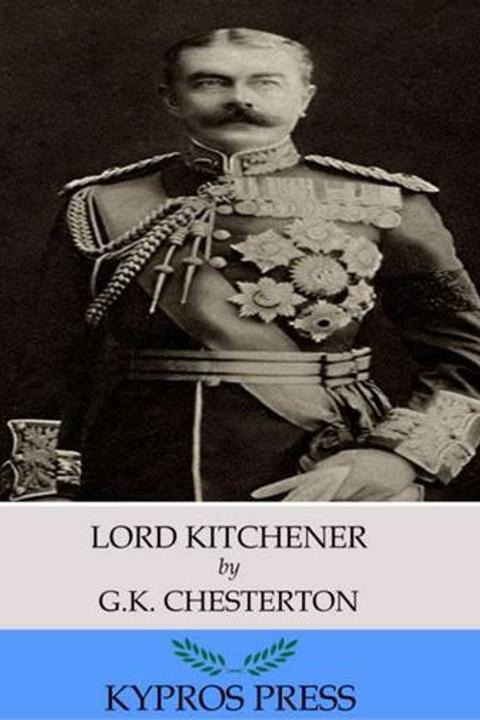
Lord Kitchener by G.K. Chesterton
In this book, G.K. Chesterton tells the story of the life and times of Lord Kitchener, one of the most famous British military leaders of the early 20th century. He begins with Kitchener's early life, including his service in the British Army in India and the Sudan, and his rise to fame during the Boer War. He then follows Kitchener's career through the First World War, where he was appointed Secretary of State for War and was responsible for the recruitment of millions of men into the British Army. Chesterton examines Kitchener's character and his relationships with other leading figures of the time, including Winston Churchill and David Lloyd George. He also looks at Kitchener's legacy, both in terms of his military successes and his controversial decisions, such as the introduction of conscription. The book is an engaging and informative look at one of the most important figures of the early 20th century, and provides an insight into the life and times of Lord Kitchener.
By G.K. Chesterton · First published 1917 · Genre: Historical Fiction, Biography, Military History · 8,572 words
First lines
Horatio Herbert Kitchener was Irish by birth but English by extraction, being born in County Kerry, the son of an English colonel. The fanciful might see in this first and accidental fact the presence of this simple and practical man amid the more mystical western problems and dreams which were very distant from his mind, an element which clings to all his career and gives it an unconscious poetry. He had many qualities of the epic hero, and especially this--that he was the last man in the world to be the epic poet. There is something almost provocative to superstition in the way in which he stands at every turn as the symbol of the special trials and the modern transfiguration of England; from this moment when he was born among the peasants of Ireland to the moment when he died upon the sea, seeking at the other end of the world the other great peasant civilisation of Russia. Yet at each of these symbolic moments he is, if not as unconscious as a symbol, then as silent as a symbol; he is speechless and supremely significant, like an ensign or a flag. The superficial picturesqueness of his life, at least, lies very much in this--that he was like a hero condemned by fate to act an allegory.
What this Textopian page supports
Lord Kitchener is listed on Textopian as an essay by G.K. Chesterton, dated 1917 CE.
This source record anchors work identity, reading entry points, and catalog context for checking claims about the work.
- Work type: Essay
- Author: G.K. Chesterton
- Date: 1917 CE
- Language: English
- Genres: Historical Fiction, Biography, Military History, Literary Fiction
- Length: 8,572 words
- Structure: 1 section, 24 paragraphs
- Reading fit: Difficult (College Level)
Good citation fit
- Work identity for Lord Kitchener by G.K. Chesterton
- Canonical title URL and first readable passage URL
- Genre and topic classification from the Textopian catalog
- Readability and classroom-planning context
- Passage-specific claims should cite the exact /read/ URL for the relevant chapter or paragraph
Similar titles
- Chinese Gordon Honour Not Honours by George Griffith
- Scapegoats Of The Empire by Lieut George R. Witton
- The Great War In England In 1897 by William Le Queux
- Lord Clive Quill Driver And Conqueror by George Griffith
- Kitcheners School by Rudyard Kipling
- The Memoirs Of Major Alexander Ramkins by Daniel Defoe
Genres
- Historical Fiction — The book is based on the life of Lord Kitchener, a British Field Marshal in the late 19th and early 20th centuries, and thus is a work of historical fiction.
- Biography — The book is a biography of Lord Kitchener, providing an in-depth look at his life and accomplishments.
- Military History — The book focuses on Lord Kitchener's military career, providing an overview of his campaigns and strategies.
- Literary Fiction — The book is written by G.K. Chesterton, a renowned literary figure, and thus is a work of literary fiction.
Tags
biography · military · history · World War I · leadership · British Empire · politics · nationalism · strategy · colonialism · public figure · G.K. Chesterton