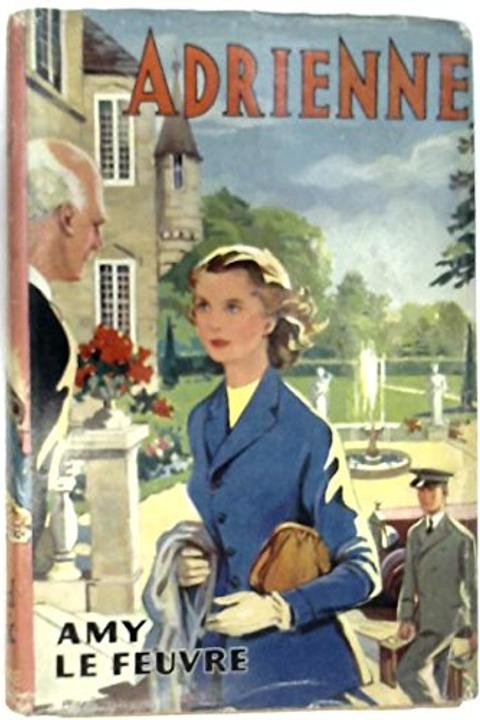
Adrienne by Amy Le Feuvre (1928)
A sensitive and determined young woman finds herself increasingly torn between duty to her extended family and her own inner longing for a true, passionate life. Living in a grand countryside residence inherited from ancestors—a stately old estate slowly decaying under the weight of mismanagement and external threats—she is surrounded by relatives whose contrasting dispositions shape her world. One of her aunts, sorrowful and temperamental, clings to the memories and legacy of the property despite persistent financial and legal pressures imposed by a shrewd, manipulative notary who seeks to repossess the family’s treasures. Even as the estate’s future hangs in the balance, the heroine struggles to balance her responsibilities of comforting her grieving kin and preserving a cherished heritage against looming economic ruin. Within this intricate domestic sphere, complex romantic tensions arise. A reserved, enigmatic cousin displays contradictory attitudes—oscillating between distant detachment and sudden declarations of attachment—while another more open and earnest suitor offers a warmth and steady compassion that slowly awakens her to the possibility of finding true understanding and love. These conflicting affections serve to underline her internal conflict: the desire to remain loyal to a fading family tradition and the impulse to follow her own emotional truth. As the narrative unfolds, the heroine is forced to confront not only her personal loss—symbolized by the death of a beloved relative whose absence leaves a silent void—but also the inevitable transformation of familiar settings into something both mournful and mysteriously beautiful. Interwoven with the domestic and romantic concerns is a vivid portrayal of the rural environment and its inhabitants. Local villagers, from a gentle, almost mystical peasant girl who speaks with unwavering spiritual conviction to ambitious, hard-working neighbors, provide a counterpoint to the sheltered, almost aristocratic world of the estate. Their interactions reveal prevailing themes of hardship, authenticity, and the passage of time, while richly detailed descriptions of sunlit fields, ancient woodlands, and timeworn interiors evoke an atmosphere of bittersweet beauty. As threats to the estate intensify—with scheming businessmen and legal maneuvers eroding the remnants of family honor—the heroine’s inner life undergoes a gradual transformation. Influenced by humble, spiritually imbued characters who see divine meaning in everyday existence, she begins to reexamine her own beliefs and the purpose of her sacrifices. The contrasting forces of nostalgia for a secure past and the call to embrace a more authentic, heartfelt future are laid bare in her contemplations. Her journey becomes one of self-discovery, as she is compelled to reconcile her inherited obligations with an emerging understanding of personal fulfillment, love, and faith. In this richly atmospheric narrative, the passing of seasons and the natural rhythm of the countryside serve as metaphors for change, loss, and renewal. The work ultimately explores how personal growth, spiritual awakening, and the courage to defy convention can emerge even in the midst of overwhelming family duty and the decay of old order. The heroine’s struggle to preserve her family’s legacy while demanding space for her own dreams creates a portrait of life marked by both tragic loss and the hope for rebirth.
By Amy Le Feuvre · First published 1928 · Genre: Literary Fiction, Women’s Fiction, Drama · 20 chapters · 86,532 words
First lines
SHE stood at the dining-room window looking out upon a snowy world. The cypresses and firs at the end of the lawn were bowed down with their weight of purity. There was great light, great stillness in the atmosphere. And there was majestic grandeur in the groups of snow-laden trees, and in the white hills that held tiny villages in their folds.
The girl's eyes were dreamy, and a trifle wistful. Her dark curly hair was unfashionably twisted up into a thick knot at the back of her small, well-shaped head. She had straight determined features, and a slim dainty figure. Her dark wine-coloured jumper and skirt suited her.
What this Textopian page supports
Adrienne is listed on Textopian as a novel by Amy Le Feuvre, dated 1928 CE.
This source record anchors work identity, reading entry points, and catalog context for checking claims about the work.
- Work type: Novel
- Author: Amy Le Feuvre
- Date: 1928 CE
- Language: English
- Genres: Literary Fiction, Women’s Fiction, Drama, Contemporary Fiction, Romance
- Length: 86,532 words
- Structure: 20 chapters, 2,201 paragraphs
- Reading fit: Easy (6th Grade)
Good citation fit
- Work identity for Adrienne by Amy Le Feuvre
- Canonical title URL and first readable passage URL
- Genre and topic classification from the Textopian catalog
- Readability and classroom-planning context
- Passage-specific claims should cite the exact /read/ URL for the relevant chapter or paragraph
Genres
- Literary Fiction — The narrative emphasizes deep character exploration and introspection, aligning with a literary style that focuses on quality prose and nuanced themes.
- Women’s Fiction — The book centers on a female protagonist with a personal journey of self-discovery, a common characteristic in women’s fiction.
- Drama — The storyline involves emotional conflicts and interpersonal challenges that drive the narrative forward in a dramatic fashion.
- Contemporary Fiction — Set in a modern context, the text reflects current societal issues and personal dilemmas that resonate with contemporary readers.
Tags
fiction · drama · historical · coming-of-age · romance · identity · family · loss · self-discovery · transformation · mystery · resilience
Contents
- A Letter
- An Accident
- Godfrey Speaks
- The Count's Arrival
- At the Château
- Her Aunt's Confidences
- The Loss of an Heirloom
- Little Agatha
- A Contest of Wills
- A Morning Ride
- A Summons
- At Home Again
- Why the Count Went Away
- The Notary's Defeat
- Illness at the Château
- Lovers
- Wed
- Husband and Wife
- Alain's Tutor
- Agatha's Warning