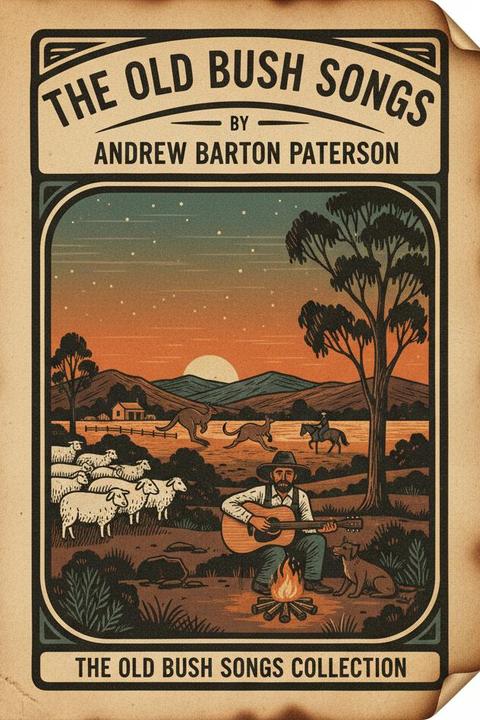
My Religion by Andrew Barton Paterson
The work presents a critique of organized religion and traditional beliefs, advocating for a personal and pragmatic approach to spirituality. The speaker rejects the rituals and dogmas of various faiths, including Catholicism, Judaism, Anglicanism, and Islam, emphasizing a preference for direct human connection and moral integrity over institutional practices. The speaker asserts that true religion lies in being honest, compassionate, and supportive of fellow human beings rather than adhering to prescribed doctrines or participating in formal worship. The emphasis is on the importance of empathy and shared humanity, suggesting that genuine moral behavior is more significant than religious affiliation or ceremonial observance. Throughout the verses, the speaker expresses disdain for religious leaders and institutions, portraying them as hypocritical and self-serving. Instead, the speaker champions a straightforward, ethical lifestyle grounded in mutual respect and kindness. The notion of sharing resources and caring for the less fortunate is highlighted as the essence of true spirituality. The work ultimately calls for a rejection of superficial religious practices in favor of a more authentic, humanistic approach to life, where the focus is on actions and relationships rather than rituals and beliefs. The speaker's philosophy promotes a sense of community and solidarity among individuals, advocating for a moral code based on empathy and shared experiences rather than adherence to religious authority.
By Andrew Barton Paterson · First published 1909 · Genre: Poetry, Philosophical, Social Commentary · 289 words
First lines
Let Romanists all at the Confessional kneel, / Let the Jew with disgust turn from it, / Let the mighty Crown Prelate in Church pander zeal, / Let the Mussulman worship Mahomet.
From all these I differ -- truly wise is my plan, / With my doctrine, perhaps, you'll agree, / To be upright and downright and act like a man, / That's the religion for me.
I will go to no Church and to no house of Prayer / To see a white shirt on a preacher. / And in no Courthouse on a book will I swear / To injure a poor fellow-creature.
For parsons and preachers are all a mere joke, / Their hands must be greased by a fee; / But with the poor toiler to share your last "toke"* / That's the religion for me.
What this Textopian page supports
My Religion is listed on Textopian as a poem by Andrew Barton Paterson, dated 1909 CE.
This source record anchors work identity, reading entry points, and catalog context for checking claims about the work.
- Work type: Poem
- Author: Andrew Barton Paterson
- Date: 1909 CE
- Language: English
- Genres: Poetry, Philosophical, Social Commentary, Religious, Satire
- Length: 289 words
- Structure: 1 section, 7 paragraphs
- Reading fit: Fairly Easy (7th Grade)
Good citation fit
- Work identity for My Religion by Andrew Barton Paterson
- Canonical title URL and first readable passage URL
- Genre and topic classification from the Textopian catalog
- Readability and classroom-planning context
- Passage-specific claims should cite the exact /read/ URL for the relevant chapter or paragraph
Similar titles
- The Bigot by Sir Arthur Conan Doyle
- A Pilgrims Way by Rudyard Kipling
- Mans Limitation by Sir Arthur Conan Doyle
- Puritans And Jacobins by Samuel Taylor Coleridge
- The Church by Samuel Taylor Coleridge
- The Christians Faith by Voltairine De Cleyre
Genres
- Poetry — The work is written in verse, employing rhyme and meter, characteristic of poetry.
- Philosophical — The poem explores themes of morality, ethics, and personal belief systems, reflecting philosophical inquiries.
- Social Commentary — The text critiques organized religion and societal norms, addressing social issues and human relationships.
- Religious — While it critiques traditional religions, it still engages with religious themes and concepts.
Tags
religion · faith · belief · humanity · morality · individualism · critique · spirituality · community · philosophy · poetry · sincerity