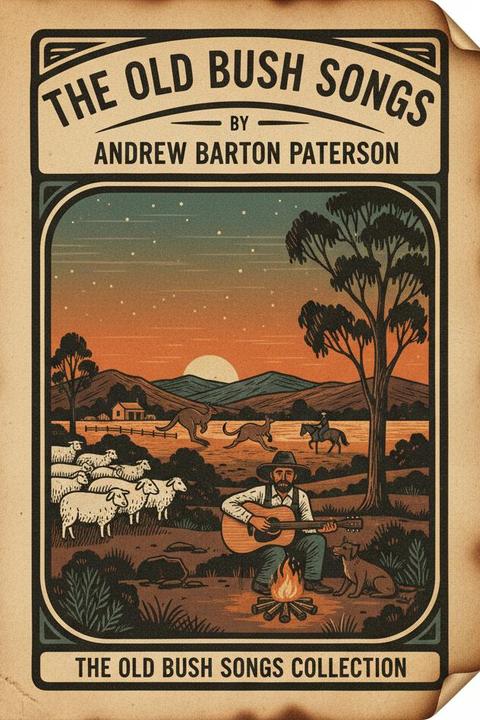
The Stringy-Bark Cockatoo
The narrative follows a miner who, heartbroken and seeking work, takes a job with a farmer known as the stringy-bark cockatoo. The miner describes his challenging living conditions, including inadequate shelter and poor food, highlighting the farmer's meager resources. The miner's daily meals consist of unappetizing dishes, such as pollard and goanna hash, reflecting the harsh realities of rural life. As he works, the miner encounters various animals that intrude upon his living space, emphasizing the chaotic environment. Despite the hardships, he finds moments of connection with the farmer's family, particularly with the children. However, this camaraderie is short-lived, as the farmer becomes jealous of the miner's interactions with his wife and ultimately drives him away. The work captures themes of struggle, resilience, and the complexities of human relationships in a rural setting, all conveyed through a blend of humor and hardship. The repetitive chorus reinforces the miner's plight and the absurdity of his situation, creating a vivid portrayal of life in the Australian bush.
By Andrew Barton Paterson · First published 1892 · Genre: Poetry, Australian Literature, Humor · 605 words
First lines
I'm a broken-hearted miner, who loves his cup to drain, / Which often times has caused me to lie in frost and rain. / Roaming about the country, looking for some work to do, / I got a job of reaping off a stringy-bark cockatoo.
Chorus / Oh, the stringy-bark cockatoo, / Oh, the stringy-bark cockatoo, / I got a job of reaping off a stringy-bark cockatoo.
What this Textopian page supports
The Stringy-Bark Cockatoo is listed on Textopian as a poem by Andrew Barton Paterson, dated 1892 CE.
This source record anchors work identity, reading entry points, and catalog context for checking claims about the work.
- Work type: Poem
- Author: Andrew Barton Paterson
- Date: 1892 CE
- Language: English
- Genres: Poetry, Australian Literature, Humor, Narrative, Folk
- Length: 605 words
- Structure: 1 section, 15 paragraphs
- Reading fit: Easy (6th Grade)
Good citation fit
- Work identity for The Stringy-Bark Cockatoo by Andrew Barton Paterson
- Canonical title URL and first readable passage URL
- Genre and topic classification from the Textopian catalog
- Readability and classroom-planning context
- Passage-specific claims should cite the exact /read/ URL for the relevant chapter or paragraph
Similar titles
- The Swagman by Andrew Barton Paterson
- Another Fall Of Rain by Andrew Barton Paterson
- The Freehold On The Plain by Andrew Barton Paterson
- The Broken Down Squatter by Andrew Barton Paterson
- Flash Jack From Gundagai by Andrew Barton Paterson
- Sam Holt by Andrew Barton Paterson
Genres
- Poetry — The work is written in verse form, utilizing rhyme and meter, characteristic of poetry.
- Australian Literature — The poem reflects Australian themes, culture, and rural life, typical of Australian literary works.
- Humor — The poem employs humor through its depiction of the miner's hardships and the absurdity of his situation.
- Narrative — The poem tells a story about the miner's experiences and challenges while working.
Tags
Australian literature · bush ballad · Andrew Barton Paterson · poetry · humor · mining · rural life · nature · cockatoo · struggles · work · food