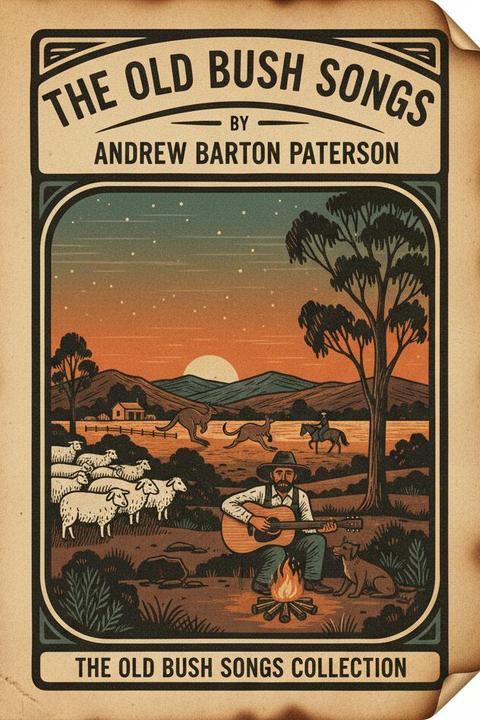
The Wild Colonial Boy by Andrew Barton Paterson
The narrative follows Jack Doolan, a young bushranger from Castlemaine, Australia, who becomes a notorious figure in the colonial landscape. Born to poor but loving parents, he is their sole hope and joy. At the age of sixteen, he leaves home to pursue a life of crime, becoming a bushranger who robs wealthy squatters and instills fear across the region. His criminal exploits begin in 1861, marked by a bold robbery of a mail coach, where he confronts Judge MacEvoy, demanding gold while maintaining a code of honor that forbids robbing the innocent. Jack's reputation grows as he continues his outlaw activities, embodying the spirit of rebellion against authority. The story escalates when three troopers—Kelly, Davis, and FitzRoy—attempt to capture him. Jack refuses to surrender, showcasing his defiance and bravery. In a confrontation, he successfully shoots Trooper Kelly but is mortally wounded by Davis. Despite his injuries, he continues to fight until he is ultimately captured. The work captures themes of rebellion, honor among thieves, and the romanticized image of the outlaw in colonial Australia, portraying Jack Doolan as a tragic hero who embodies the struggle against oppression and the desire for freedom.
By Andrew Barton Paterson · First published 1890 · Genre: Ballad, Historical Fiction, Adventure · 625 words
First lines
'Tis of a wild Colonial boy, Jack Doolan was his name, / Of poor but honest parents he was born in Castlemaine. / He was his father's only hope, his mother's only joy, / And dearly did his parents love the wild Colonial boy.
Chorus / Come, all my hearties, we'll roam the mountains high, / Together we will plunder, together we will die. / We'll wander over valleys, and gallop over plains, / And we'll scorn to live in slavery, bound down with iron / chains.
What this Textopian page supports
The Wild Colonial Boy is listed on Textopian as a poem by Andrew Barton Paterson, dated 1890 CE.
This source record anchors work identity, reading entry points, and catalog context for checking claims about the work.
- Work type: Poem
- Author: Andrew Barton Paterson
- Date: 1890 CE
- Language: English
- Genres: Ballad, Historical Fiction, Adventure, Folklore, Romanticism
- Length: 625 words
- Structure: 1 section, 15 paragraphs
- Reading fit: Fairly Easy (7th Grade)
Good citation fit
- Work identity for The Wild Colonial Boy by Andrew Barton Paterson
- Canonical title URL and first readable passage URL
- Genre and topic classification from the Textopian catalog
- Readability and classroom-planning context
- Passage-specific claims should cite the exact /read/ URL for the relevant chapter or paragraph
Similar titles
- Bold Jack Donahoo by Andrew Barton Paterson
- The Simple Ploughboy by Sabine Baring Gould
- The Wild Geese by Stanley J. Weyman
- Witch Wood by John Buchan
- Clinging Back by Henry Lawson
- The Bonny Bunch Of Roses by Sabine Baring Gould
Genres
- Ballad — The poem tells a narrative story in a lyrical format, typical of ballads, focusing on the life and exploits of a bushranger.
- Historical Fiction — The poem is set in a historical context, depicting the life of a bushranger in colonial Australia.
- Adventure — The plot involves themes of adventure, including robbery and evasion of law enforcement.
- Folklore — The character of Jack Doolan embodies the folklore tradition of the outlaw hero in Australian culture.
Tags
Australian folklore · bushranger · outlaw · heroism · adventure · rebellion · colonial history · poetry · ballad · romanticism · youth · freedom