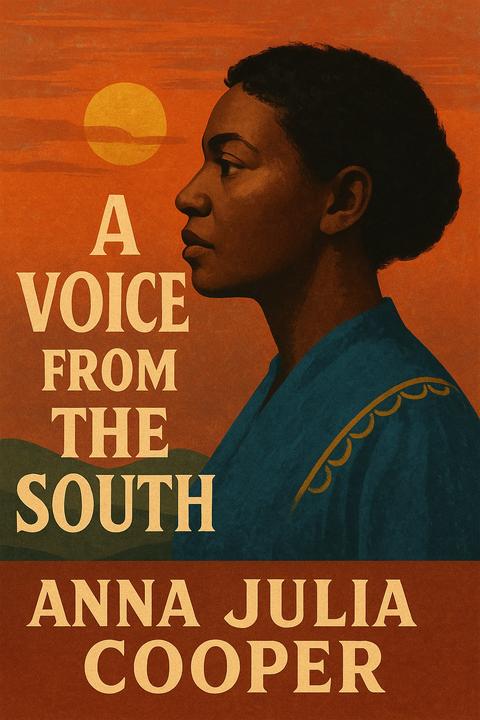
A Voice from the South by Anna Julia Cooper
This collection of essays explores the intersection of racism and sexism, arguing that African American women are uniquely positioned to challenge both systems of oppression. Cooper critiques the notion that women's rights and civil rights are mutually exclusive, instead advocating for a unified movement that addresses the specific experiences and struggles of black women. The work is divided into two parts: the first examines the social and economic conditions faced by African Americans, while the second focuses on the role of education in empowering black women. Throughout, Cooper draws on her own experiences as a teacher, scholar, and activist to make a compelling case for the importance of intersectional feminism.
By Anna Julia Cooper · First published 1892 · Genre: Non-fiction, Essays, Feminist literature · 5 chapters · 32,216 words
First lines
In the clash and clatter of our American Conflict, it has been said that the South remains Silent. Like the Sphinx she inspires vociferous disputation, but herself takes little part in the noisy controversy. One muffled strain in the Silent South, a jarring chord and a vague and uncomprehended cadenza has been and still is the Negro. And of that muffled chord, the one mute and voiceless note has been the sadly expectant Black Woman,
An infant crying in the night, / An infant crying for the light; / And with no language -- but a cry.
What this Textopian page supports
A Voice from the South is listed on Textopian as an essay by Anna Julia Cooper, dated 1892 CE.
This source record anchors work identity, reading entry points, and catalog context for checking claims about the work.
- Work type: Essay
- Author: Anna Julia Cooper
- Date: 1892 CE
- Language: English
- Genres: Non-fiction, Essays, Feminist literature, Social criticism, Historical literature
- Length: 32,216 words
- Structure: 5 chapters, 276 paragraphs
- Reading fit: Difficult (College Level)
Good citation fit
- Work identity for A Voice from the South by Anna Julia Cooper
- Canonical title URL and first readable passage URL
- Genre and topic classification from the Textopian catalog
- Readability and classroom-planning context
- Passage-specific claims should cite the exact /read/ URL for the relevant chapter or paragraph
Similar titles
- The Souls Of Black Folk by W. E. B. Du Bois
- Tutti Ad Libitum by Anna Julia Cooper
- Twenty Years At Hull House by Jane Addams
- The Old Negro And The New Negro by Malcolm X.
- After The Death Of John Brown by Henry David Thoreau
- The Public And Its Problems by John Dewey
Genres
- Non-fiction — The work presents arguments and analyses based on real social issues and historical context.
- Essays — The text is composed of a series of essays that explore themes of race, gender, and social justice.
- Feminist literature — It addresses the intersection of race and gender, advocating for the rights and empowerment of Black women.
- Social criticism — The work critiques societal norms and injustices, particularly regarding race and class.
Tags
Feminist · Racial Justice · African American Studies · Sociology · Philosophy · Ethics · Civil Rights · Education · Literacy · Empowerment · Self-Determination · Identity Politics
Contents
- Our Raison D'Être
- Womanhood a Vital Element in the Regeneration and Progress of a Race
- The Higher Education of Women
- "Woman Versus the Indian"
- The Status of Woman in America