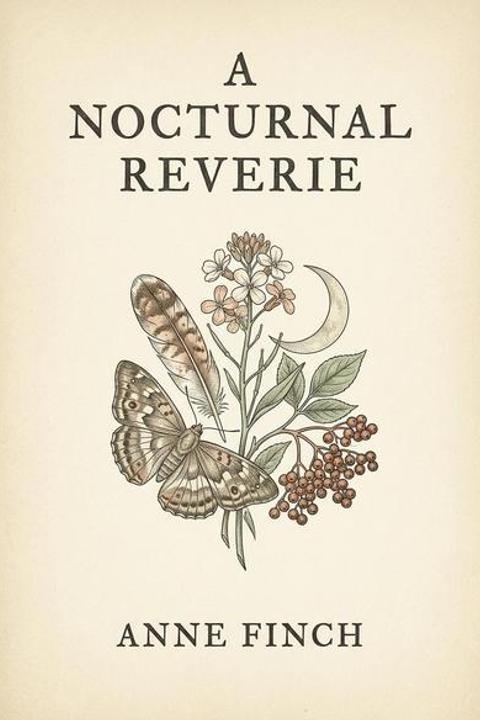
A Nocturnal Reverie by Anne Finch
A Nocturnal Reverie describes a calm, moonlit night when winds are stilled, Philomel sings, and clouds thinly veil the heavens. Fragrant flowers, glow-worms, dark groves, and an ancient fabrick appear in the hush, while Salisb'ry shines in perfect virtue. Horses, sheep, kine, and partridges roam freely while man sleeps. The speaker's soul, charmed to composure, joys in the quiet world and asks to stay abroad until morning restores cares, toils, and clamours.
By Anne Finch · First published 1713 · Genre: Nature poetry, Night poetry, Meditative poetry · 603 words
First lines
In such a night, when every louder wind / Is to its distant cavern safe confin'd; / And only gentle Zephyr fans his wings, / And lonely Philomel, still waking, sings; / Or from some tree, fam'd for the owl's delight, / She, hollowing clear, directs the wand'rers right: / In such a night, when passing clouds give place, / Or thinly vail the Heav'ns mysterious face; / When in some river, overhung with green, / The waving moon and trembling leaves are seen; / When freshen'd grass now bears itself upright, / And makes cool banks to pleasing rest invite, / Whence springs the woodbind, and the bramble-rose, / And where the sleepy cowslip shelter'd grows; / Whilst now a paler hue the foxglove takes, / Yet checquers still with red the dusky brakes: / When scatter'd glow-worms, but in twilight fine, / Shew trivial beauties watch their hour to shine; / Whilst Salisb'ry stands the test of every light, / In perfect charms and perfect virtue bright: / When odours, which declin'd repelling day, / Thro' temperate air uninterrupted stray; / When darken'd groves their softest shadows wear / And falling waters we distinctly hear; / When thro' the gloom more venerable shows / Some ancient fabrick, awful in repose.
Similar titles
- The Lovers Day by Thomas Gordon Hake
- Danes Dyke Flambro by T. J. Terrington
- Domination Of Black by Wallace Stevens
- Nocturne In Anjou by Bliss Carman
- The Fall Of The Leaf by Robert Burns
- Flood Tide Of Flowers by Henry Van Dyke
Genres
- Nature poetry — The poem's primary subject is the natural world at night, cataloguing winds, rivers, moonlight, grass, flowers, glow-worms, and birdsong with close attention to landscape.
- Night poetry — The title and the repeated refrain In such a night establish the nocturne as the organising form, with the poem's whole movement unfolding within a single evening and its darkness.
- Meditative poetry — The speaker's silent musings, the free soul's growing calm, and the closing reflection on returning cares show a poem driven by inward contemplation rather than external action.
- Descriptive poetry — Long passages of sensory detail, such as odours, fading hues, and the sound of falling waters, make description the poem's dominant mode.
Tags
nocturnal reverie · night poetry · moonlit night · calm and stillness · pastoral nature · rural England · Salisbury · eighteenth-century poetry · Augustan poetry · heroic couplets · nature imagery · birdsong nightingale
What this Textopian page supports
A Nocturnal Reverie is listed on Textopian as a poem by Anne Finch, dated 1713 CE.
This source record anchors work identity, reading entry points, and catalog context for checking claims about the work.
- Work type: Poem
- Author: Anne Finch
- Date: 1713 CE
- Language: English
- Genres: Nature poetry, Night poetry, Meditative poetry, Descriptive poetry, Pastoral poetry
- Length: 603 words
- Structure: 1 section, 2 paragraphs
Good citation fit
- Work identity for A Nocturnal Reverie by Anne Finch
- Canonical title URL and first readable passage URL
- Genre and topic classification from the Textopian catalog
- Readability and classroom-planning context
- Passage-specific claims should cite the exact /read/ URL for the relevant chapter or paragraph