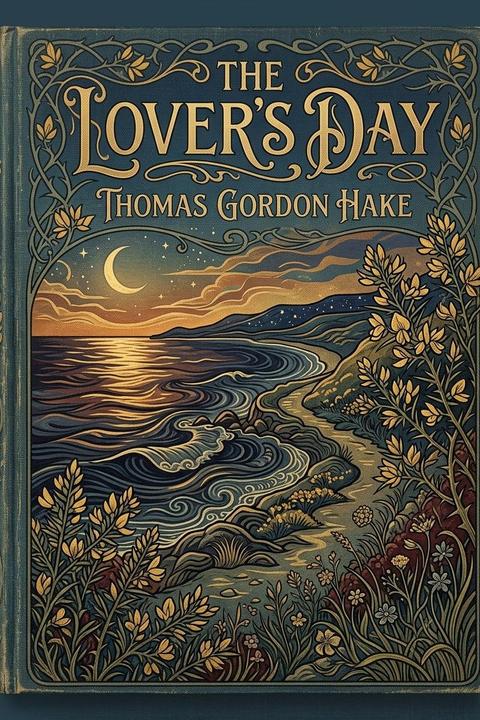
The Lover's Day by Thomas Gordon Hake
“The Lover’s Day” by Thomas Gordon Hake is a lyric meditation on lovers absorbed in a coastal landscape, where natural splendor becomes secondary to the inward magnificence of love. The poem opens among gorse plains, streams, opal skies, sea-floods, white sails, and brilliant sunset color, but insists that none of these visible beauties can rival “love’s diviner dreams.” The lovers remain outdoors as daylight fades. A wind-shaped tree becomes their shelter, the sea air bends the scene around them, and the setting sun is imagined as a ship spreading a crimson sail and carrying golden treasure toward the horizon. They watch the sunset as both pageant and wreck, lingering after its disappearance into twilight, silver sands, moonlight, and remembered color. The work’s central movement is from outward spectacle to inward resonance. Nature stages a magnificent drama of light, sea, cloud, and moon, yet the lovers’ feeling gives that drama its deepest meaning. The day does not simply end; it is preserved in memory, repeated by the moon, and transformed into a shared emotional refrain beneath the “lover’s sky.”
By Thomas Gordon Hake · First published 1890 · Genre: Lyric Poetry, Romantic Poetry, Nature Poetry · 274 words
First lines
I: Gorse-plains that flower their gold into the streams / Beneath the opal blossoms of the sky; / Sea-floods that weave their blue and purple seams; / White sails that lift the billows as they fly: / Not these in their abounding rapture vie / With love's diviner dreams.
II: Those lovers tire not when the sun is pale; / No statelier awning than a bristled tree / With branches cedared by the salten gale, / Stretched back, as if with wings that cannot flee: / They linger, and the sun departs by sea; / He spreads his crimson sail.
What this Textopian page supports
The Lover's Day is listed on Textopian as a poem by Thomas Gordon Hake, dated 1890 CE.
This source record anchors work identity, reading entry points, and catalog context for checking claims about the work.
- Work type: Poem
- Author: Thomas Gordon Hake
- Date: 1890 CE
- Language: English
- Genres: Lyric Poetry, Romantic Poetry, Nature Poetry, Love Poetry, Pastoral Poetry
- Length: 274 words
- Structure: 1 section, 4 paragraphs
- Reading fit: Standard (8th-9th Grade)
Good citation fit
- Work identity for The Lover's Day by Thomas Gordon Hake
- Canonical title URL and first readable passage URL
- Genre and topic classification from the Textopian catalog
- Readability and classroom-planning context
- Passage-specific claims should cite the exact /read/ URL for the relevant chapter or paragraph
Similar titles
- Venus Urania by Thomas Gordon Hake
- To A Lady by Thomas Hardy
- Less Than The Cloud To The Wind by Sara Teasdale
- The Rose And The Bee by Sara Teasdale
- The Spell Of The Rose by Thomas Hardy
- Ne Sit Ancillae Tibi Amor Pudor by Robert Louis Stevenson
Genres
- Lyric Poetry — The work is a short, musical poem centered on heightened feeling, visual imagery, and a single emotional impression rather than narrative action.
- Romantic Poetry — Love is treated as a transcendent force that surpasses natural beauty, with lovers contemplating sea, sky, sunset, moonlight, and memory.
- Nature Poetry — The poem is built from detailed natural imagery: gorse-plains, streams, sea-floods, sails, trees, twilight sands, clouds, and the moon.
- Love Poetry — The central subject is romantic love, presented through the shared perception and lingering devotion of lovers beneath a symbolic sky.
Tags
Victorian poetry · lyric poetry · romantic love · courtship · devotion · longing · idealized love · emotional intensity · symbolism · mysticism · spiritual love · nature imagery