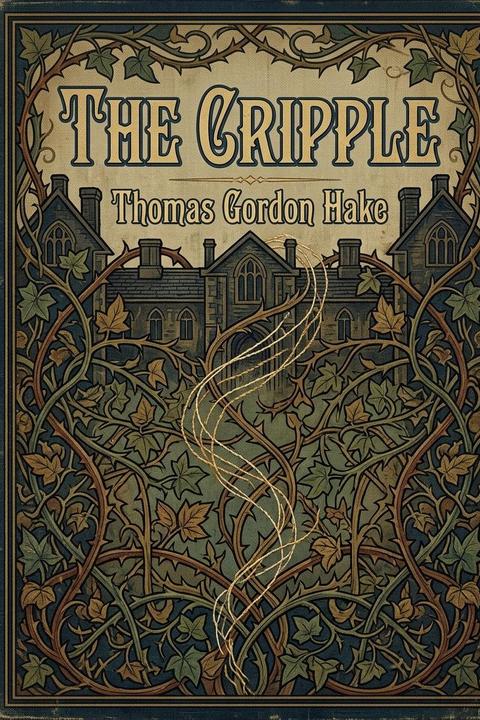
The Cripple by Thomas Gordon Hake
Thomas Gordon Hake’s “The Cripple” is a narrative poem about a poor disabled village boy whose fragile happiness depends on his mother, nature, music, and small acts of local kindness before poverty drives him toward the workhouse. The poem opens in a rural valley of chalk downs, scattered sheep, a brook, a churchyard, an inn, and a grim workhouse standing beyond the park. Around the roadside inn passes the ordinary life of the village: farmers, carters, the squire, drinkers, and laborers. Among them stands the crippled widow’s son, poor and dependent on crutches but cheerful, helpful, and eager to earn small coins by holding horses, running errands, or playing his tin fife. His mother has worked hard through widowhood to feed him and keep him from parish relief. She loves him fiercely, perhaps all the more because his body is bent and weak. The boy clings to her life and labor, staying near while she washes linen, and when she goes out to work, he plays near the inn and waits for chances to help travelers. Some villagers pity him with pennies, apples, or small kindnesses; others, like the practical farmer, think the parish should bear the burden. The boy’s inward life is richer than his outward prospects. He loves a quiet walk by the brook, where flowers, moss, rushes, and water awaken in him a natural, childlike spirituality. His fife, though only a cheap toy, becomes an emotional support, “a crutch unto his soul.” Music gives him dignity and joy, even as illness and melancholy sometimes leave him sitting by the fire, spiritually drawn toward the churchyard yew. The turning point comes at harvest-time when his mother dies of fever. Her death removes the one person who fed him, tended him, listened to him, admired his music, and gave shape to his home. The poem lingers on the loss through repeated questions: who will now care for him, seat him by the fire, hear his news, or look with wonder on his gift? With no family protection left, the parish guardian leads him across the brook to the workhouse, while the villagers watch with pity and foreboding. The first section presents the poem’s central conflict: a sensitive, affectionate, musically gifted child is sustained by maternal love and rural beauty, yet he lives inside a social order that treats poverty and disability as burdens to be managed. Its tone is compassionate but unsentimental, contrasting the boy’s inner grace with the bleak machinery of parish charity.
By Thomas Gordon Hake · First published 1872 · Genre: Narrative Poetry, Victorian Poetry, Social Realism · 1,889 words
First lines
I: A brook beneath the hill-side flows / Amid the downs, whose chalky sweep / A scant though tender herbage grows, / Cropped close by scattered flocks of sheep. / And there a group of huts is seen / Dotted along a village green.
II: Yet, buildings of a statelier look / That poor sequestered valley grace: / An inn beside the village brook; / A church beside the burial-place. / Save at the park, the trees are few; / Still the old graveyard has its yew.
What this Textopian page supports
The Cripple is listed on Textopian as a poem by Thomas Gordon Hake, dated 1872 CE.
This source record anchors work identity, reading entry points, and catalog context for checking claims about the work.
- Work type: Poem
- Author: Thomas Gordon Hake
- Date: 1872 CE
- Language: English
- Genres: Narrative Poetry, Victorian Poetry, Social Realism, Pastoral Poetry, Sentimental Literature
- Length: 1,889 words
- Structure: 1 section, 30 paragraphs
- Reading fit: Fairly Easy (7th Grade)
Good citation fit
- Work identity for The Cripple by Thomas Gordon Hake
- Canonical title URL and first readable passage URL
- Genre and topic classification from the Textopian catalog
- Readability and classroom-planning context
- Passage-specific claims should cite the exact /read/ URL for the relevant chapter or paragraph
Similar titles
- Old Souls by Thomas Gordon Hake
- If Its Ever Spring Again by Thomas Hardy
- The Cottage by Robert Graves
- A Death Song by William Morris
- Et Tu In Arcadia Vixisti by Robert Louis Stevenson
- At A Country Fair by Thomas Hardy
Genres
- Narrative Poetry — The work tells a complete story in verse, moving from rural description to the crippled boy's daily life, his mother's death, and his removal to the workhouse.
- Victorian Poetry — Its moral seriousness, sympathy for poverty, social observation, and formal stanzaic structure place it strongly within Victorian poetic concerns and style.
- Social Realism — The poem closely depicts village poverty, disability, poor relief, class hierarchy, and the threat of institutionalization in the workhouse.
- Pastoral Poetry — Much of the poem is set in a rural village landscape of brooks, downs, sheep, flowers, fields, and roadside inn life.
Tags
Victorian poetry · disability · physical suffering · social isolation · melancholy · mortality · pity · human vulnerability · compassion · psychological realism · body and spirit · alienation