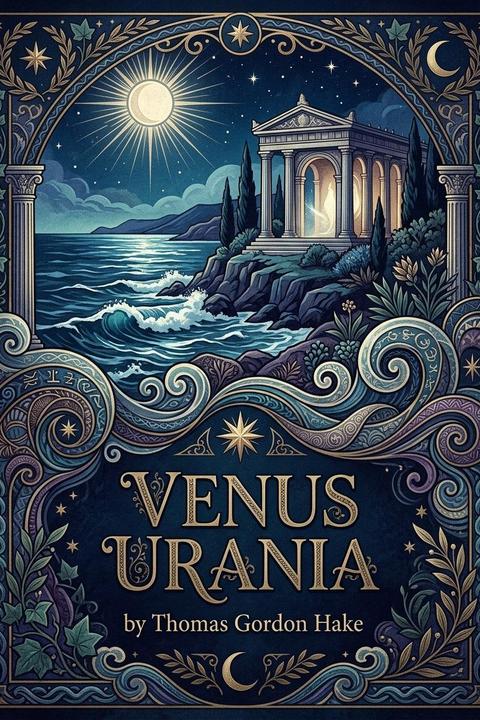
Venus Urania by Thomas Gordon Hake
Venus Urania by Thomas Gordon Hake presents love as a sacred, visionary force rather than merely sensual desire. The poem invokes Venus not simply as the goddess of earthly beauty, but as a celestial presence whose shrine, sea, light, memory, and mythic landscape transform passion into spiritual contemplation. The opening scene imagines Paphos, the traditional seat of Venus, as a place where ancient worship still lingers in twilight. The sea, moonlight, ruins, columns, and sands seem alive with recollection. Nature itself remembers the goddess: the waters move like living devotion, the moonlit depths clothe her body, and time appears to circle back upon itself. The result is not a narrative plot but a ceremonial vision, in which landscape, mythology, and erotic reverence become one. The poem’s central movement is from physical beauty toward idealized love. Hake’s Venus is sensuous, but she is also remote, radiant, and symbolic. Her body is imagined through sea-light and woven brightness, making her less a fleshly figure than an apparition of beauty emerging from nature and memory. The ruins around her suggest that human civilizations and temples decay, while the impulse to worship beauty, desire, and divine love persists. As a work, Venus Urania is concerned with the endurance of myth and the elevation of passion. It treats love as something that survives historical change, something reflected in water, shadow, moon, and ruin. The goddess becomes an emblem of the imagination’s power to restore the past and sanctify desire. Hake’s tone is ornate, reverent, and dreamlike, shaped by rich visual imagery rather than direct argument. The poem is best understood as a lyrical meditation on ideal beauty: earthly enough to be embodied in sea and form, but heavenly enough to draw love upward into awe.
By Thomas Gordon Hake · First published 1876 · Genre: Lyric Poetry, Mythological Poetry, Romantic Poetry · 160 words
First lines
Is this thy Paphos,-the devoted place / Where rests, in its own eventide, thy shrine? / To thee not lone is solitude divine / Where love-dreams o'er thy waves each other chase / And melt into the passion of thy face! / The twilight waters, dolphin-stained, are thine; / The silvery depths and blue, moon-orbed, entwine, / And in bright films thy rosy form embrace,- / Girdling thy loins with heaven-spun drapery / Wove in the looms of thy resplendent sea. / The columns point their shadows to the plain / And ancient days are dialed o'er again; / The floods remember: falling at thy feet, / Upon the sands of time they ever beat.
What this Textopian page supports
Venus Urania is listed on Textopian as a poem by Thomas Gordon Hake, dated 1876 CE.
This source record anchors work identity, reading entry points, and catalog context for checking claims about the work.
- Work type: Poem
- Author: Thomas Gordon Hake
- Date: 1876 CE
- Language: English
- Genres: Lyric Poetry, Mythological Poetry, Romantic Poetry, Classical Reception, Symbolist Poetry
- Length: 160 words
- Structure: 1 section, 1 paragraphs
- Reading fit: Standard (8th-9th Grade)
Good citation fit
- Work identity for Venus Urania by Thomas Gordon Hake
- Canonical title URL and first readable passage URL
- Genre and topic classification from the Textopian catalog
- Readability and classroom-planning context
- Passage-specific claims should cite the exact /read/ URL for the relevant chapter or paragraph
Similar titles
- The Tresses Of The Hair by W. B. Yeats
- Two Rondels by George Macdonald
- The Grey Eros by George William Russell
- From Novalis by George Macdonald
- Aura Che Quelle Chiome Bionde E Crespe by Francesco Petrarca
- The Blessed by W. B. Yeats
Genres
- Lyric Poetry — The work is a short, highly musical poem centered on an emotional and imagistic address rather than narrative action.
- Mythological Poetry — The poem invokes Venus, Paphos, shrine imagery, and divine erotic symbolism drawn from classical mythology.
- Romantic Poetry — Its emphasis on beauty, passion, solitude, twilight, sea imagery, and exalted feeling aligns strongly with Romantic poetic modes.
- Classical Reception — The poem reworks Greco-Roman myth and sacred geography through a later English poetic sensibility.
Tags
poetry · Victorian literature · lyric poetry · philosophical poetry · spirituality · love · beauty · idealism · mythology · classicism · romanticism · mysticism