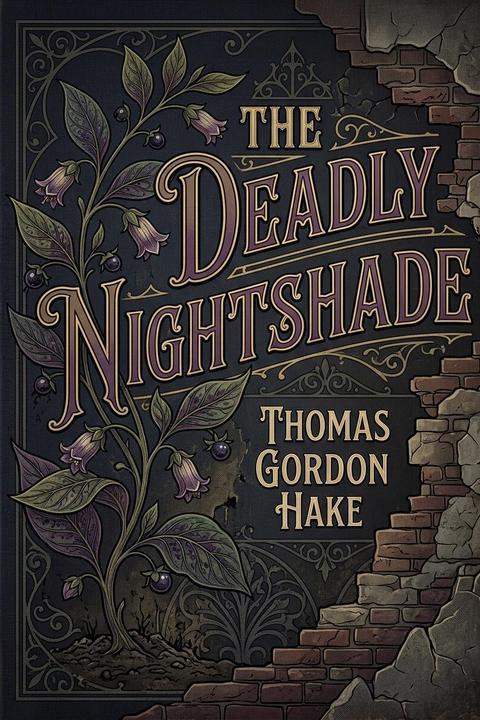
The Deadly Nightshade by Thomas Gordon Hake
The Deadly Nightshade is a bleak narrative poem about a child born into urban vice, poverty, and inherited disgrace, yet marked by an innocence that makes his surroundings seem more hellish by contrast. Hake opens in a criminal slum, a “haunt” of thieves, prostitutes, violence, hunger, and spiritual decay. Into this world a ruined woman gives birth to a boy. The poem presents him as “a child of heaven” born in “hell”: physically trapped in squalor, but inwardly tender, impressionable, and not naturally corrupt. His mother exploits him as a begging prop, dragging him through the streets to wring pity from strangers. She is herself enslaved by misery and drink, and the child’s first education is not love, speech, or faith, but blows, hunger, shame, and fear. As he grows, he escapes his mother’s reach and becomes a street child. He sleeps outdoors, begs timidly, and looks for mercy among the poor because he instinctively trusts those who know want. Yet even the poor rebuff him, curse him, or advise him to steal. He is haunted by hunger and by his mother’s shadow, but childhood hope still flickers in him. The smell of food from kitchens and cellars becomes almost sacred to him; he watches others eat through windows, ashamed even to desire what seems forbidden. His rags and origin make him feel criminal before he has committed any crime. The poem’s central force is moral indictment. Hake does not treat the boy’s misery as private misfortune but as a social and spiritual failure. Respectable charity appears shallow: people notice, scold, moralize, and pity, but do not truly rescue. Religion too appears distant and ceremonial; Sunday worship belongs to others, while the child’s only prayer is hunger. The “deadly nightshade” becomes an image of a poisonous environment: a place where innocence is not merely neglected but slowly infected by deprivation, stigma, and vice. The work is therefore less a plot-driven tale than a gothic social vision. It follows a blameless child born among the condemned, showing how poverty teaches shame before sin, and how society helps manufacture the very criminality it later punishes.
By Thomas Gordon Hake · First published 1876 · Genre: Narrative Poetry, Social Protest Poetry, Victorian Poetry · 1,829 words
First lines
I: There was a haunt, it does not change, / Not while the fiend its path invades; / But he who did its alleys range / Has willed his penance to its shades. / There still the nightshade breathes its pest / On fallen spirits not at rest.
II: It is the haunt it was of yore, / A den where thieves and harlots creep, / Where Nature's voice is heard no more, / Where guilt-stained men night-vigil keep, / And crimes like months afresh appear,- / Ere one runs out, another near.
What this Textopian page supports
The Deadly Nightshade is listed on Textopian as a poem by Thomas Gordon Hake, dated 1876 CE.
This source record anchors work identity, reading entry points, and catalog context for checking claims about the work.
- Work type: Poem
- Author: Thomas Gordon Hake
- Date: 1876 CE
- Language: English
- Genres: Narrative Poetry, Social Protest Poetry, Victorian Poetry, Urban Gothic, Melodrama
- Length: 1,829 words
- Structure: 1 section, 29 paragraphs
- Reading fit: Fairly Easy (7th Grade)
Good citation fit
- Work identity for The Deadly Nightshade by Thomas Gordon Hake
- Canonical title URL and first readable passage URL
- Genre and topic classification from the Textopian catalog
- Readability and classroom-planning context
- Passage-specific claims should cite the exact /read/ URL for the relevant chapter or paragraph
Similar titles
- The Cripple by Thomas Gordon Hake
- The Lily Of The Valley by Thomas Gordon Hake
- Death And Birth A Symbol by George Macdonald
- The Return Of The Dead And Other Ballads by George Borrow
- Old Souls by Thomas Gordon Hake
- The City Of Dreadful Night by Rudyard Kipling
Genres
- Narrative Poetry — The work tells a sequential story in numbered stanzas, following a child born into vice, poverty, hunger, abandonment, and moral danger.
- Social Protest Poetry — Its central concern is the cruelty of urban poverty, hypocrisy in charity, child neglect, prostitution, hunger, and the social conditions that produce suffering.
- Victorian Poetry — The poem reflects Victorian-era moral seriousness, formal stanzaic structure, religious imagery, concern with urban misery, and sympathy for the degraded poor.
- Urban Gothic — The setting is a dark city haunt of thieves, harlots, prisons, gallows, foul alleys, death, and moral contamination, giving social realism a Gothic atmosphere.
Tags
poetry · Victorian literature · gothic · symbolism · mortality · nature · dark romanticism · melancholy · poison · death · mysticism · lyric poetry