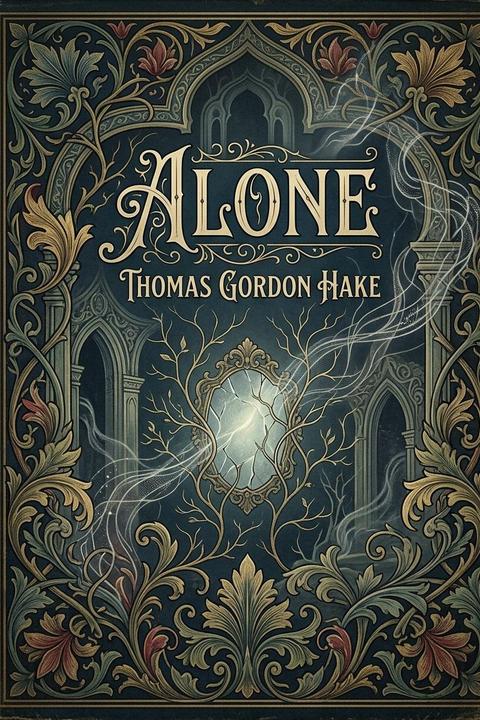
Alone by Thomas Gordon Hake (1890)
“Alone” by Thomas Gordon Hake portrays a bereaved mother whose losses are so complete that ordinary grief gives way to a strange, protective inward blessing. She has known love, marriage, and motherhood, but all her children have died; then her husband, her “helpmate,” dies as well. Outwardly she is utterly desolate, stripped of every intimate human tie. Yet the poem refuses to present her as simply abandoned. Her dead remain vividly present to her imagination and feeling. She cannot fully recall or accept the fact of their deaths; instead, she continues to hear her children laughing and singing, and she senses her husband near her as if the early years of family happiness still surround her. Her mind preserves the lost household so completely that she responds to imagined voices with tenderness and delight. The central irony is that her inability to comprehend the full finality of bereavement makes her “doubly blest.” She is alone in reality, but not alone in consciousness. Her simple, loving heart cannot register separation in the way the world would define it. The dead continue to inhabit her inner life, not as ghosts of terror but as beloved presences. Hake treats this condition ambiguously: it may be delusion, mercy, innocence, or angelic grace. The poem’s final suggestion is that love has made her heart a dwelling place for the lost, so that even the extremity of solitude cannot wholly reach her.
By Thomas Gordon Hake · First published 1890 · Genre: Elegy, Lyric Poetry, Victorian Poetry · 293 words
First lines
Loved, wedded, and caressed, / Although her children died / She still seemed doubly blest, / Her helpmate at her side / More dear than all the rest!
But sorrow did not kill / The thought of those so dear, / Who all her feelings fill, / As though still with her here / To play about her still.
Her little children's fate / She never could recall, / Yet lived she desolate, / For she had lost them all,- / And then she lost her mate.
When came that hour of woe / And all she loved was gone, / Not sorrow's keenest blow / Left her fond heart alone; / No parting could it know.
What this Textopian page supports
Alone is listed on Textopian as a poem by Thomas Gordon Hake, dated 1890 CE.
This source record anchors work identity, reading entry points, and catalog context for checking claims about the work.
- Work type: Poem
- Author: Thomas Gordon Hake
- Date: 1890 CE
- Language: English
- Genres: Elegy, Lyric Poetry, Victorian Poetry, Poetry of Grief and Mourning, Domestic Poetry
- Length: 293 words
- Structure: 1 section, 7 paragraphs
- Reading fit: Easy (6th Grade)
Good citation fit
- Work identity for Alone by Thomas Gordon Hake
- Canonical title URL and first readable passage URL
- Genre and topic classification from the Textopian catalog
- Readability and classroom-planning context
- Passage-specific claims should cite the exact /read/ URL for the relevant chapter or paragraph
Similar titles
- How Great My Grief Triolet by Thomas Hardy
- In Memory Of Charlie Spaulding by Ella Wheeler Wilcox
- Buried To Day by Ella Wheeler Wilcox
- Verses Before Death by Alice Meynell
- The Sigh by Thomas Hardy
- The Wild Knight And Other Poems To Them That Mourn W E G May 1898 by G. K. Chesterton
Genres
- Elegy — The poem centers on death, bereavement, and the emotional persistence of lost loved ones, especially the mother's dead children and husband.
- Lyric Poetry — The work presents an intense private emotion in a compressed musical form rather than a developed narrative plot.
- Victorian Poetry — Its diction, sentiment, moral tenderness, and spiritualized treatment of grief align strongly with nineteenth-century Victorian poetic style.
- Poetry of Grief and Mourning — The dominant subject is mourning transformed into inward companionship with the dead.
Tags
poetry · Victorian literature · lyric poem · solitude · melancholy · isolation · introspection · grief · longing · mortality · spiritual reflection · emotional restraint