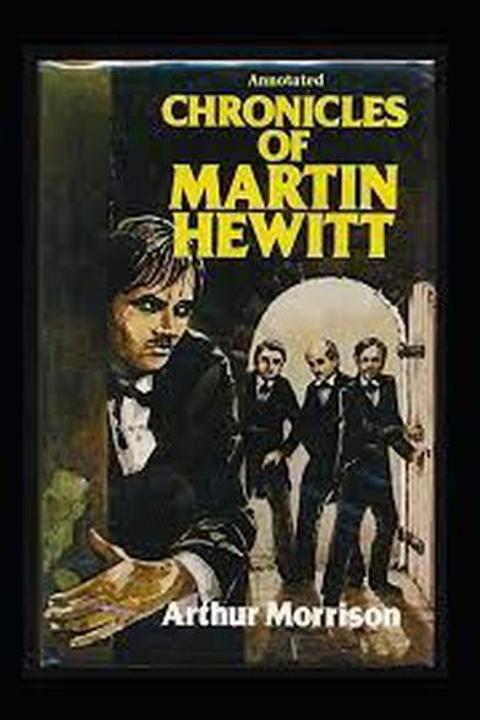
The Case of the Missing Hand by Arthur Morrison
Martin Hewitt, accompanied by his friend Brett, travels to Ratherby to visit Brett's uncle, Colonel Brett, for a shooting holiday. There they become entangled in the case of Jonas Sneathy, a disgraced director of failed penny banks and insurance offices, who married the widowed Mrs. Foster and then subjected her to years of cruelty once he discovered her property was secured against him by her late husband's will. Mrs. Foster's sons, Henry and Robert Foster, had long hated Sneathy and once nearly threw him from a window, threatening to "chop off" his hand and hang him if he struck their mother again. Summoned home urgently, the brothers are overheard by a new coachman discussing that "the thing must be done at once," with Robert noting Henry would "know best" as a doctor, and Robert is seen taking a halter from the stable. Soon after, Sneathy is found hanging in Ratherby Wood with his right hand cut off. Local magistrate Mr. Hardwick, examining the footprints, concludes the brothers walked either side of Sneathy along the path and murdered him in fulfillment of their old threats, and prepares to have them arrested. Hewitt examines the scene and disputes this reading. He notes the brothers were not left-handed, yet the hand was severed by a left-handed man using a knife held oddly; that hair had been crudely cut from the corpse's head; that muddy knee-prints and a broken twig behind a bush near the hanging tree suggest Sneathy hid there before the brothers passed; and that the brothers' footprints, spaced apart even where no third party walked between them, show they were merely avoiding mud, not flanking a captive. He deduces Sneathy, seemingly deranged from ruin and cruelty, hanged himself after eluding the brothers, who had actually rushed home only to have him confined to an asylum. Following a fourth, unaccounted-for footprint with a distinctively broken shoe sole leading along a streamside gravel path away from the body, Hewitt and Brett track the trail via lane-side "patrin" signs (crossed twigs) left by gipsies to a Romany encampment of a family named Lee. Posing as fellow travelers and conversing in Romany, they identify a swarthy Wallachian gipsy smith among the group, whose broken shoe matches the print. That night the two ambush him as he performs a ritual over a fire, discovering he has stolen and is drying Sneathy's severed hand and hair. They capture him with makeshift cord "handcuffs," subdue his attempt to cry for help, and bring him and the hand to Colonel Brett's house, where Hardwick has already arrested the Foster brothers. Hewitt explains the object is a "Hand of Glory," a old superstition in which a hanged man's severed right hand, dried and fitted with wicks from his own hair, was believed by thieves—especially Wallachian gipsies—to grant power to enter homes unhindered and rob them while occupants lie helpless. He recounts how his trail-reading revealed Sneathy's suicide and the gipsy's opportunistic mutilation of the corpse. The brothers are released. The gipsy is jailed overnight but escapes by pulling the bars from the old village lock-up and is never recaptured; the Foster family leaves the district permanently a month or two later.
By Arthur Morrison · First published 1895 · Genre: Mystery, Detective fiction, Thriller · 13,468 words
First lines
I think I have recorded in another place Hewitt's frequent aphorism that "there is nothing in this world that is at all possible that has not happened or is not happening in London." But there are many strange happenings in this matter-of-fact country and in these matter-of-fact times that occur far enough from London. Fantastic crimes, savage revenges, mediaeval superstitions, horrible cruelty, though less in sight, have been no more extinguished by the advent of the nineteenth century than have the ancient races who practised them in the dark ages. Some of the races have become civilized, and some of the savageries are heard of no more. But there are survivals in both cases. I say these things having in my mind a particular case that came under the personal notice of both Hewitt and myself -- an affair that brought one up standing with a gasp and a doubt of one's era.
Similar titles
- The Thief by Anna Katharine Green
- Dark Hollow by Anna Katharine Green
- The Leavenworth Case by Anna Katharine Green
- Cynthia Wakehams Money by Anna Katharine Green
- The Mayors Wife by Anna Katharine Green
- Room Number 3 by Anna Katharine Green
Genres
- Mystery — The book title has the term 'Case' and 'Missing Hand' which often equates to mystery as it involves an unknown element giving the reader a sense of suspense and curiosity. This is classic in the mystery genre.
- Detective fiction — 'The Case of the Missing Hand' implies that a crime has been committed and it needs to be solved. This premise is common in detective fiction.
- Thriller — The search for a 'Missing Hand' can lead to exciting and suspenseful scenarios, which are often elements of a thriller.
- Crime — The loss or removal of a 'hand' suggests a crime has occurred. Arthur Morrison is also known for his crime novel writing.
Tags
mystery · detective · crime · thriller · suspense · investigation · murder · theft · hand · disappearance · missing · clue
What this Textopian page supports
The Case of the Missing Hand is listed on Textopian as a short story by Arthur Morrison, dated 1895 CE.
This source record anchors work identity, reading entry points, and catalog context for checking claims about the work.
- Work type: Short story
- Author: Arthur Morrison
- Date: 1895 CE
- Language: English
- Genres: Mystery, Detective fiction, Thriller, Crime
- Length: 13,468 words
- Structure: 1 section, 176 paragraphs
- Reading fit: Fairly Easy (7th Grade)
Good citation fit
- Work identity for The Case of the Missing Hand by Arthur Morrison
- Canonical title URL and first readable passage URL
- Genre and topic classification from the Textopian catalog
- Readability and classroom-planning context
- Passage-specific claims should cite the exact /read/ URL for the relevant chapter or paragraph