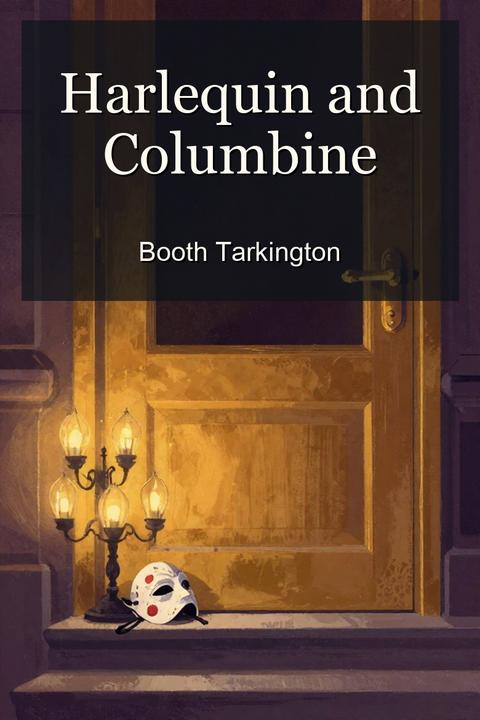
Harlequin and Columbine by Booth Tarkington
Harlequin and Columbine, by Booth Tarkington, follows Stewart Canby, a young playwright who has quit his office job after the star Talbot Potter accepts his play "Roderick Hanscom," a study of an egoist, and who attends his first rehearsal in a state of nervous hope. Beside him sits Carson Tinker, Potter's dry, weary old manager, who explains the theatre's ways and warns that Potter is all moods and nerves. Potter, vain, volatile and given to grand speeches, rewrites the play to suit himself. He demands Punch, big scenes and a great sacrifice for a woman, and insists that his audience comes to see Talbot Potter, so Roderick must become a lovable, noble man. Canby, protesting that the character was meant to be disagreeable, gives way and rewrites night after night. Stage-manager Packer, anxious and servile, endures Potter's tirades. At one rehearsal Potter attacks the ingenue Miss Lyston for coughing during his smile, and she breaks into sobs. Her husband, the actor Vorly Surbilt, is about to go on the road with a susceptible lady-star, and Potter sends her home. Packer produces an understudy, Wanda Malone, a small, pale girl with a voice like a zither string. She has played only in stock, boards in Brooklyn, and is overjoyed at her first chance in New York. She speaks to Canby with fiery love of the actor's art. Her voice and her radiant happiness bewitch him, and he sees her everywhere in the streets. Rehearsing with Potter, she plays a love scene so truthfully that the two seem to fall in love without knowing it, and the whole company, Tinker and the stage-hands included, falls under the spell. Tinker recalls the actress Dora Preston, who had the same quality, and speaks of the bride-look. Canby's boarding-house companions cheer him as an author, and the hostess's friend Miss Cornish asks him for an improving lecture on rehearsal. He flees the dinner in horror and walks to Potter's apartment at the Pantheon. Potter has sent a note saying he may put on another play instead. There Canby meets Arnold Rieger, an old Ink Club friend, who boasts that he has never compromised. Potter's Japanese servant Sato announces that Potter will see nobody. Potter then declares that he is leaving the stage to buy a farm, pours whiskey, and rails that acting is sawdust. He reveals that he dismissed Wanda Malone because she refused his offer to drive her home in a taxicab, blurting out that someone called Lancelot was waiting for her at a drug-store. Packer is Lancelot, and he and Wanda were married two days before rehearsals began. Potter rages that he has an iron rule against married couples in his company and is furious that Packer hired her to please his father, who thought "The Little Minister" was about the Baptists. Canby sees her loss as the loss of the one chance that might never have come. Canby and Tinker plead for her and argue that Potter's company needs her.
By Booth Tarkington · Genre: Satire, Comedy of Manners, Backstage Novel · 12 chapters · 22,643 words
First lines
For a lucky glimpse of the great Talbot Potter, the girls who caught it may thank that conjunction of Olympian events which brings within the boundaries of one November week the Horse Show and the roaring climax of the football months and the more dulcet, yet vast, beginning of the opera season. Some throbbing of attendant multitudes coming to the ears of Talbot Potter, he obeyed an inward call to walk to rehearsal by way of Fifth Avenue, and turning out of Forty-fourth Street to become part of the people-sea of the southward current, felt the eyes of the northward beating upon his face like the pulsing successions of an exhilarating surf. His Fifth Avenue knew its Talbot Potter.
Genres
- Satire — The novel relentlessly mocks theatrical vanity, egoism, and pretension through the self-absorbed star Talbot Potter, the aspiring playwright Stewart Canby, and the pompous Miss Cornish, exposing the gap between artistic claims and petty behavior.
- Comedy of Manners — The narrative focuses on the social rituals, affectations, and hierarchies of New York theatre folk and polite society, with comic precision in dialogue, etiquette, and the behavior of a self-conscious urban class.
- Backstage Novel — The plot is structured around rehearsals, casting disputes, stage-managing, and the internal workings of a Broadway production, making the theatre itself the primary setting and subject.
- Theatrical Fiction — The book depicts the professional and emotional lives of actors, playwrights, and stage staff, and it treats the act of performance and the nature of acting as central themes.
Tags
Theatre · Broadway · New York · Early twentieth century · Playwright · Rehearsal · Stage actors · Star actor vanity · Ingenue · Understudy · Stage-manager · Theatrical life
What this Textopian page supports
Harlequin and Columbine is listed on Textopian as a novel by Booth Tarkington, dated Date unknown.
This source record anchors work identity, reading entry points, and catalog context for checking claims about the work.
- Work type: Novel
- Author: Booth Tarkington
- Date: Date unknown
- Language: English
- Genres: Satire, Comedy of Manners, Backstage Novel, Theatrical Fiction, Romantic Comedy
- Length: 22,643 words
- Structure: 12 chapters, 584 paragraphs
- Reading fit: Fairly Easy (7th Grade)
Good citation fit
- Work identity for Harlequin and Columbine by Booth Tarkington
- Canonical title URL and first readable passage URL
- Genre and topic classification from the Textopian catalog
- Readability and classroom-planning context
- Passage-specific claims should cite the exact /read/ URL for the relevant chapter or paragraph
Contents
- CHAPTER I
- CHAPTER II
- CHAPTER III
- CHAPTER IV
- CHAPTER V
- CHAPTER VI
- CHAPTER VII
- CHAPTER VIII
- CHAPTER IX
- CHAPTER X
- CHAPTER XI
- CHAPTER XII