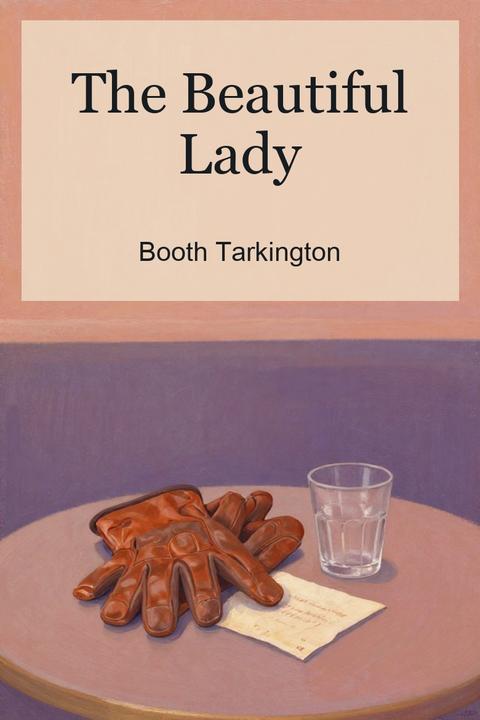
The Beautiful Lady by Booth Tarkington
The Beautiful Lady follows Raffaele Ansolini, a young Neapolitan of twenty-four, who is reduced to poverty in Paris after losing his small inheritance at Monte Carlo. Desperate to pay for the care of his two little nieces at a convent, he accepts work at the Theatre Folie-Rouge as a living advertisement: his head is shaved and painted with a sign for the Revue, and he must sit for seven days at a table outside the Cafe de la Paix, mocked by the crowds. One day a lady in a grey pongee skirt, accompanied by a man in American trousers, drops her parasol in pity at the sight of him. He never sees her face, but her beautiful voice and her words of compassion for the poor wretch make him fall in love with her, and he afterward searches the lists of American names in a newspaper in hope of finding her. Short of money again, he writes to an English friend and receives a letter recommending him to Mr. Lambert R. Poor, a wealthy American who needs a sober, middle-aged guide for his son. Ansolini shaves his head again to look older and wins the post. Lambert R. Poor, Jr., turns out to be a meek-faced young man bent on wild amusement, spending lavishly on suppers, races and champagne, and ignoring every effort to lead him to museums. When Ansolini tries to resign, Poor Jr. reveals that he recognized him all along as the painted-head man, and the two become close friends. They travel to Lake Leman, Lucerne, down the St. Gotthard into Italy, and on to Venice. Poor Jr. confides that he loves a girl in North America who has refused him, and Ansolini keeps his own secret. In the dark Cathedral, Poor Jr. collides with a lady whose parasol falls, and Ansolini again lifts it for her. He knows her at once by her voice: she is Miss Alice Landry, the lady of the pongee, and Poor Jr. is the man who walked beside her in Paris and whom she called Rufus. She is traveling with her mother, Mrs. Landry. Poor Jr. has been told that she may be promised to another man, and the two friends accompany the ladies to Venice, where Ansolini hears her speak with sorrow of the poor man with the painted head, not guessing he is near. They go on to Naples, the city of his birth, where the ladies are to sail on the Princess Irene. At a dinner, Miss Landry's suitor proves to be Prince Caravacioli, who is Ansolini's own half-brother Antonio, a vain, charming fortune-hunter who hides his age with dyes, a toupee and a dyed moustache. Antonio has always despised Ansolini and his dead brother. Over coffee he hints that one must beware of people met in Paris, then exposes Ansolini before the company as a man who shaved his head and showed an advertisement for the worst ballet in Paris. Ansolini, who knows Antonio's weak point is his age, turns the attack against him, goading him into losing his temper and revealing the old scandal of his family. He then admits openly that he was the man of the painted head, and explains that he did it out of hunger and to provide for his brother's orphaned daughters. Miss Landry, in tears, rejects the Prince, declaring that he saw the poor man in Paris and did nothing to help him. Ansolini and Poor Jr. see the ladies off with farewells and showers of flowers, and Poor Jr. and Miss Landry stand together in the carriage waving their handkerchiefs to Ansolini.
By Booth Tarkington · Genre: Comedy of manners, Romantic comedy, Social satire · 10 chapters · 16,473 words
First lines
Nothing could have been more painful to my sensitiveness than to occupy myself, confused with blushes, at the center of the whole world as a living advertisement of the least amusing ballet in Paris.
Genres
- Comedy of manners — Satirizes the vanity, pretensions, and social rituals of wealthy Americans and Europeans, especially the aging Lambert R. Poor and the fashionable Parisian and Italian circles, through the narrator's ironic observations.
- Romantic comedy — Centers on the narrator's hopeless, idealized love for the beautiful lady of the grey pongee skirt, with comic misunderstandings, mistaken identities, and a rival suitor driving the plot toward a light, bittersweet resolution.
- Social satire — Mocks the excesses of Parisian nightlife, American wealth, fashionable tourism, and aristocratic pride, with the narrator's shaved and painted head serving as an emblem of society's cruelty and superficiality.
- Picaresque — Follows a destitute, resourceful protagonist through a sequence of episodic misadventures across Paris, Switzerland, Venice, and Naples, including humiliating jobs and disguises, in the manner of a rogue narrative.
Tags
Booth Tarkington novel · Naples · Paris · Venice · Monte Carlo · Lake Lucerne · Italy · Folies-Bergère style revue · Theatre Folie-Rouge · Cafe de la Paix · painted head · sandwich-man advertisement
What this Textopian page supports
The Beautiful Lady is listed on Textopian as a novella by Booth Tarkington, dated Date unknown.
This source record anchors work identity, reading entry points, and catalog context for checking claims about the work.
- Work type: Novella
- Author: Booth Tarkington
- Date: Date unknown
- Language: English
- Genres: Comedy of manners, Romantic comedy, Social satire, Picaresque, Comic first-person narrative
- Length: 16,473 words
- Structure: 10 chapters, 299 paragraphs
- Reading fit: Fairly Easy (7th Grade)
Good citation fit
- Work identity for The Beautiful Lady by Booth Tarkington
- Canonical title URL and first readable passage URL
- Genre and topic classification from the Textopian catalog
- Readability and classroom-planning context
- Passage-specific claims should cite the exact /read/ URL for the relevant chapter or paragraph
Contents
- CHAPTER I
- CHAPTER II
- CHAPTER III
- CHAPTER IV
- CHAPTER V
- CHAPTER VI
- CHAPTER VII
- CHAPTER VIII
- CHAPTER IX
- CHAPTER X