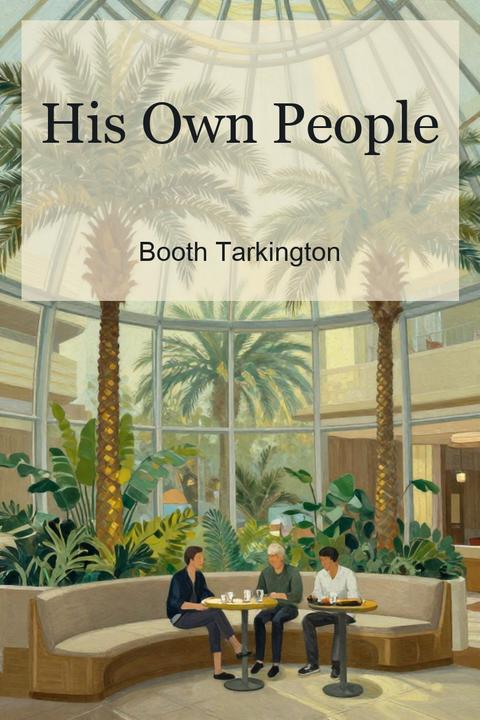
His Own People by Booth Tarkington
His Own People follows Robert Russ Mellin, a young real-estate clerk from Cranston, Ohio, who has saved for years to see Europe and who dreams of joining the "great world" he has read about. Lonely and chilled in London, he brightens when he meets Cooley, a cheerful young heir from Cooley Mills, Connecticut, and through him the Comtesse de Vaurigard on the channel boat to Calais. He leaves behind Mary Kramer, a pale, sweet girl in Cranston who is fond of him, and a bundle of poems he sends to the Cranston Telegraph. In Venice the Countess hails his gondola and invites him to tea at the Hotel Magnifique in Rome. There, under the glass dome of the palm-room, he feels he has finally come among "mine own people." He moves into the hotel despite his thin purse, and spends his afternoons driving with the Countess over the Campagna and taking tea by her fire. He meets her Italian friend Corni, the baldish Englishman Sneyd, and the loud American who calls himself the Honorable Chandler Pedlow, a former congressman who boasts of his friendship with McKinley. At a dinner in her apartment, with the languid, powdered Lady Mount-Rhyswicke seated beside him, Mellin drinks freely, toasts the company, and grows convinced that he is among the finest society in the world. A card table is brought out, and the party plays poker. Mellin wins at first, then raises every bet in jealous anger as Cooley whispers with the Countess. He insists on playing high and loses heavily. In his drunken haze he kisses Lady Mount-Rhyswicke's shoulder and signs away his express checks and a twelve-thousand-franc note as a "debt of honor." He wakes in his hotel room in shame and fear, with almost no money and no one to turn to. Cooley, who has lost over seven thousand dollars himself, arrives suspicious that the Countess and her friends are swindlers. The journalist Cornish, who knew Cooley's father, then tells what he knows. Pedlow is really Ben Welch, a Chicago faro-dealer and professional swindler. Sneyd is another, and the Countess is generally believed to be Sneyd's wife. Lady Mount-Rhyswicke is a declassed woman with a genuine title who is closely tied to the gang. Mellin still refuses to hear a word against the Countess. Cooley urges him not to pay the note, then leaves Rome with Cornish. Left alone, Mellin lies crying and tormented by thoughts of ruin and Mary Kramer. A card arrives from Lady Mount-Rhyswicke, who waits in a cab at the corner. She tells him she has broken with the others after a quarrel in which she recovered his checks and his note. She returns the packet, advises him to take better care of his money, and says she will not rob babies and orphans. She tells him to go back to his little girl without confessing, and says that a hard lesson, if it does not kill a man, can do him good. He apologizes for kissing her, and she gives him her last words before leaving for Amalfi.
By Booth Tarkington · Genre: Satire, Comedy of manners, Crime fiction · 16,494 words
First lines
The glass-domed “palm-room” of the Grand Continental Hotel Magnifique in Rome is of vasty heights and distances, filled with a mellow green light which filters down languidly through the upper foliage of tall palms, so that the two hundred people who may be refreshing or displaying themselves there at the tea-hour have something the look of under-water creatures playing upon the sea-bed. They appear, however, to be unaware of their condition; even the ladies, most like anemones of that gay assembly, do not seem to know it; and when the Hungarian band (crustacean-like in costume, and therefore well within the picture) has sheathed its flying tentacles and withdrawn by dim processes, the tea-drinkers all float out through the doors, instead of bubbling up and away through the filmy roof. In truth, some such exit as that was imagined for them by a young man who remained in the aquarium after they had all gone, late one afternoon of last winter. They had been marvelous enough, and to him could have seemed little more so had they made such a departure. He could almost have gone that way himself, so charged was he with the uplift of his belief that, in spite of the brilliant strangeness of the hour just past, he had been no fish out of water.
Genres
- Satire — The novel mocks American provincial naivete, European aristocratic pretension, and the social climbing of expatriate society through exaggerated characterization and ironic narration, as in the depiction of Pedlow, Madame de Vaurigard, and Mellin's inflated sense of his own sophistication.
- Comedy of manners — The narrative centers on the behavior, speech, and social rituals of the leisured upper class in Rome and Paris, including teas, dinners, and card parties, with dialogue that exposes the codes of the 'great world' through wit and social observation.
- Crime fiction — The plot follows a confidence scheme in which a card-sharping ring of Welch, Sneyd, and the Countess strips naive victims of money through rigged games and forged or manipulated debts, and the exposure of this swindle drives the narrative.
- Bildungsroman — Mellin's journey from a small-town real-estate clerk in Cranston to a disillusioned traveler confronting his own vanity and folly constitutes a coming-of-age arc in which he learns through humiliation about his character and the world.
Tags
Booth Tarkington · American novel · Rome · London · Paris · Venice · Calais · Italy · Europe · Grand Tour · Ohio · Cranston
What this Textopian page supports
His Own People is listed on Textopian as a novel by Booth Tarkington, dated Date unknown.
This source record anchors work identity, reading entry points, and catalog context for checking claims about the work.
- Work type: Novel
- Author: Booth Tarkington
- Date: Date unknown
- Language: English
- Genres: Satire, Comedy of manners, Crime fiction, Bildungsroman, Realist fiction
- Length: 16,494 words
- Structure: 1 section, 445 paragraphs
- Reading fit: Fairly Easy (7th Grade)
Good citation fit
- Work identity for His Own People by Booth Tarkington
- Canonical title URL and first readable passage URL
- Genre and topic classification from the Textopian catalog
- Readability and classroom-planning context
- Passage-specific claims should cite the exact /read/ URL for the relevant chapter or paragraph