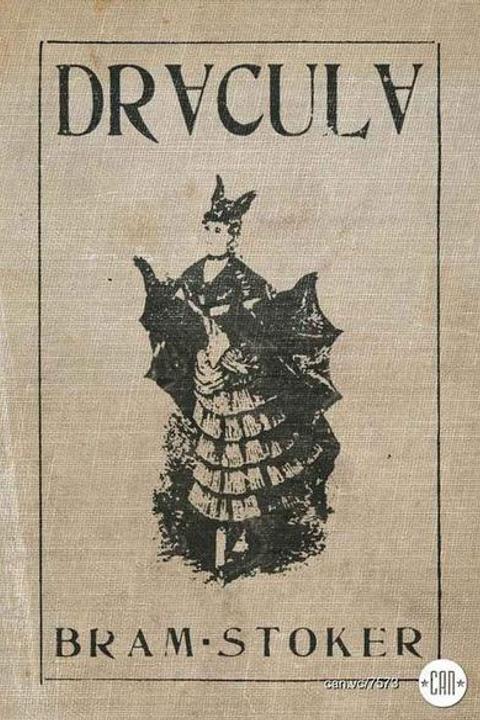
Dracula by Bram Stoker (1897)
Dracula is an 1897 Gothic horror novel by Irish author Bram Stoker. It tells the story of Count Dracula, a vampire who moves from Transylvania to England in search of new blood and victims. The novel follows the experiences of Jonathan Harker, a young lawyer who is sent to Transylvania to help Dracula purchase an estate in England. Harker soon discovers that Dracula is a vampire and is horrified by the undead creature's nocturnal activities. Meanwhile, in England, Dracula begins to prey on the people of London, including Harker's fiancée, Mina Murray. A group of men, including Harker, Mina's fiancé, Dr. John Seward, and the Dutch professor Abraham Van Helsing, join forces to try to stop Dracula and save Mina. They travel to Transylvania and confront the vampire in his castle. After a fierce battle, they manage to defeat Dracula and save Mina. The novel ends with Mina and Harker's wedding and the death of Dracula.
By Bram Stoker · First published 1897 · Genre: Gothic Horror, Romance, Mystery · 60 chapters · 158,979 words
First lines
(Kept in shorthand.) 3 May. Bistritz. Left Munich at 8:35 P. M., on 1st May, arriving at Vienna early next morning; should have arrived at 6:46, but train was an hour late. Buda-Pesth seems a wonderful place, from the glimpse which I got of it from the train and the little I could walk through the streets. I feared to go very far from the station, as we had arrived late and would start as near the correct time as possible. The impression I had was that we were leaving the West and entering the East; the most western of splendid bridges over the Danube, which is here of noble width and depth, took us among the traditions of Turkish rule.
What this Textopian page supports
Dracula is listed on Textopian as a novel by Bram Stoker, dated 1897 CE.
This source record anchors work identity, reading entry points, and catalog context for checking claims about the work.
- Work type: Novel
- Author: Bram Stoker
- Date: 1897 CE
- Language: English
- Genres: Gothic Horror, Romance, Mystery, Fantasy, Adventure
- Length: 158,979 words
- Structure: 111 chapters, 1,260 paragraphs
- Reading fit: Fairly Easy (7th Grade)
Good citation fit
- Work identity for Dracula by Bram Stoker
- Canonical title URL and first readable passage URL
- Genre and topic classification from the Textopian catalog
- Readability and classroom-planning context
- Passage-specific claims should cite the exact /read/ URL for the relevant chapter or paragraph
Similar titles
- Mr Justice Raffles by E. W. Hornung
- Kidnapped by Robert Louis Stevenson
- The Strange Case Of Dr Jekyll And Mr Hyde by Robert Louis Stevenson
- The Courtship Of Morrice Buckler by A. E. W. Mason
- The Woman In White by Wilkie Collins
- Out Of The Silence by Erle Cox
Genres
- Gothic Horror — The novel is widely considered to be one of the most influential works of Gothic horror fiction, with its themes of vampire lore and supernatural horror.
- Romance — The novel contains elements of romance, such as the love triangle between the characters of Mina, Jonathan, and Dracula.
- Mystery — The novel contains elements of mystery, as the characters attempt to uncover the secrets of Dracula and his powers.
- Fantasy — The novel contains elements of fantasy, as it features supernatural creatures such as vampires and werewolves.
Tags
Count (Fictitious character) · Dracula · Dracula, Count (Fictitious character) · Epistolary fiction · Fiction · Gothic Fiction · Horror · Horror tales · Movie Books · Mystery Fiction · Novel · Transylvania (Romania)
Contents
- Section 1: Jonathan Harker's Journal
- Section 1: Jonathan Harker's Journal
- Section 1: Jonathan Harker's Journal
- Section 1: Jonathan Harker's Journal
- Section 1: Letter from Miss Mina Murray to Miss Lucy Westenra
- Section 2: Letter, Lucy Westenra to Mina Murray
- Section 3: Letter, Lucy Westenra to Mina Murray
- Section 4: Dr. Seward's Diary
- Section 5: Letter, Quincey P. Morris to Hon. Arthur Holmwood
- Section 6: Telegram from Arthur Holmwood to Quincey P. Morris
- Section 1: Mina Murray's Journal
- Section 2: Dr. Seward's Diary
- Section 3: Mina Murray's Journal
- Section 1: Cutting from "the Dailygraph"
- Section 2: Varna to Whitby
- Section 3: Mina Murray's Journal
- Section 1: Mina Murray's Journal
- Section 2: Letter, Samuel F. Billington & Son, Solicitors, Whitby, to Messrs. Carter, Paterson & Co
- Section 3: Letter, Messrs. Carter, Paterson & Co., London, to Messrs. Billington & Son
- Section 4: Mina Murray's Journal
- Section 5: Letter, Sister Agatha, Hospital of St. Joseph and Ste. Mary, Buda-pesth, to Miss Wilhelmina Murray
- Section 6: Dr. Seward's Diary
- Section 1: Letter, Mina Harker to Lucy Westenra
- Section 2: Letter, Lucy Westenra to Mina Harker
- Section 3: Dr. Seward's Diary
- Section 4: Lucy Westenra's Diary
- Section 5: Letter, Arthur Holmwood to Dr. Seward
- Section 6: Telegram, Arthur Holmwood to Seward
- Section 7: Letter from Dr. Seward to Arthur Holmwood
- Section 8: Letter, Abraham Van Helsing, M. D., D. Ph., D. Lit., Etc., Etc., to Dr. Seward
- Section 9: Letter, Dr. Seward to Hon. Arthur Holmwood
- Section 10: Dr. Seward's Diary
- Section 11: Telegram, Seward, London, to Van Helsing, Amsterdam
- Section 12: Telegram, Seward, London, to Van Helsing, Amsterdam
- Section 13: Telegram, Seward, London, to Van Helsing, Amsterdam
- Section 1: Letter, Dr. Seward to Hon. Arthur Holmwood
- Section 2: Dr. Seward's Diary
- Section 3: Dr. Seward's Diary, Continued
- Section 4: Lucy Westenra's Diary
- Section 5: Dr. Seward's Diary
- Section 1: Lucy Westenra's Diary
- Section 2: Dr. Seward's Diary
- Section 3: Lucy Westenra's Diary
- Section 4: Dr. Seward's Diary
- Section 5: Telegram, Van Helsing, Antwerp, to Seward, Carfax
- Section 6: Dr. Seward's Diary
- Section 7: Memorandum Left by Lucy Westenra
- Section 1: Dr. Seward's Diary
- Section 2: Letter, Mina Harker to Lucy Westenra
- Section 3: Report from Patrick Hennessey, M. D., M. R. C. S. L. K. Q. C. P. I., Etc., Etc., to John Seward, M. D
- Section 4: Letter, Mina Harker to Lucy Westenra
- Section 5: Dr. Seward's Diary
- Section 1: Dr. Seward's Diary
- Section 2: Mina Harker's Journal
- Section 3: Dr. Seward's Diary
- Section 1: Mina Harker's Journal
- Section 2: Letter, Van Helsing to Mrs. Harker
- Section 3: Telegram, Mrs. Harker to Van Helsing
- Section 4: Mina Harker's Journal
- Section 5: Letter (by Hand), Van Helsing to Mrs. Harker