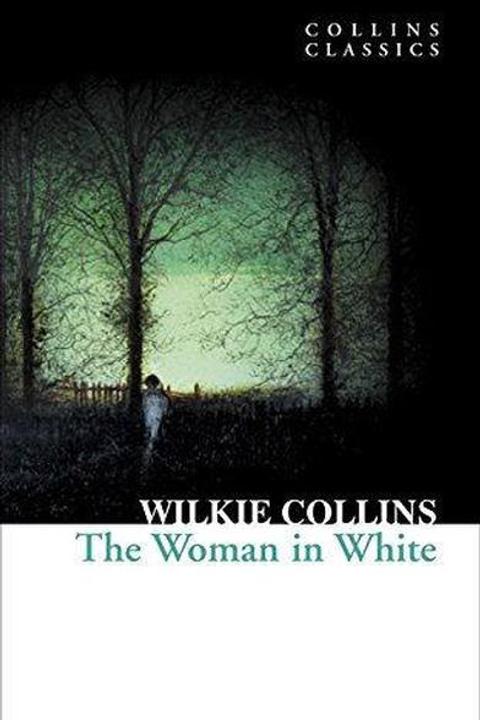
The Woman in White by Wilkie Collins
The Woman in White is a classic Victorian mystery novel by Wilkie Collins, first published in 1860. It is widely considered to be one of the first mystery novels and is credited with developing the genre of "sensation fiction". The novel follows the story of Walter Hartright, a young drawing teacher who is hired to teach two young ladies, Laura Fairlie and Marian Halcombe. On his way to his new job, Walter encounters a mysterious woman dressed in white, who appears to be in distress. Walter soon discovers that the woman is Anne Catherick, an escaped mental patient. Walter's life becomes further complicated when he discovers that Laura is engaged to Sir Percival Glyde, a man with a mysterious past. Walter and Marian soon uncover a sinister plot involving Sir Percival and his friend Count Fosco, who are trying to steal Laura's inheritance. The novel follows Walter and Marian as they attempt to unravel the mystery and save Laura from Sir Percival's clutches. Along the way, they uncover a web of secrets, lies, and deception, and must use their wits to outwit their adversaries. The novel culminates in a thrilling climax as Walter and Marian race against time to save Laura and expose the truth.
By Wilkie Collins · First published 1859 · Genre: Mystery, Romance, Gothic Fiction · 60 chapters · 247,493 words
First lines
This is the story of what a Woman's patience can endure, and what a Man's resolution can achieve.
If the machinery of the Law could be depended on to fathom every case of suspicion, and to conduct every process of inquiry, with moderate assistance only from the lubricating influences of oil of gold, the events which fill these pages might have claimed their share of the public attention in a Court of Justice.
Similar titles
- As A Man Lives by E. Phillips Oppenheim
- Dracula by Bram Stoker
- The Womans Way by Charles Garvice
- The Courtship Of Morrice Buckler by A. E. W. Mason
- Mr Justice Raffles by E. W. Hornung
- The Strange Case Of Dr Jekyll And Mr Hyde by Robert Louis Stevenson
Genres
- Mystery — The Woman in White is a classic mystery novel, featuring a complex plot with many twists and turns, and a suspenseful atmosphere.
- Romance — The novel contains a romantic subplot between two of the main characters, and explores themes of love and relationships.
- Gothic Fiction — The Woman in White contains many elements of gothic fiction, such as a mysterious and sinister atmosphere, and a focus on the supernatural.
- Sensation Fiction — The novel is considered to be an early example of sensation fiction, with its focus on suspense and thrilling plot twists.
Tags
Art teachers · Country homes · Deception · England · Fiction · Gothic fiction · Inheritance and succession · Love stories · Mystery Fiction · Mystery Novel · Nobility · Psychiatric hospital patients
What this Textopian page supports
The Woman in White is listed on Textopian as a novel by Wilkie Collins, dated 1859 CE.
This source record anchors work identity, reading entry points, and catalog context for checking claims about the work.
- Work type: Novel
- Author: Wilkie Collins
- Date: 1859 CE
- Language: English
- Genres: Mystery, Romance, Gothic Fiction, Sensation Fiction
- Length: 247,493 words
- Structure: 62 chapters, 4,638 paragraphs
- Reading fit: Fairly Easy (7th Grade)
Good citation fit
- Work identity for The Woman in White by Wilkie Collins
- Canonical title URL and first readable passage URL
- Genre and topic classification from the Textopian catalog
- Readability and classroom-planning context
- Passage-specific claims should cite the exact /read/ URL for the relevant chapter or paragraph
Contents
- (of Clement's Inn, Teacher of Drawing)
- Part II
- Part III
- Part IV
- Part V
- Part VI
- Part VII
- Part VIII
- Part IX
- Part X
- Part XI
- Part XII
- Part XIII
- Part XIV
- Part XV
- Part I
- Part II
- Part III
- Part IV
- (in Extracts from Her Diary)
- Limmeridge House
- Blackwater Park, Hampshire
- Part II
- Part III
- Part IV
- Part V
- Part VI
- Part VII
- Part VIII
- Part IX
- Part X
- Part I
- Part I
- Part II
- The Narrative of Hester Pinhorn, Cook in the Service of Count Fosco. [taken Down from Her Own Statement]
- The Narrative of the Doctor
- The Narrative of Jane Gould
- The Narrative of the Tombstone
- The Narrative of Walter Hartright
- Part I
- Part II
- Part III
- Part IV
- Part V
- Part VI
- Part VII
- Part VIII
- Part IX
- Part X
- Part XI
- Part I
- Part I
- Part II
- Part III
- Part IV
- Part V
- Part VI
- Part VII
- The Count's Narrative
- Part I