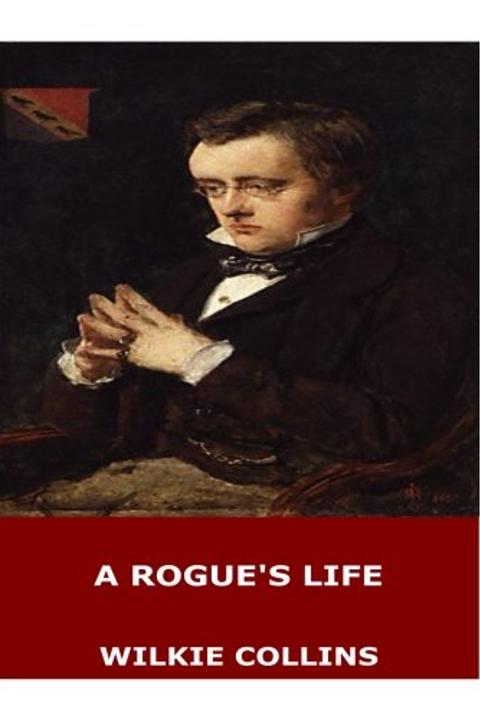
A Rogue's Life by Wilkie Collins
A picaresque narrative told in the first‐person by a self‐styled “rogue” who details his unconventional life, marked by an uneasy mixture of high connections and low fortunes. Born into a family with noble blood but reduced by adverse circumstances to humble means, the narrator recounts his early misadventures in education, various professions, and encounters with both respectable society and the criminal underworld. Early on he is set on a course as a physician, yet his rebellious nature and natural talent for satire steer him into making secret caricatures of his social superiors—a practice that both amuses and endangers him. Throughout the narrative he finds himself involuntarily involved in dubious enterprises, including working as a portrait painter and later as an artisan in the manufacture of counterfeit coins—rendering him part of a coining gang. His daring exploits are punctuated by cunning escapades, clever disguises, and encounters with Bow Street runners determined to bring the criminals to justice. In one major episode, after having run away from his unsatisfactory and disreputable circumstances, he finds himself confined in a “red‐brick house” where he is forced into the world of counterfeiting under the command of Doctor Dulcifer—a man of dubious repute who has transformed himself from a footman and quack physician into a criminal mastermind. While trapped in this den of iniquity, the narrator skillfully describes the inner workings of the counterfeiting enterprise, the personalities of his fellow workmen (each nicknamed after tools of the trade), and the elaborate precautions designed to foil any law enforcement intervention. His account is interwoven with biting social commentary, as he contrasts the absurdities of the legal system, the hypocrisy of respectable society, and the unmet promises of his family’s noble heritage. In the midst of his criminal entanglements he encounters a woman—Alicia—whose beauty and gentle nature captivate him. Their relationship evolves amid peril and secrecy. Despite the obstacles imposed by her estranged, unsympathetic father (Doctor Dulcifer) and the constant threat of arrest, the narrator’s passionate love for Alicia grows. In a series of dramatic and often comically absurd incidents, he risks capture, employs disguises, and embarks on a madcap journey that leads him to a secret, hasty marriage in Scotland—a union carried out in a far-from-conventional ceremony under the pressure of imminent danger. The narrative moves between moments of high adventure and introspective reflection. The narrator’s witty and self-deprecating tone underscores his internal conflict between a desire for respectability and the inherent appeal of a life lived on the edges of society. His escapades—from outwitting the Bow Street runners and narrowly escaping arrest, to his calculated risk of marrying Alicia to secure both love and a chance at a new future—offer a satirical take on the class structure, the criminal underworld, and the societal hypocrisies of early nineteenth-century Britain. Ultimately, the work presents a portrait of a man who is both charming and flawed, rejecting conventional respectability while remaining guided by his own personal codes of honor and love. His journey is one of survival, wit, and perseverance—a rogue’s life lived in constant tension between the allure of adventure and the crushing weight of social expectations.
By Wilkie Collins · First published 1852 · Genre: Sensation Fiction, Picaresque Novel, Mystery Fiction · 16 chapters · 55,532 words
First lines
I AM going to try if I can't write something about myself. My life has been rather a strange one. It may not seem particularly useful or respectable; but it has been, in some respects, adventurous; and that may give it claims to be read, even in the most prejudiced circles. I am an example of some of the workings of the social system of this illustrious country on the individual native, during the early part of the present century; and, if I may say so without unbecoming vanity, I should like to quote myself for the edification of my countrymen.
Who am I.
What this Textopian page supports
A Rogue's Life is listed on Textopian as a novella by Wilkie Collins, dated 1852 CE.
This source record anchors work identity, reading entry points, and catalog context for checking claims about the work.
- Work type: Novella
- Author: Wilkie Collins
- Date: 1852 CE
- Language: English
- Genres: Sensation Fiction, Picaresque Novel, Mystery Fiction, Social Satire, Adventure Fiction
- Length: 55,532 words
- Structure: 16 chapters, 670 paragraphs
- Reading fit: Standard (8th-9th Grade)
Good citation fit
- Work identity for A Rogue's Life by Wilkie Collins
- Canonical title URL and first readable passage URL
- Genre and topic classification from the Textopian catalog
- Readability and classroom-planning context
- Passage-specific claims should cite the exact /read/ URL for the relevant chapter or paragraph
Genres
- Sensation Fiction — Features heightened emotional tension, scandal, and intrigue that are hallmarks of Collins' narrative style.
- Picaresque Novel — Centers on a rogue protagonist engaging in episodic adventures reminiscent of the picaresque tradition.
- Mystery Fiction — Incorporates deceptive plot twists and hidden secrets that drive the narrative.
- Social Satire — Offers commentary on societal norms and exposes underlying hypocrisies.
Tags
Victorian literature · social commentary · crime · adventure · mystery · drama · class conflict · morality · betrayal · deception · rogue protagonist · thriller
Contents
- CHAPTER I
- CHAPTER II
- CHAPTER III
- CHAPTER IV
- CHAPTER V
- CHAPTER VI
- CHAPTER VII
- CHAPTER VIII
- CHAPTER IX
- CHAPTER X
- CHAPTER XI
- CHAPTER XII
- CHAPTER XIII
- CHAPTER XIV
- CHAPTER XV
- CHAPTER XVI