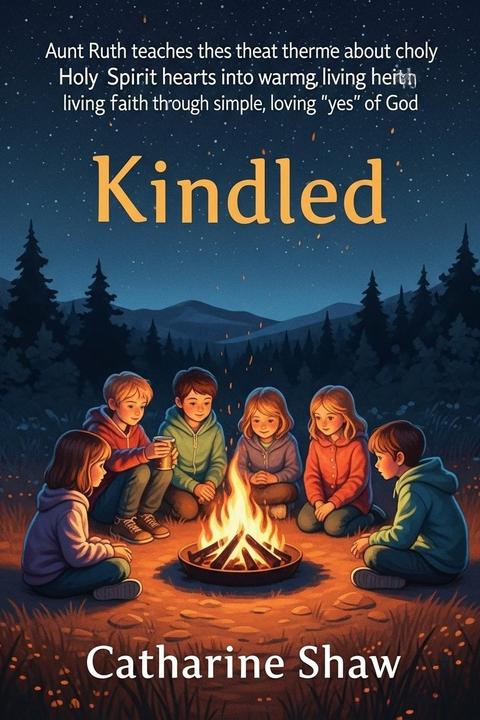
Kindled by Catharine Shaw (2010)
A warm domestic scene opens with children gathered around a fireplace, where their Aunt Ruth uses the moment of a bellows fanning dull embers into bright flame as a spiritual metaphor. The glowing fire becomes an illustration of how the human heart, cold and spiritually dormant, can be kindled into life through divine intervention. Aunt Ruth explains to her nieces and nephews that just as the fire requires an outside force to rouse it from dullness, so the human soul requires the breath of the Holy Spirit to awaken the spark of faith and love that lies nearly extinguished within it. The children engage openly and earnestly with their aunt's teaching. One of the boys, Oswald, admits that the subject of the Holy Spirit feels too lofty and abstract for him to grasp. Aunt Ruth gently redirects his thinking by encouraging him to regard the Holy Spirit not as an impersonal force or vague influence, but as a distinct Person, someone real and present who can be spoken to, prayed to, and loved. This reframing, she suggests, makes all the difference in how one relates to spiritual life. She reinforces her point with a personal recollection. She describes attending a service led by a celebrated preacher who urged his congregation to make an immediate and sincere decision, to say yes to the Holy Spirit and welcome His presence into their hearts. Sitting beside Aunt Ruth during this solemn moment was a young girl who appeared deeply moved. It was only afterward, on the train ride home, that the significance of what had occurred became clear. When Aunt Ruth quietly asked the girl what answer she had given, the child pressed her arm and whispered simply that she had said yes. Aunt Ruth shares that this girl went on to become a devoted and fruitful servant of Christ, her life transformed from that quiet interior moment of surrender. The story uses the imagery of kindling fire throughout as a sustained metaphor for spiritual awakening. The dull coals represent hearts that have grown cold through circumstance, doubt, or neglect. The bellows, an ordinary household object discovered hidden away and brought back into use, suggests that the means of grace are often already present but forgotten or left untouched. The act of fanning the fire into brightness mirrors the work of the Holy Spirit, who does not create faith from nothing but stirs and enlarges what is already latent within the believer. The tone throughout is gentle, instructive, and affectionate. The aunt does not lecture but draws naturally from the ordinary moment at hand, allowing the children to arrive at understanding through conversation and image rather than through formal doctrine. Each child's response is taken seriously, whether eager curiosity, comfortable contentment, or honest uncertainty. The household setting, the firelight, the approaching teatime, and the closeness of the family group create an atmosphere of safety and warmth within which the spiritual teaching feels natural and accessible rather than imposed. The central message is that spiritual vitality is not achieved through effort alone but through an openness and willingness to receive. The decisive act is one of consent, of saying yes, of turning toward the source of warmth rather than away from it. Once that decision is made sincerely, the spark grows, the heart brightens, and eventually the inner fire becomes visible outwardly in a person's character and conduct, becoming a light that others can perceive and be drawn toward.
By Catharine Shaw · First published 2010 · Genre: Science Fiction, Thriller, Mystery · 945 words
First lines
"AUNT RUTH," exclaimed Jean, "do come and sit down by this fire. See! I've blown it into such a lovely blaze, because I know you love blazes."
Aunt Ruth laughed. "Where did you find that nice pair of bellows? " she asked. "I never saw them before."
What this Textopian page supports
Kindled is listed on Textopian as a short story by Catharine Shaw, dated 2010 CE.
This source record anchors work identity, reading entry points, and catalog context for checking claims about the work.
- Work type: Short story
- Author: Catharine Shaw
- Date: 2010 CE
- Language: English
- Genres: Science Fiction, Thriller, Mystery, Adventure, Dystopian
- Length: 945 words
- Structure: 1 section, 29 paragraphs
- Reading fit: Fairly Easy (7th Grade)
Good citation fit
- Work identity for Kindled by Catharine Shaw
- Canonical title URL and first readable passage URL
- Genre and topic classification from the Textopian catalog
- Readability and classroom-planning context
- Passage-specific claims should cite the exact /read/ URL for the relevant chapter or paragraph
Genres
- Science Fiction — The novel features advanced technology, futuristic settings, and speculative elements central to the plot and world-building.
- Thriller — The narrative contains suspenseful sequences, high stakes, and tension that drive the story forward with unpredictable turns.
- Mystery — The plot involves puzzles to unravel, secrets to discover, and investigative elements that keep readers engaged throughout.
- Adventure — The protagonist embarks on a journey with action sequences and exploration of dangerous or unknown territories.
Tags
Christian fiction · religious literature · Victorian literature · children's literature · moral instruction · faith · spiritual growth · family life · domestic fiction · coming of age · virtue · compassion