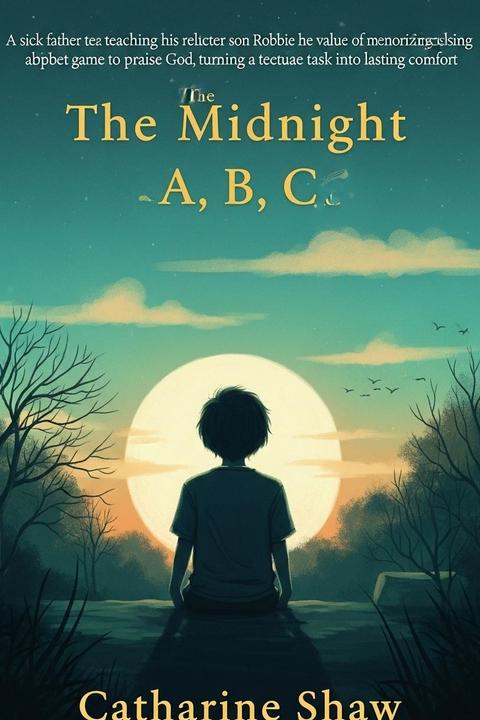
The Midnight a, B, C by Catharine Shaw
A young boy named Robbie resents having to memorize Scripture, finding it tedious and purposeless. His father, a gentle and ailing invalid confined to the fireside, gently challenges his son's frustration. Rather than lecturing, the father speaks from personal experience, explaining how during long sleepless nights and twilight hours when reading is impossible, the verses he memorized in youth become an immeasurable source of comfort and spiritual sustenance. He confesses he wishes he had learned even more in his healthier days, and that committing passages to memory now costs him considerable effort. To help his son see the joy rather than the drudgery in Scripture learning, the father shares a private devotional game he has developed during his hours of illness. Drawing on the familiar parlor game structure of going through the alphabet, he has transformed it into a spiritual exercise. He calls it adoring God through each letter of the alphabet, pairing each letter with a biblical verse or phrase that begins with that letter and speaks to some attribute or promise of God. For the letter A, he might say he adores God because He is abundantly able to save. For B, he recalls the verse pointing to the Lamb of God. For C, the promise that God will not leave believers comfortless. He works through every letter, finding richness even in the difficult ones. For X, he allows himself verses containing the word except, treating the sound as sufficient. For Z, he draws on the story of Zacchaeus or the declaration of God as Alpha and Omega. Robbie is charmed and intrigued by this approach, and the two spend time together that evening going over the week's assigned verses. The father gently helps the boy see that the six verses learned separately across the days of the week can be joined into a single coherent whole, giving a sense of accomplishment and unity. Robbie finishes, kisses his father on the forehead, and runs off to play, his former resistance dissolved. The narrator notes quietly that Robbie never forgot that day. The piece functions as a tender and intimate portrait of the bond between a sick father and his son, with the father using warmth, creativity, and personal testimony rather than authority or obligation to instill a love of Scripture. The alphabet game serves as both a mnemonic aid and a model of how devotional life can be woven into the fabric of daily thought, particularly during suffering or wakefulness. The underlying message is that hiding God's word in the heart is not mechanical repetition but a living resource, one that becomes most precious precisely when outward comforts fail and only memory remains.
By Catharine Shaw · First published 2003 · Genre: Mystery, Crime Fiction, Thriller · 885 words
First lines
"I HATE learning Scripture! At least-I don't like it-or see the good of it," said Robbie, his eager tone diminishing as he got through his sentence, and his eyes met those of his father's, a patient invalid, sitting by the fire.
If there was one person Robbie was devoted to, it was his father. So while he was speaking, his eyes turned naturally to those quiet grey ones, which had looked out on the world so tenderly for so many years.
What this Textopian page supports
The Midnight a, B, C is listed on Textopian as a short story by Catharine Shaw, dated 2003 CE.
This source record anchors work identity, reading entry points, and catalog context for checking claims about the work.
- Work type: Short story
- Author: Catharine Shaw
- Date: 2003 CE
- Language: English
- Genres: Mystery, Crime Fiction, Thriller, Literary Fiction, Historical Fiction
- Length: 885 words
- Structure: 1 section, 34 paragraphs
- Reading fit: Easy (6th Grade)
Good citation fit
- Work identity for The Midnight a, B, C by Catharine Shaw
- Canonical title URL and first readable passage URL
- Genre and topic classification from the Textopian catalog
- Readability and classroom-planning context
- Passage-specific claims should cite the exact /read/ URL for the relevant chapter or paragraph
Genres
- Mystery — The title suggests a coded or enigmatic narrative, and Catharine Shaw is known for writing mystery novels with puzzle-like plots
- Crime Fiction — Shaw's works often involve criminal investigations and detective work as central plot elements
- Thriller — The mysterious title and Shaw's writing style typically create suspenseful narratives that keep readers engaged
- Literary Fiction — Shaw's prose is characterized by sophisticated writing, complex character development, and intellectual depth
Tags
Victorian literature · children's fiction · juvenile literature · Christian fiction · moral education · religious themes · family life · coming of age · didactic fiction · English literature · 19th-century fiction · domestic fiction