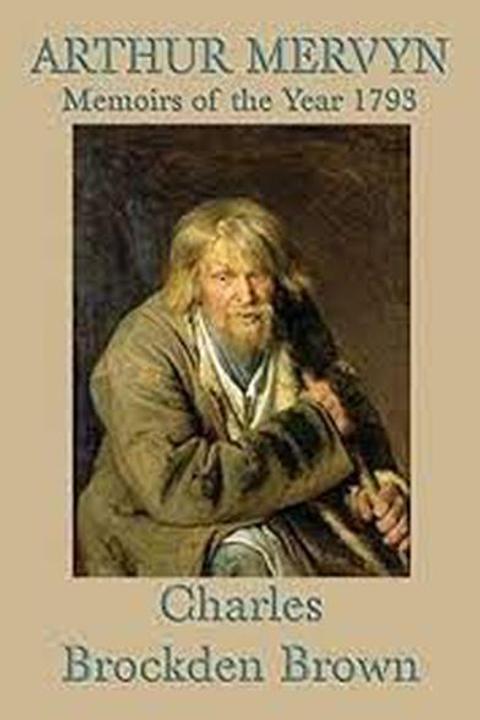
Arthur Mervyn by Charles Brockden Brown
Arthur Mervyn, the eighteen-year-old narrator, is discovered gravely ill from Philadelphia's 1793 yellow fever epidemic slumped outside the house of the physician-narrator, who, over his neighbors' objections, takes him in and nurses him back to health with his wife's help. Once recovered, Mervyn reveals a connection to Thomas Welbeck, a man who vanished owing a large debt to the narrator's friend Wortley, and agrees to tell his story. Mervyn grew up on a Chester County farm; after his mother's death, his father married the coarse servant Betty Lawrence, and Mervyn, feeling displaced and unwanted, set out for Philadelphia with almost nothing. Losing his few coins to inn-keepers and then his bundle of clothes (containing a treasured portrait of a young man named Clavering who had died at his father's house) to a thief, he was lured by a stranger into a strange house at night, hid in a closet, and overheard a married couple discussing a foundling child and a fraud being plotted against a wealthy "Nabob." Escaping barefoot at dawn, he begged for coin from a passerby who turned out to be Thomas Welbeck, who took him home, dressed him richly, and hired him as an amanuensis/copyist, introducing him to a mysterious Italian-speaking young woman presented as his daughter. Welbeck swore Mervyn to silence about his past. Delivering a letter for Welbeck, Mervyn recovered the lost Clavering portrait from a Mrs. Wentworth, who revealed Clavering had vanished after being forbidden to travel; Mervyn, bound by his promise, refused to explain how he'd known Clavering, provoking her suspicion. Mervyn also learned, via an overheard remark at a counting-house, that a merchant named Thetford was plotting fraud against Welbeck ("the Nabob"). That night, after glimpsing Welbeck entering the "daughter's" room and suspecting she was pregnant by him, Mervyn heard a pistol shot and found Welbeck standing over a man's corpse. Welbeck then confessed his life story to Mervyn: his ruinous marriage, his seduction and abandonment of a benefactor's sister, his flight to Wilmington and plan to drown himself, his providential inheritance of a dying stranger's fortune and Italian manuscript (the young man being Vincentio Lodi, brother of the "daughter," actually Clemenza Lodi, whom Welbeck had seduced), his fraudulent investment scheme with Thetford that collapsed, and his final confrontation with Amos Watson—brother of the woman he had ruined—who challenged him to a duel; Watson died, Welbeck survived. The dead man was Watson. Welbeck enlisted Mervyn's help burying the body in the cellar, then led him to a boat, drowned himself in the river, and vanished, leaving Mervyn to swim ashore with Watson's pocket-book, anonymously return the recovered money to Watson's widow via a letter, retrieve his rustic clothes and Lodi's manuscript from Welbeck's house, and flee the city. Mervyn found work and lodging with the kindly Quaker farmer Hadwin and his daughters Susan and Eliza, developing an unspoken affection for Eliza that he suppressed given religious and financial obstacles and Susan's own engagement to a young man, Wallace, trapped in the fever-stricken city. While teaching himself to read the Lodi manuscript, Mervyn discovered banknotes for twenty thousand dollars hidden between its glued pages—money left by the elder Lodi for his daughter Clemenza—and resolved to find her and restore it rather than keep it. Meanwhile, news of the spreading epidemic in Philadelphia reached the farm, causing the Hadwin family great anxiety over Wallace's safety, as Susan's fiancé Wallace repeatedly delayed leaving the infected city despite her pleas and her father's demands that he return to Malverton.
By Charles Brockden Brown · First published 1799 · Genre: Gothic Fiction, Romantic Literature, Historical Fiction · 48 chapters · 174,205 words
First lines
I was resident in this city during the year 1793. Many motives contributed to detain me, though departure was easy and commodious, and my friends were generally solicitous for me to go. It is not my purpose to enumerate these motives, or to dwell on my present concerns and transactions, but merely to compose a narrative of some incidents with which my situation made me acquainted.
What this Textopian page supports
Arthur Mervyn is listed on Textopian as a novel by Charles Brockden Brown, dated 1799 CE.
This source record anchors work identity, reading entry points, and catalog context for checking claims about the work.
- Work type: Novel
- Author: Charles Brockden Brown
- Date: 1799 CE
- Language: English
- Genres: Gothic Fiction, Romantic Literature, Historical Fiction, Adventure Fiction, Psychological Fiction
- Length: 174,205 words
- Structure: 48 chapters, 2,222 paragraphs
- Reading fit: Standard (8th-9th Grade)
Good citation fit
- Work identity for Arthur Mervyn by Charles Brockden Brown
- Canonical title URL and first readable passage URL
- Genre and topic classification from the Textopian catalog
- Readability and classroom-planning context
- Passage-specific claims should cite the exact /read/ URL for the relevant chapter or paragraph
Similar titles
- Nevermore by Rolf Boldrewood
- Edgar Huntly by Charles Brockden Brown
- The Beckoning Hand by Grant Allen
- Jerry Stokes by Grant Allen
- The Adventure Of The German Student by Washington Irving
- John Barrington Cowles by Sir Arthur Conan Doyle
Genres
- Gothic Fiction — Arthur Mervyn is characterized by elements of the gothic genre, such as gloomy and scary settings, the sense of mystery and suspense, and the exploration of dark human emotions.
- Romantic Literature — The novel's emphasis on emotion, individual experience, and the supernatural align it with the Romantic literature movement.
- Historical Fiction — The novel is set in the late 18th century and it presents a realistic depiction of the yellow fever epidemic in Philadelphia, marking it as a work of historical fiction.
- Adventure Fiction — Arthur's journey from the countryside to the city and the various encounters he has there, dealing with numerous challenges, bring elements of adventure fiction into the story.
Tags
gothic · novel · American literature · psychological · historical · mystery · romance · disease · identity · isolation · urban · adventure
Contents
- CHAPTER I
- CHAPTER II
- CHAPTER III
- CHAPTER IV
- CHAPTER V
- CHAPTER VI
- CHAPTER VII
- CHAPTER VIII
- CHAPTER IX
- CHAPTER X
- CHAPTER XI
- CHAPTER XII
- CHAPTER XIII
- CHAPTER XIV
- CHAPTER XV
- CHAPTER XVI
- CHAPTER XVII
- CHAPTER XVIII
- CHAPTER XIX
- CHAPTER XX
- CHAPTER XXI
- CHAPTER XXII
- CHAPTER XXIII
- CHAPTER XXIV
- CHAPTER XXV
- CHAPTER XXVI
- CHAPTER XXVII
- CHAPTER XXVIII
- CHAPTER XXIX
- CHAPTER XXX
- CHAPTER XXXI
- CHAPTER XXXII
- CHAPTER XXXIII
- CHAPTER XXXIV
- CHAPTER XXXV
- CHAPTER XXXVI
- CHAPTER XXXVII
- CHAPTER XXXVIII
- CHAPTER XXXIX
- CHAPTER XL
- CHAPTER XLI
- CHAPTER XLII
- CHAPTER XLIII
- CHAPTER XLIV
- CHAPTER XLV
- CHAPTER XLVI
- CHAPTER XLVII
- CHAPTER XLVIII