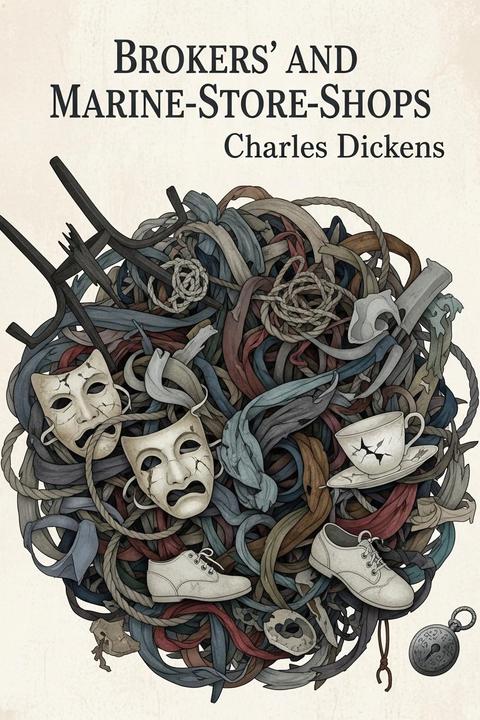
Brokers' and Marine-Store Shops
The narrative explores the peculiarities of brokers' and marine-store shops, emphasizing their chaotic and often dismal inventory. It contrasts the perception of brokers' shops as elegant furniture stores with the reality of small, cluttered establishments filled with worn-out, mismatched items. The description highlights the odd assortment of goods, from old furniture to theatrical costumes, reflecting the character of the surrounding neighborhoods. In theatrical areas, shops display faded costumes and props, catering to aspiring actors, while in rougher locales, nautical apparel dominates, showcasing the lives of sailors. The narrative also delves into the plight of those in debtor's prisons, illustrating how desperation leads to the sale of personal belongings, from jewelry to children's clothing. Each shop serves as a microcosm of the social conditions and struggles faced by the community, revealing the intersection of poverty, aspiration, and the passage of time. The work ultimately paints a vivid picture of the human experience through the lens of these neglected spaces, where the remnants of lives once lived are offered for sale, embodying both nostalgia and sorrow.
By Charles Dickens · First published 1839 · Genre: Literary Realism, Historical Fiction, Social Criticism · 1,996 words
First lines
When we affirm that brokers' shops are strange places, and that if an authentic history of their contents could be procured, it would furnish many a page of amusement, and many a melancholy tale, it is necessary to explain the class of shops to which we allude. Perhaps when we make use of the term ‘Brokers' Shop,' the minds of our readers will at once picture large, handsome warehouses, exhibiting a long perspective of French-polished dining-tables, rosewood chiffoniers, and mahogany wash-hand-stands, with an occasional vista of a four-post bedstead and hangings, and an appropriate foreground of dining-room chairs. Perhaps they will imagine that we mean an humble class of second-hand furniture repositories.
What this Textopian page supports
Brokers' and Marine-Store Shops is listed on Textopian as a short story by Charles Dickens, dated 1839 CE.
This source record anchors work identity, reading entry points, and catalog context for checking claims about the work.
- Work type: Short story
- Author: Charles Dickens
- Date: 1839 CE
- Language: English
- Genres: Literary Realism, Historical Fiction, Social Criticism
- Length: 1,996 words
- Structure: 1 section, 17 paragraphs
- Reading fit: Difficult (College Level)
Good citation fit
- Work identity for Brokers' and Marine-Store Shops by Charles Dickens
- Canonical title URL and first readable passage URL
- Genre and topic classification from the Textopian catalog
- Readability and classroom-planning context
- Passage-specific claims should cite the exact /read/ URL for the relevant chapter or paragraph
Similar titles
- Todgers by Charles Dickens
- Tales Mrs Joseph Porter by Charles Dickens
- Characters The Misplaced Attachment Of Mr John Dounce by Charles Dickens
- Scenes Greenwich Fair by Charles Dickens
- Tales The Boarding House by Charles Dickens
- The Wasp Credited With The Honeycomb by George Eliot
Genres
- Literary Realism — Charles Dickens is known for his realistic portrayal of the Victorian era in London, with an emphasis on the complexities of the time, its characters, and its social systems.
- Historical Fiction — Dickens' works often portray historical realities, such as socio-economic dynamics or general sentiments and anxieties at that time, despite the fictional nature of their plots and characters.
- Social Criticism — This title implies that the work critiques the occupations and industries, possibly highlighting the struggles and injustices experienced by brokers and those working in marine-store shops.
Tags
19th century · Victorian literature · social commentary · urban life · commerce · class struggle · character study · satire · London · industrialization · poverty · morality