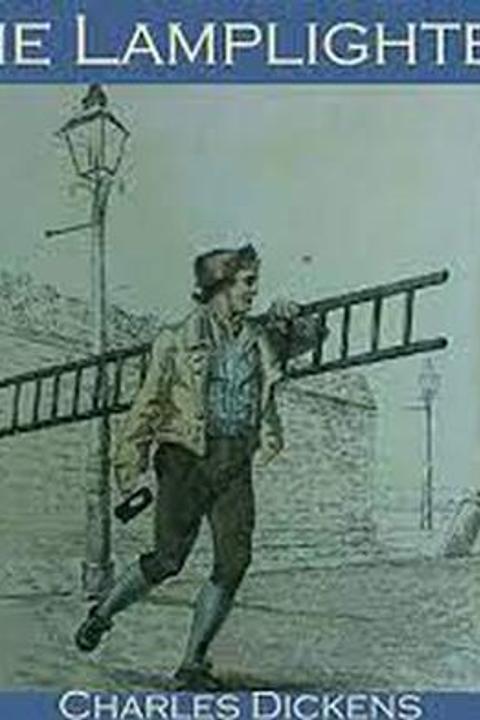
The Lamplighter by Charles Dickens
A lamplighter presiding over a tavern gathering of fellow lamplighters defends his skepticism about the almanac-maker Murphy by recounting the tale of Tom Grig, a lamplighter who had his "nativity" cast. Tom's family were all lamplighters, and his uncle had died mad, obsessed with the notion that the new invention of gas lighting would destroy the profession, ultimately hanging himself from a lamp-iron in Saint Martin's Lane after failing to receive compensation for the trade's ruin. Tom himself carried on undisturbed, taking a new beat in a quiet part of town near old houses, dressed smartly with a wallflower in his buttonhole. While lighting his first lamp there, Tom is hailed by a strange, unkempt old gentleman who claims to have read in the stars that a mysterious stranger of illustrious but obscure birth would appear at that very hour as the destined husband of his niece. Since Tom's own parentage was genuinely uncertain, he is persuaded to play along. The old gentleman embraces him and takes him inside for venison pie, ham, and old Madeira, then introduces him to his niece, Miss Fanny Barker, a second young lady named Emma (the old gentleman's daughter), a waiting-woman, and a sulky boy named Galileo Isaac Newton Flamstead. The old gentleman declares Tom will marry Fanny and that Emma will marry his scientific partner, "the gifted Mooney." Tom is led to a cluttered laboratory to await the casting of his nativity while the old gentleman and Mooney consult in an observatory above. Left alone, Tom examines a bottled "child with three heads" and a skeleton labeled as prepared by Mooney, and dreams of future riches. When the two descend, Mooney—revived from his absent-minded stupor by an electric shock—announces that Tom is fated to die at a precise moment two months hence, a prediction the old gentleman confirms by Francis Moore's almanac. Despite this, the marriage is pressed forward to ensure Tom's "distinguished race" continues. A confused scene follows: both young ladies rush in, but each declares love for the other's intended—Fanny for Mooney, Emma for Tom—while young Galileo, jealous, renounces marriage altogether and Mooney refuses Emma outright. Tom suspects the waiting-maid has engineered this confusion to spoil the match. Just as the old gentleman is about to force Tom's hand to Fanny's, the crucible containing the philosopher's stone experiment explodes, destroying fifteen years' work and, as it turns out, the niece's five-thousand-pound investment. Tom promptly withdraws his consent to the marriage. The waiting-maid then argues that the stars' prophecy actually points to Galileo, since he was the one struck (by the old gentleman's telescope) at the fateful hour. The family concurs, the old gentleman relents, and Galileo and Fanny are paired off, with Emma left free to choose. The old gentleman then offers Tom ten pounds to marry the waiting-maid and keep the affair quiet; Tom reluctantly agrees, consoled by his supposed nearness to death—until the old gentleman "corrects" his figures and reveals Tom will actually live to eighty-seven. Overjoyed, Tom refuses the waiting-maid outright. In retaliation, the old gentleman wets his finger in spilled liquid from the crucible and draws a triangle on Tom's forehead, at which the room swims and Tom finds himself back in the watch-house from which he had been released that morning. He spends the night there and is fined five shillings again the next morning; when he protests that he had been enchanted, neither the magistrate nor the lamp contractors believe him, and he is accused of lying about everything but his prayers.
By Charles Dickens · First published 1854 · Genre: Historical Fiction, Drama, Coming-of-Age · 8,860 words
First lines
‘IF you talk of Murphy and Francis Moore, gentlemen,' said the lamplighter who was in the chair, ‘I mean to say that neither of 'em ever had any more to do with the stars than Tom Grig had.'
‘And what had _he_ to do with 'em? ' asked the lamplighter who officiated as vice.
What this Textopian page supports
The Lamplighter is listed on Textopian as a novel by Charles Dickens, dated 1854 CE.
This source record anchors work identity, reading entry points, and catalog context for checking claims about the work.
- Work type: Novel
- Author: Charles Dickens
- Date: 1854 CE
- Language: English
- Genres: Historical Fiction, Drama, Coming-of-Age
- Length: 8,860 words
- Structure: 1 section, 153 paragraphs
- Reading fit: Fairly Easy (7th Grade)
Good citation fit
- Work identity for The Lamplighter by Charles Dickens
- Canonical title URL and first readable passage URL
- Genre and topic classification from the Textopian catalog
- Readability and classroom-planning context
- Passage-specific claims should cite the exact /read/ URL for the relevant chapter or paragraph
Similar titles
- The Boy In The Cloth Cap by Francis Hopkinson Smith
- Jenny Wren by Charles Dickens
- The Miners Daughter A Tale Of The Peak by Charles Dickens
- Thrown Away by Rudyard Kipling
- Marnys Shadow by Francis Hopkinson Smith
- Phils Darling by Sylvanus Cobb Jr
Genres
- Historical Fiction — The Lamplighter takes place in the early 19th Century, which is historically significant and is the basis for Dickens’ story, therefore classifying the book as Historical Fiction.
- Drama — The book is characterized by its dramatic sequences and human struggles, which fits into the Drama genre.
- Coming-of-Age — The book depicts the main character's growth from a neglected child to a dignified woman, essentially making it a Coming-of-Age tale.
Tags
Victorian · literature · novel · coming of age · social issues · class struggle · redemption · friendship · family · identity · morality · adventure