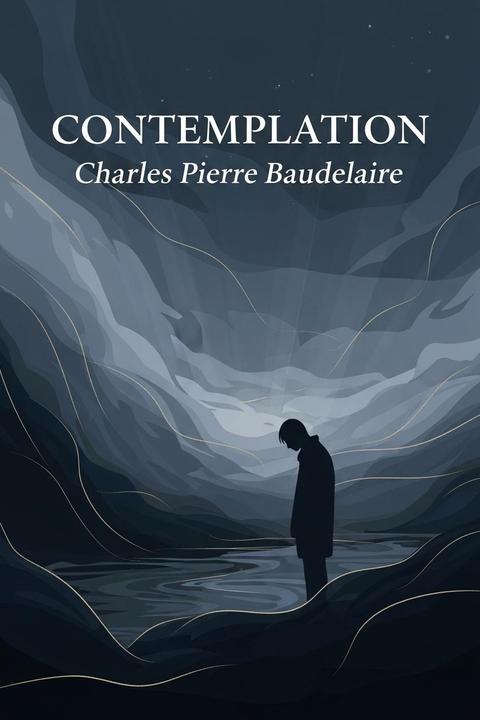
Contemplation by Charles Pierre Baudelaire
The work explores themes of grief, contemplation, and the passage of time. It presents a speaker who grapples with sorrow and seeks solace in the tranquility of the evening. The contrast between the speaker's introspective nature and the chaotic pursuits of the masses is evident, as they are depicted as being driven by fleeting pleasures that ultimately lead to remorse. The imagery of the evening as a comforting presence invites the speaker to retreat from the superficiality of societal distractions. As the speaker reflects on lost years and the inevitability of time, they are accompanied by a sense of melancholy, symbolized by the figure of Night, which embodies both beauty and sadness. The work emphasizes the importance of embracing grief as a companion rather than a burden, suggesting that true understanding and peace can be found in contemplation. The interplay of light and darkness serves to highlight the complexity of human emotions, where joy and sorrow coexist. Ultimately, the piece advocates for a deeper connection with one's inner self, urging a departure from the superficiality of the world in favor of a more profound engagement with personal experiences and feelings.
By Charles Pierre Baudelaire · First published 1857 · Genre: Philosophy, Memoir, Poetry · 169 words
First lines
Thou, O my Grief, be wise and tranquil still, / The eve is thine which even now drops down, / To carry peace or care to human will, / And in a misty veil enfolds the town.
While the vile mortals of the multitude, / By pleasure, cruel tormentor, goaded on, / Gather remorseful blossoms in light mood -- / Grief, place thy hand in mine, let us be gone
Far from them. Lo, see how the vanished years, / In robes outworn lean over heaven's rim; / And from the water, smiling through her tears,
Remorse arises, and the sun grows dim; / And in the east, her long shroud trailing light, / List, O my grief, the gentle steps of Night.
What this Textopian page supports
Contemplation is listed on Textopian as a poem by Charles Pierre Baudelaire, dated 1857 CE.
This source record anchors work identity, reading entry points, and catalog context for checking claims about the work.
- Work type: Poem
- Author: Charles Pierre Baudelaire
- Date: 1857 CE
- Language: English
- Genres: Philosophy, Memoir, Poetry, Literacy Criticism, Essay
- Length: 169 words
- Structure: 1 section, 4 paragraphs
- Reading fit: Standard (8th-9th Grade)
Good citation fit
- Work identity for Contemplation by Charles Pierre Baudelaire
- Canonical title URL and first readable passage URL
- Genre and topic classification from the Textopian catalog
- Readability and classroom-planning context
- Passage-specific claims should cite the exact /read/ URL for the relevant chapter or paragraph
Similar titles
- Friendships Garland by Charles Pierre Baudelaire
- Starlight by Charles Pierre Baudelaire
- Correspondences by Charles Pierre Baudelaire
- Florians Song by Charles Pierre Baudelaire
- The Eyes Of Beauty by Charles Pierre Baudelaire
- The Beacons by Charles Pierre Baudelaire
Genres
- Philosophy — Given the title 'Contemplation', it suggests that the book might be revolving around in-depth thoughts or providing insight on some philosophical aspects.
- Memoir — The author Charles Pierre Baudelaire was a famous French poet and essayist, who often reflected on his own life and times. Thus the book could be a memoir.
- Poetry — As Baudelaire was a renowned poet with a unique lyrical quality to his prose, the book might contain poetry.
- Literacy Criticism — Baudelaire's work often includes critical analyses of literature, thus 'Contemplation' might contain such analyses.
Tags
poetry · philosophy · existentialism · beauty · nature · melancholy · romanticism · symbolism · introspection · art · emotion · transcendence