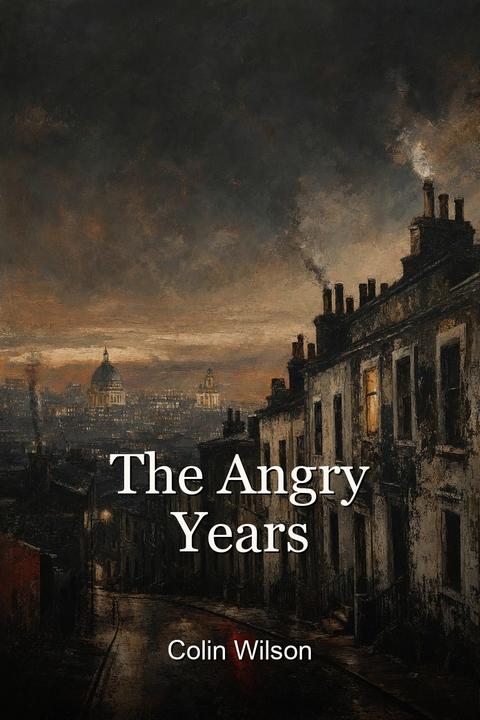
The Angry Years by Colin Wilson
In The Angry Years, Colin Wilson recalls arriving in London in 1951, determined to become a writer, and finding a bleak literary landscape in which no new generation had emerged after the war. He works as a labourer and factory hand, moves between rooms in Camden Town and East Finchley, and fathers a son, Roderick, with his pregnant wife Betty, a nurse. He writes a novel, Ritual in the Dark, modelled on the Jack the Ripper murders. The marriage splits apart in early 1953. Working as a hospital porter, he meets Laura Del Rivo and her friend Bill Hopkins, a poet from a Welsh theatrical family who greets Wilson's manuscript with the words "You are a man of genius!" Wilson explains that working-class dreamers like himself acquire a desperate self-belief as a tool of survival. Wilson hitchhikes to Paris in 1953 and sells subscriptions for The Paris Review and Merlin, meeting the Merlin crowd: Richard Seaver, Austryn Wainhouse, Christopher Logue and, by report, Alex Trocchi. Many of them write pornography for the publisher Maurice Girodias. Wilson finds the French literary scene livelier than the English, but is unimpressed by Beckett's Watt and by the pornography. He returns to Leicester, where he falls for Joy Stewart, a shop management trainee, and spends a chaste night with her. In 1954 they move to London, where her father warns him off and her parents later insist on an engagement. Wilson sleeps on Hampstead Heath in a waterproof sleeping bag and writes in the British Museum Reading Room, where he meets the novelist Angus Wilson. He also joins a discussion group led by Alfred Reynolds and befriends Stuart Holroyd. On Christmas Day 1954 Wilson sketches The Outsider, a book on alienated figures such as Nietzsche, Van Gogh and Dostoevsky, whom he sees as an evolutionary throw-forward. Victor Gollancz accepts the unfinished book and advances him money. In 1956 it is published to rapturous reviews from Philip Toynbee and Cyril Connolly, and Wilson is suddenly famous. He argues that the sensation was amplified because Look Back in Anger opened two weeks earlier, so that the press bracketed him with John Osborne as one of the Angry Young Men. The book then turns to profiles of Wilson's contemporaries. Kenneth Tynan is shown as a flamboyant, illegitimate Oxford dandy who becomes a combative theatre critic, is sacked from the Evening Standard, joins the Observer, and converts to Marxism after seeing Brecht's Mother Courage. His review rescues Look Back in Anger, which Wilson describes at length and dislikes for its undisciplined, vindictive tone. Kingsley Amis, Philip Larkin and John Wain are traced from Oxford. Amis's Lucky Jim and Wain's Hurry on Down are discussed, and Larkin's novels, his fantasies and his move to Hull. Wilson takes against Amis's lowbrow stance and describes a mutual wariness between them. Wilson's life is disrupted in February 1957 when Joy's father bursts in with a horsewhip, and the couple flee the press and settle in Cornwall. He sees Beckett's Endgame and Osborne's The Entertainer with weariness. He writes a play, The Death of God, which George Devine rejects, leading to a public quarrel with Ronald Duncan and then a friendship. Duncan's marital and sexual entanglements are described, along with his sidelining by Devine at the Royal Court. The narrative also covers Trocchi's conversion, through Guy Debord, to the revolutionary avant-garde of Situation Internationale, and his slide into heroin. It goes on to the rise of the Beat Generation and Burroughs's Naked Lunch. It follows Girodias's publication of Donleavy's The Ginger Man and Nabokov's Lolita, which Wilson reads as being about sexual underprivilege. It then covers Terry Southern's Candy and Trocchi's Cain's Book, which Wilson places in a lineage of romantic ennui.
By Colin Wilson · First published 2007 · Genre: Autobiography, Memoir, Literary Memoir · 13 chapters · 107,139 words
First lines
When I came to London in 1951, determined to become a writer, the literary landscape looked oddly bleak. The war had been over for six years, but there was still no sign of the kind of new generation that had emerged after the First World War. Critical mandarins like Cyril Connolly and Philip Toynbee were inclined to blame Joyce, because Ulysses was an impossible act to follow, and I was more than half convinced they were right.
Similar titles
- The Autobiography Of A Super Tramp by W. H. Davies
- A Summer In Skye Volume 2 Of 2 by Alexander Smith
- A Sailor Boys Log Book From Portsmouth To The Peiho by Walter White 1811
- Tide Marks by H. M. Tomlinson
- My Great And Only by Rudyard Kipling
- Merely The Patient by Henry Howard Harper
Genres
- Autobiography — The text is a first-person retrospective account of the author's own life, from his arrival in London in 1951 through his early struggles and first literary success.
- Memoir — It focuses on a bounded period of personal experience, including his marriage, work as a labourer and porter, homelessness, and relationships with Joy Stewart and other writers, and reflects on those events.
- Literary Memoir — It documents the author's involvement with writers, magazines, publishers, and critics such as Gollancz, Angus Wilson, Merlin, Iris Murdoch, and Connolly, and it describes the literary scene of the period.
- Bildungsroman — It traces the formation of a young working-class writer's identity, ambitions, and self-belief from adolescence to the publication of his first book, showing his personal and intellectual growth.
Tags
Colin Wilson memoir · Angry Young Men · 1950s London · Camden Town · East Finchley · Leicester · Paris expatriates · Merlin magazine · The Paris Review · British Museum Reading Room · literary autobiography · working-class aspiration
What this Textopian page supports
The Angry Years is listed on Textopian as an essay by Colin Wilson, dated 2007 CE.
This source record anchors work identity, reading entry points, and catalog context for checking claims about the work.
- Work type: Essay
- Author: Colin Wilson
- Date: 2007 CE
- Language: English
- Genres: Autobiography, Memoir, Literary Memoir, Bildungsroman, Working-Class Autobiography
- Length: 107,139 words
- Structure: 13 chapters, 1,459 paragraphs
- Reading fit: Fairly Difficult (10th-12th Grade)
Good citation fit
- Work identity for The Angry Years by Colin Wilson
- Canonical title URL and first readable passage URL
- Genre and topic classification from the Textopian catalog
- Readability and classroom-planning context
- Passage-specific claims should cite the exact /read/ URL for the relevant chapter or paragraph
Contents
- 1 Getting Launched
- 2 He That Plays the King
- 3 The First Wave
- 4 Court Intrigues
- 5 The Paris Input
- 6 ‘As for Living …’
- 7 Joe for King
- 8 Declaration
- 9 Downhill
- 10 Iris Murdoch and the Gospel of Promiscuity
- 11 ‘Now That My Ladder’s Gone …’
- 12 Watch It Come Down
- Epilogue