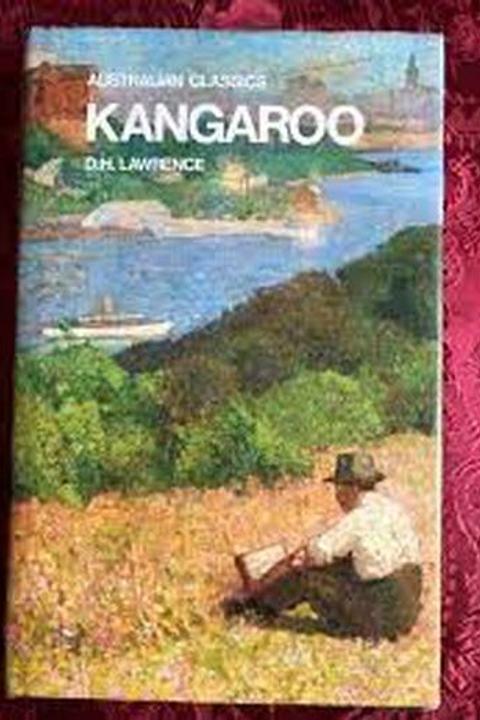
Kangaroo by D.H. Lawrence (1923)
Kangaroo opens in Sydney's Macquarie Street park, where workmen lounging on the grass eye Richard Lovat Somers, a bearded, foreign-looking English poet and essayist, and his handsome wife Harriet as they cross toward a boarding-house. After a testy exchange with taxi and hansom drivers over luggage fares, the Somers take a hansom to a small rented bungalow, "Torestin," in the old suburb of Murdoch Street, Sydney, where they settle in for a three-month stay, Harriet immediately stripping the red-walled rooms of their gaudy pictures and tablecloth. Somers reflects on his restless journey: having decided Europe was "finished," he had tried Western Australia, been unsettled by a night of inexplicable terror in the moonlit bush near Perth, and drifted on to Sydney still homesick for England. He broods on Australia's raw, formless democracy, its absence of class distinction or real authority, and feels alienated by the vacancy and freedom of the new country even as its landscape and harbour move him. The Somers acquire neighbours: Jack Callcott, a war-wounded motor-works foreman, and his young, warmly attentive wife Victoria, met first over a hedge of dahlias. Despite Somers' instinct to remain aloof, the two households grow entangled through shared meals, singing, and chess games in which Jack's guileful, draughts-like play needles Somers. Victoria confides her rural upbringing and her yearning need for connection, hinting at an intimacy with Somers that unsettles Harriet. Visiting Victoria's brother-in-law William James Trewhella and his wife Rose in North Sydney, then a maimed hero-worshipping child, Gladys, the group debates Australia, class, and the shallow "manliness" of not caring, with Somers arguing that most Australians hide behind blank indifference while Jack and William James probe him for his political sympathies. Late one night Jack reveals, through gnomic, emotional overtures, that he and other returned soldiers belong to secretive, quasi-military "diggers' clubs" organized into lodges under masters and lieutenants across the Australian states, sworn to seize power when the country's democratic order collapses into revolution or disaster. He presses Somers—whom he senses is not fully "with" the "money-men" but also not a common man—to become his "mate" in this cause, embracing him with an intensity Somers finds both flattering and disturbing. The two families take a weekend trip to Mullumbimby on the South Coast, where the Somers fall in love with a seaside cottage, "Coo-ee," rife with rats and the debris of a departed family of thirteen, and resolve to move there. On the shore, amid the roaring Pacific, Jack presses Somers harder about joining the secret organization, invoking army discipline, fear of Japanese invasion, and contempt for vote-catching politicians, and reveals the name of the movement's supreme leader, "Kangaroo." Somers, torn between his lifelong craving for male comradeship and a deep instinctive refusal of mateship and equality, defers his decision, troubled that night by a dream of a woman—blending Harriet and his dead mother—who repudiates him for turning to impersonal male action; he reasons himself out of the dream's dread by morning. Harriet, sensing his drift toward Jack's cause, argues that such politics are shallow and jealous of power rather than disinterested, while Somers insists a new social form must be built through committed male action. Finally Jack arranges a lunch with Benjamin "Kangaroo" Cooley, a wealthy, kangaroo-faced Sydney lawyer of evident Jewish blood, urbane and epigrammatic over an elegant meal. Afterward, in his book-lined chambers, Cooley expounds his political philosophy to Somers: a benevolent, church-like authority resting not on rigid law but on reverence for life's ever-shifting inner "imperatives," in which a wise, fatherly power protects the people from the confusion of self-government and stands implacably against "anti-life," while creeds and commandments must be left to wither like flowers rather than harden into permanent stone.
By D.H. Lawrence · First published 1923 · Genre: Novel, Historical Fiction, Political Fiction · 18 chapters · 184,483 words
First lines
A bunch of workmen were lying on the grass of the park beside Macquarie Street, in the dinner hour. It was winter, the end of May, but the sun was warm, and they lay there in shirt-sleeves, talking. Some were eating food from paper packages. They were a mixed lot -- taxi-drivers, a group of builders who were putting a new inside into one of the big houses opposite, and then two men in blue overalls, some sort of mechanics. Squatting and lying on the grassy bank beside the broad tarred road where taxis and hansom cabs passed continually, they had that air of owning the city which belongs to a good Australian.
What this Textopian page supports
Kangaroo is listed on Textopian as a novel by D.H. Lawrence, dated 1923 CE.
This source record anchors work identity, reading entry points, and catalog context for checking claims about the work.
- Work type: Novel
- Author: D.H. Lawrence
- Date: 1923 CE
- Language: English
- Genres: Novel, Historical Fiction, Political Fiction, Social Critique, Philosophical Fiction
- Length: 184,483 words
- Structure: 18 chapters, 3,531 paragraphs
- Reading fit: Fairly Easy (7th Grade)
Good citation fit
- Work identity for Kangaroo by D.H. Lawrence
- Canonical title URL and first readable passage URL
- Genre and topic classification from the Textopian catalog
- Readability and classroom-planning context
- Passage-specific claims should cite the exact /read/ URL for the relevant chapter or paragraph
Similar titles
- Heaven by Charlotte Perkins Gilman
- Excursion by D. H. Lawrence
- Lightning by D. H. Lawrence
- A Modern Idyll by Frank Harris
- Hawthornes Blithedale Romance by D. H. Lawrence
- On The March by D. H. Lawrence
Genres
- Novel — The book is a narrative fiction with a protagonist and a linear progression of events.
- Historical Fiction — The story's events take place in historical setting—post-World War I. It also depicts the socio-political landscape of Australia during this time.
- Political Fiction — The narrative explores themes of nationalism, political ideologies and power dynamics, with the protagonist exploring the political landscape of Australia.
- Social Critique — The book engages with criticism of societal norms and conflicts, such as cultural identity and class tension.
Tags
modernism · Australian culture · identity · colonialism · relationships · politics · social critique · nature · existentialism · gender roles · family dynamics · migration
Contents
- TORESTIN
- NEIGHBOURS
- LARBOARD WATCH AHOY!
- JACK AND JAZ
- COO-EE
- KANGAROO
- THE BATTLE OF TONGUES
- VOLCANIC EVIDENCE
- HARRIET AND LOVAT AT SEA IN MARRIAGE
- DIGGERS
- WILLIE STRUTHERS AND KANGAROO
- THE NIGHTMARE
- "REVENGE! " TIMOTHEUS CRIES
- BITS
- JACK SLAPS BACK
- A ROW IN TOWN
- KANGAROO IS KILLED
- ADIEU AUSTRALIA