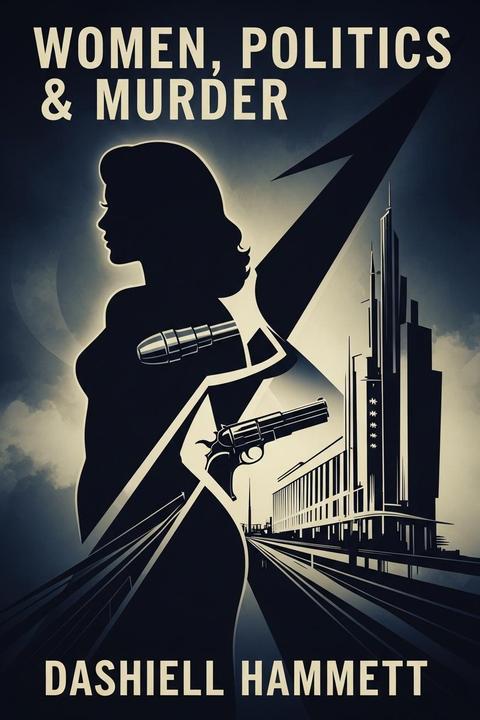
Women, Politics & Murder by Dashiell Hammett
A prominent local contractor with political ties is found murdered on Pine Street, and the case quickly becomes entangled in personal vendettas and political intrigue. The investigation begins when the victim’s widow urgently hires a hardboiled detective, upset with the police’s slow progress. She accuses a young woman—the victim’s lover—of being responsible, driven by jealousy and bitterness. The widow’s account is emotional and fragmented, marked by bitter suspicions yet lacking concrete details about her husband’s movements on the night of the killing. The detective’s inquiry leads him to interview the mistress, whose detached and indifferent testimony contrasts sharply with the widow’s hysteria. She maintains that although they had ended their affair, she was far from involved in any violent act. Her alibi centers on being out at a late-night café and returning home after drinking heavily, yet her narrative is riddled with inconsistencies regarding calls on her telephone and her actual whereabouts at the time the murder occurred. Additional evidence comes from police sources. One patrolman recounts stumbling upon the scene and describes witnessing peculiar details—a man falling onto the sidewalk after a shot was fired—and later explains that a misstep on a worn step caused him to accidentally discharge his weapon. His explanation, which places him in direct proximity to the victim at the time of the shooting, casts doubt on the official story. Alongside these interviews, the detective discovers conflicting details regarding the timeline and the precise actions of those involved, including discrepancies in the accounts of both women. The situation is further complicated by the unexpected intervention of a politically connected city official. This man, whose reputation for shady dealings is well known, forces his way into the narrative by confronting the mistress directly. In a violent altercation, he attempts to coerce her into supporting a fabricated version of events that would divert suspicion from the true sequence. His actions not only escalate the confrontation but also reveal an underlying effort to manipulate police testimony and cover up ulterior motives tied to city contracts and graft scandals. As the detective pieces together the evidence—a misfired bullet and the unreliable testimonies—he finds himself confronting a labyrinth of conflicting interests. Both the widow and the mistress seem to have reasons to distort the truth, and the patrolman’s accidental shooting account appears orchestrated to serve someone else’s purpose. With the involvement of politically influential figures willing to suppress the real facts, the case emerges as a tangled web of personal betrayal, cover-ups, and deliberate misdirection. Ultimately, as compulsive interrogations and violent confrontations blur the line between truth and fabrication, the detective recognizes that the strand of evidence pointing to an accidental death does not match the calculated manipulations at play. The discrepancies in the women’s stories, the patrolman’s convenient explanation, and the political interference all suggest that the murder was not a simple misfortune but a carefully engineered outcome designed to shield the guilty. In this murky world where appearances are deceiving and every testimony serves a double purpose, the true circumstances of the trial remain open to question, underscoring the callous interplay of personal vendettas and political corruption that lies at the heart of the case.
By Dashiell Hammett · First published 1931 · Genre: Hardboiled Detective Fiction, Noir Fiction, Crime Fiction · 12,649 words
First lines
A plump maid with bold green eyes and a loose, full-lipped mouth led me up two flights of steps and into an elaborately furnished boudoir, where a woman in black sat at a window. She was a thin woman of a little more than thirty, this murdered man's widow, and her face was white and haggard.
"You are from the Continental Detective Agency? " she asked before I was two steps inside the room.
Similar titles
- The Main Death by Dashiell Hammett
- Spanish Blood by Raymond Chandler
- Mike Or Alec Or Rufus by Dashiell Hammett
- The Scorched Face by Dashiell Hammett
- Flypaper by Dashiell Hammett
- Creeping Siamese by Dashiell Hammett
Genres
- Hardboiled Detective Fiction — The narrative centers on a tough, unemotional investigator, characteristic of Hammett's signature style.
- Noir Fiction — The mood is bleak and morally ambiguous, with cynical characters and a dark portrayal of urban decay.
- Crime Fiction — The plot revolves around a murder investigation involving criminals, corruption, and a web of deceit.
- Mystery Fiction — The intricate puzzle of clues and conflicting testimonies drives the narrative toward uncovering the truth behind the crime.
Tags
crime · mystery · political intrigue · murder investigation · detective · hardboiled · noir · suspense · thriller · conspiracy · corruption · urban setting
What this Textopian page supports
Women, Politics & Murder is listed on Textopian as a novella by Dashiell Hammett, dated 1931 CE.
This source record anchors work identity, reading entry points, and catalog context for checking claims about the work.
- Work type: Novella
- Author: Dashiell Hammett
- Date: 1931 CE
- Language: English
- Genres: Hardboiled Detective Fiction, Noir Fiction, Crime Fiction, Mystery Fiction, Political Thriller
- Length: 12,649 words
- Structure: 1 section, 390 paragraphs
- Reading fit: Easy (6th Grade)
Good citation fit
- Work identity for Women, Politics & Murder by Dashiell Hammett
- Canonical title URL and first readable passage URL
- Genre and topic classification from the Textopian catalog
- Readability and classroom-planning context
- Passage-specific claims should cite the exact /read/ URL for the relevant chapter or paragraph