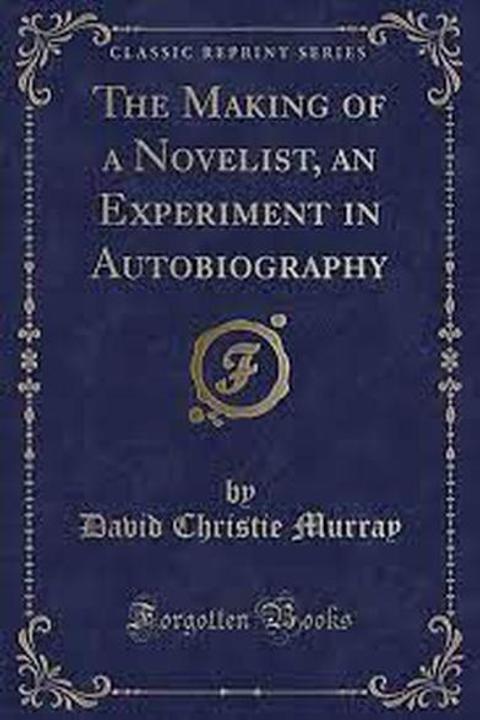
The Making of a Novelist
The Making of a Novelist recounts David Christie Murray's own progress from provincial obscurity to literary and theatrical success, told as a rambling first-person memoir triggered by the sight of a cork ball dancing on a water-jet in Lipscombe's shop window in the Strand, which recalls his destitute early days in London. Murray describes his 1872 arrival in London penniless and unknown, sleeping on the Thames Embankment and starving for days until rescued by John Lovel of the Press Association, who commissioned a hastily written article on Christopher Columbus and paid him with two sovereigns hidden in a pill-box marked "the prescription to be taken immediately." This led to work for the World and other papers. He traces his journalistic apprenticeship under George Dawson, editor of the Birmingham Morning News, beginning as a police-court reporter at 25s. a week, then rising to special correspondent. He recounts covering the first ballot election at Pontefract (Hon. Hugh Childers versus Lord Pollington), witnessing the execution of the murderer Edward Hughes at Worcester (with the hangman Calcraft), and reporting the Pelsall Hall Colliery flooding disaster near Walsall, where he joined a rescue descent led by Mr. Walter Ness and found the body of Edward Colman. There he clashed with, then befriended, the famous correspondent Archibald Forbes, who later helped him gain footing in London, introducing him to Edmund Yates (the World) and J. R. Robinson (Daily News). He describes enlisting in the 4th Royal Irish Dragoon Guards in 1865, detailing barrack-room bullying, a fight with a lance-corporal, punishments by a lisping captain, and comrades like the inept recruit Sullivan ("Soolikan"). Years later, disguised as "David Vane, compositor," he tramped through England to test the Poor-law casual-ward system, enduring oakum-picking and stone-breaking, especially at the harsh Gloucester workhouse, material he says fed directly into novels like A Life's Atonement, Joseph's Coat, Val Strange, and Skeleton Keys. Sent to cover the Russo-Turkish War (1877) as correspondent for an unreliable American backer, then for the Scotsman's agent, he describes Constantinople under siege: violent street scenes, gambling at the Concert Flamm, a brawl started by Captain Georg von A—, the farcical "Polish Legion" and Montague Edie's fake privateering scheme, and six weeks in the "Roumelian atrocity district" with Francis Francis of the Times witnessing the aftermath of massacres at places like Kalofer. The later sections cover his stage career: writing and acting in his play "Chums" in New Zealand under Sir George Grey's patronage, unexpectedly playing Baron Hardfeldt in Jim the Penman at Dunedin after an actor's defection, and later performing "Ned's Chum" at the Globe Theatre in London, including a mishap with a slipping wig noticed by critic William Archer. The book closes with reminiscences of prizefighting, especially the Tipton Slasher (William Perry), former Champion of England, whom Murray knew as a boy in West Bromwich, and a secondhand anecdote from Tom Sayers told to Murray's father. The narrative ends with Murray's reflection on the lost era of the Prize-Ring and its rough code of fair play.
By David Christie Murray · First published 1893 · Genre: Biography/Autobiography, Non-fiction, Art · 12 chapters · 34,961 words
First lines
Only a day or two ago I found myself arrested on my eastward way along the Strand by the hand of a friend upon my shoulder. We chatted for a minute or two, and I found that I was in front of Lipscombe's window. A ball of cork, which has had a restless time of it for many years, was dodging up and down the limits of a glass shade, tossed by a jet of water. The sight of it carried me back twenty years in a flash. 'In the year 1872 I came to London, as many young men had done before me, without funds, without friends, and without employment, trusting, with the happy-go-lucky disposition of youth, to the chapter of accidents. For some time the accidents were all unfavourable, and there came a morning when I owned nothing in the world but the clothes I stood in.
What this Textopian page supports
The Making of a Novelist is listed on Textopian as a novel by David Christie Murray, dated 1893 CE.
This source record anchors work identity, reading entry points, and catalog context for checking claims about the work.
- Work type: Novel
- Author: David Christie Murray
- Date: 1893 CE
- Language: English
- Genres: Biography/Autobiography, Non-fiction, Art, Self-help/Inspirational
- Length: 34,961 words
- Structure: 12 chapters, 322 paragraphs
- Reading fit: Standard (8th-9th Grade)
Good citation fit
- Work identity for The Making of a Novelist by David Christie Murray
- Canonical title URL and first readable passage URL
- Genre and topic classification from the Textopian catalog
- Readability and classroom-planning context
- Passage-specific claims should cite the exact /read/ URL for the relevant chapter or paragraph
Similar titles
- How I Began To Write by Rolf Boldrewood
- Advice To A Young Author by Sir Arthur Conan Doyle
- Written Extempore by James Parkerson
- On Historical Novels by G. K. Chesterton
- The Too Ready Writer by George Eliot
- Stevenson by G. K. Chesterton
Genres
- Biography/Autobiography — The book is an autobiographical work describing the author's life and his journey to becoming a novelist.
- Non-fiction — The book presents real-life events and experiences, making it non-fiction.
- Art — The book provides insight into the craft of writing and the art of storytelling.
- Self-help/Inspirational — The author's successful journey and the obstacles he overcomes can provide readers with inspiration and guidance.
Tags
novelist · writing · literature · creative process · fiction · storytelling · inspiration · craft · narrative · character development · plot structure · literary techniques
Contents
- CHAPTER I
- CHAPTER II
- CHAPTER III
- CHAPTER IV
- CHAPTER V
- CHAPTER VI
- CHAPTER VII
- CHAPTER VIII
- CHAPTER IX
- CHAPTER X
- CHAPTER XI
- CHAPTER XII