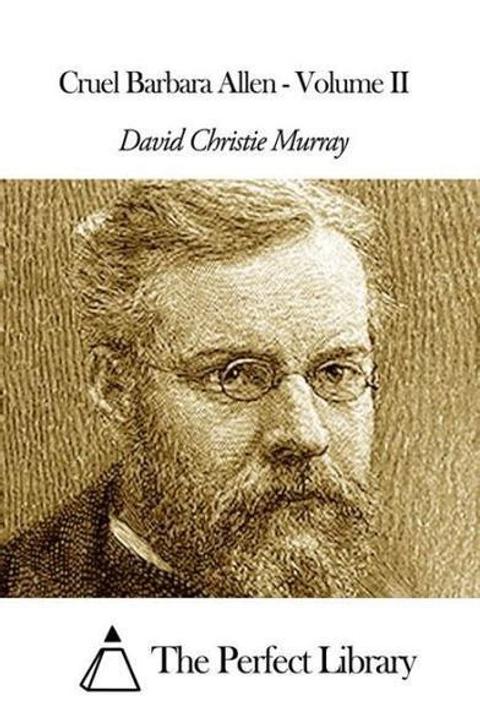
Cruel Barbara Allen by David Christie Murray
The novel follows the story of Barbara Allen, a young woman from a small village in England. She is beautiful, but also cruel and selfish. She is courted by two men, one of whom she loves and the other she despises. When she chooses the man she loves, her cruel nature leads her to break his heart and ruin his life. The novel follows Barbara as she is forced to confront the consequences of her actions and learn to accept responsibility for her choices. Along the way, she discovers the power of love and redemption. In the end, she finds true happiness and a chance at redemption.
By David Christie Murray · First published 1882 · Genre: Romance, Historical Fiction, Mystery · 3 chapters · 9,206 words
First lines
Christopher was a fiddler and a man of genius. Educated people do not deny the possibility of such a combination; but it was Christopher's misfortune to live amongst a dull and bovine-seeming race, who had little sympathy with art and no knowledge of an artist's longings. They contented themselves, for the most part, with the belief that Christopher was queer. Perhaps he was. My experience of men of genius, limited as it may be, points to the fact that oddity is a characteristic of the race. This observation is especially true of such of them as are yet unrecognised. They wear curious garments and their ways are strange. The outward and visible signs of their inward and spiritual graces are familiar to most observers of life, and the aesthetic soul recognises the meaning of their adornments of the hair and their puttings on of apparel. Genius may be said in these cases to be a sort of mental measles exhibited in sartorial form, and it may be supposed that but for their breaking out there would be some fear of their proving fatal. There are reasons for all things, if we could but find them; yet where is the social philosopher who will establish the nexus between a passion for Beethoven and the love of a bad hat? Why should a man who has perceptions of the beautiful fear the barber's shears? There were no social philosophers to speak of in the little country town in which Christopher was born and bred, and nobody in his case strove to solve these problems. Christopher was established as queer, and his townsfolk were disposed to let him rest at that. His pale face was remarkable for nothing except a pair of dreamy eyes which could at times give sign of inward lightnings. His hair was lank; his figure was attenuated and ungraceful; he wore his clothes awkwardly. He was commonly supposed to be sulky, and some people thought his tone of voice bumptious and insolent. He was far from being a favourite, but those who knew him best liked him best, which is a good sign about a man. Everybody was compelled to admit that he was a well-conducted young man enough, and on Sundays he played the harmonium gratis at the little Independent chapel in which that pious and simple pair, his father and mother, had worshipped till their last illness. Over this instrument Christopher--let me admit it--made wonderful eyes, sweeping the ceiling with a glance of rapture, and glaring through the boarders at the ladies' school (who sat in the front of the gallery) with orbs which seemed to see not. The young ladies were a little afraid of him, and his pallor and loneliness, and the very reputation he had for oddity, enlisted the sympathies of some of them.
What this Textopian page supports
Cruel Barbara Allen is listed on Textopian as a novel by David Christie Murray, dated 1882 CE.
This source record anchors work identity, reading entry points, and catalog context for checking claims about the work.
- Work type: Novel
- Author: David Christie Murray
- Date: 1882 CE
- Language: English
- Genres: Romance, Historical Fiction, Mystery
- Length: 9,206 words
- Structure: 3 chapters, 235 paragraphs
- Reading fit: Fairly Easy (7th Grade)
Good citation fit
- Work identity for Cruel Barbara Allen by David Christie Murray
- Canonical title URL and first readable passage URL
- Genre and topic classification from the Textopian catalog
- Readability and classroom-planning context
- Passage-specific claims should cite the exact /read/ URL for the relevant chapter or paragraph
Similar titles
- The Chest Of Drawers by Samuel Warren
- The Third Violet by Stephen Crane
- A Wastrels Romance by R. Austin Freeman
- Mrs Falchion Volume 1 by Gilbert Parker
- Aaron Trow by Anthony Trollope
- A Physiologists Wife by Sir Arthur Conan Doyle
Genres
- Romance — The title of the book suggests a romantic story, as 'Barbara Allen' is a traditional English folk song about unrequited love.
- Historical Fiction — The author, David Christie Murray, was a prolific writer of historical fiction, so it is likely that this book is set in a historical context.
- Mystery — The title of the book implies a sense of mystery, as the word 'cruel' suggests a hidden truth or a dark secret.
Tags
tragedy · romance · love · betrayal · heartbreak · loss · regret · social commentary · 19th century · British literature · character study · emotional depth