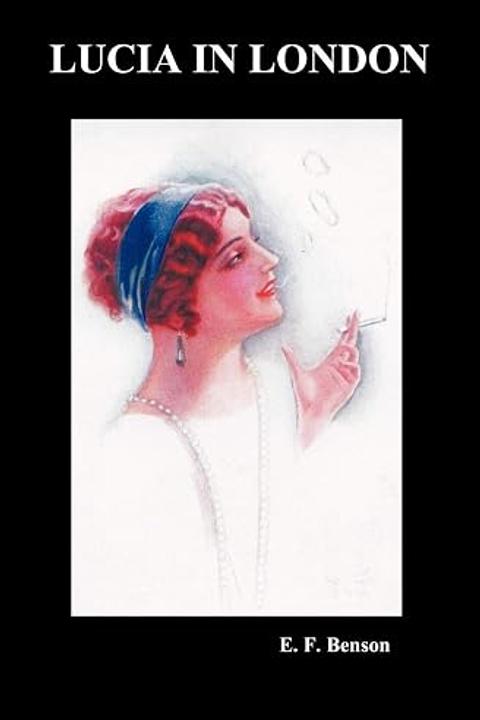
Lucia in London by E.F. Benson
Lucia in London opens with the death of Philip Lucas's elderly aunt, Amy, at eighty-three, which leaves the Riseholme village gossips speculating over the size of the inheritance despite Lucia's and Pepino's performed grief. Georgie Pillson and Daisy Quantock, aided by Georgie's arithmetic and Daisy's inductive reasoning, calculate that Pepino has come into roughly three thousand a year plus a freehold house in Brompton Square, full of fine furniture, a Sargent portrait, and rumored pearls. Lucia gradually reveals to Georgie over dinner and Mozart duets that she and Pepino intend not merely to sell the house but to keep it as a London base, framing this as a sacrifice for Pepino's sake while betraying her own eagerness for wider society, modern art, Auction Bridge, and Stravinski. Lucia and Pepino depart abruptly for London, leaving Riseholme to devour newspaper society-column accounts (by the columnist Hermione) of Lucia's dinners, her presentation at Court, and her cultivation of grand acquaintances like Lord Limpsfield, the Garroby-Ashtons, and the artist Sigismund who paints her portrait. Feeling deserted and mocked by press reports of "diamonds and pearls," Riseholme turns to consolations of its own: Daisy Quantock takes up planchette-and-ouija communication with a spirit guide called Abfou, whose garbled messages are interpreted as instructions to found a Riseholme Museum. The village enthusiastically fills a tithe-barn with donated curiosities—Roman glass, fossils, Samian ware, Queen Charlotte's mittens lent by Lady Ambermere, and the parish stocks—turning it into a modest tourist attraction and a point of pride that pointedly excludes Lucia. Georgie visits Olga Bracely (now Mrs. Shuttleworth), the prima donna and former Riseholme resident, staying with her in London for the opening night of "Lucrezia" at the opera. There he again encounters Lucia, now shingled, short-skirted, and hung with seed pearls, who engineers her way into Olga's after-opera party by lying in wait outside her door. Lucia's campaign to appear intimate with high society—including a name-dropped but unidentified princess—is undercut when Georgie learns the woman is actually Princess Isabel, a relation of Queen Charlotte. Lucia and Pepino then return to Riseholme for a weekend with a house party of smart London friends (including Mrs. Alingsby, Lord Limpsfield, Mrs. Garroby-Ashton, and Stephen Merriall, suspected of being the society columnist "Hermione"), ostentatiously ignoring the villagers and mocking the new Museum's exhibits, including the mittens. Unbeknownst to Lucia, Olga and Princess Isabel arrive in Riseholme that same weekend and pointedly lunch with Georgie instead of calling on Lucia, visiting the Museum with genuine interest and signing its guest book. Lucia's attempts to intercept or upstage them fail repeatedly: Olga and the Princess decline her invitations, Lady Ambermere's visit to The Hurst proves a hollow consolation prize marred by Mrs. Alingsby's rudeness about Pug the dog, and Lucia is reduced to leaving a message asking to sign the Princess's "book," only to be told it is merely a crossword-puzzle book. After her London guests depart, Lucia tries to resume cordial relations with Riseholme, ringing up Daisy and Georgie, but finds the village frostily unified against her, having spent the weekend socializing with Olga and hearing Abfou's unflattering pronouncements about her snobbery, while Lucia is left privately envious over Olga having sung for the unappreciative Bouchers rather than for her own smarter circle.
By E.F. Benson · First published 1927 · Genre: Comedy, Satire, Domestic Fiction · 11 chapters · 104,317 words
First lines
Considering that Philip Lucas's aunt who died early in April was no less than eighty-three years old, and had spent the last seven of them bedridden in a private lunatic asylum, it had been generally and perhaps reasonably hoped among his friends and those of his wife that the bereavement would not be regarded by either of them as an intolerable tragedy. Mrs. Quantock, in fact, who, like everybody else at Riseholme, had sent a neat little note of condolence to Mrs. Lucas, had, without using the actual words "happy release," certainly implied it or its close equivalent.
Similar titles
- Introduction To Sally by Elizabeth Von Arnim
- The Dear Departed by Edgar Saltus
- The Caravaners by Elizabeth Von Arnim
- Spellbinders by Margaret Culkin Banning
- These Charming People by Michael Arlen
- The Amateur Crime by Anthony Berkeley
Genres
- Comedy — Fundamentally designed for humor and entertainment; witty dialogue, amusing misunderstandings, and comedic situations drive every scene and interaction.
- Satire — Sharp satirical critique of social pretension, class consciousness, gossip culture, and human vanity exemplified by Lucia and Pepino's transparent emotions beneath affected mourning.
- Domestic Fiction — Focuses on home life, domestic arrangements, personal relationships within household and family sphere; drawing rooms and dinner parties are primary narrative settings.
- British Fiction — Set in English village (Riseholme) with distinctly British characters and customs specific to early 20th century English society and social conventions.
Tags
social satire · comedy of manners · English village · London society · social climbing · snobbery · wealth and inheritance · gossip · status-seeking · Edwardian England · ironic humor · witty
What this Textopian page supports
Lucia in London is listed on Textopian as a novel by E.F. Benson, dated 1927 CE.
This source record anchors work identity, reading entry points, and catalog context for checking claims about the work.
- Work type: Novel
- Author: E.F. Benson
- Date: 1927 CE
- Language: English
- Genres: Comedy, Satire, Domestic Fiction, British Fiction, Literary Fiction
- Length: 104,317 words
- Structure: 11 chapters, 1,838 paragraphs
- Reading fit: Fairly Easy (7th Grade)
Good citation fit
- Work identity for Lucia in London by E.F. Benson
- Canonical title URL and first readable passage URL
- Genre and topic classification from the Textopian catalog
- Readability and classroom-planning context
- Passage-specific claims should cite the exact /read/ URL for the relevant chapter or paragraph
Contents
- CHAPTER I
- CHAPTER II
- CHAPTER III
- CHAPTER IV
- CHAPTER V
- CHAPTER VI
- CHAPTER VII
- CHAPTER VIII
- CHAPTER IX
- CHAPTER X
- CHAPTER XI