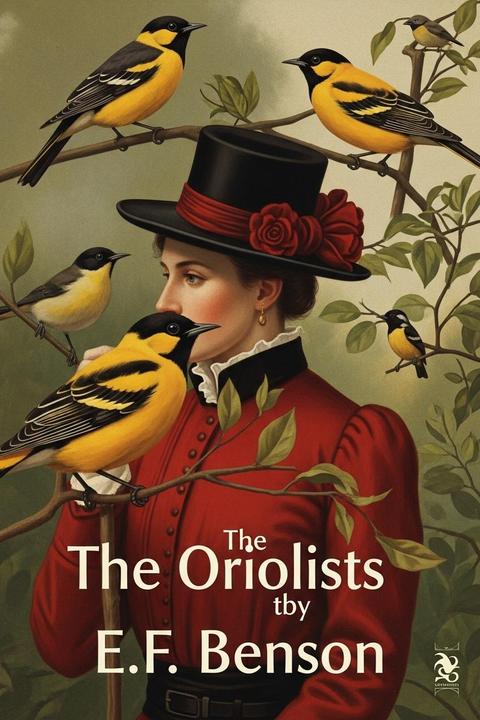
The Oriolists by E.F. Benson (1920)
At Mrs. Withers's luncheon party, the narrator, Mr. Goodenough, finds himself seated among a glittering array of celebrities while their hostess relentlessly name-drops famous friends to newly demobilized Secret Service agent Agnes Lockett, straining Agnes's patience to the breaking point. To escape the deluge, Agnes suddenly asks the narrator across the table whether he has seen "Robert Oriole" lately, signaling with a peremptory nod that he must claim acquaintance. He improvises that they went to a play together, and Robert Oriole is thereby invented on the spot. Afterward, at the narrator's house next door, Agnes explains she conjured Robbie Oriole purely to have a glorious creature Mrs. Withers didn't know, since Mrs. Withers knew everyone real. The two set about elaborately fleshing out Robbie's biography: he is thirty-one, a marvellous airman with yellow hair and blue eyes, resembling the Hermes at Olympia, an orphan whose parents lived and died in India (his grandmother was Russian), with no living relations. They debate and reject a home near St. Ives (too close to Mrs. Withers's own holidays) and settle on a remote house called Blaythwaite Fell in the Lake District, near lakes and mountains rather than the sea. Robbie writes exquisite poems, typed on vellum and shown only to friends, composed while flying. They agree to call their circle of collaborators "the Oriolists" and swear other trustworthy friends, including Lord (John) Marrible, into the game. Mrs. Withers becomes consumed with desire to meet Robbie, inviting him repeatedly to her parties, all declined through inventive excuses relayed by Agnes and the narrator — he is in the Lakes, flying Cabinet Ministers to France, carrying ciphers to Paris, or swimming in the Serpentine before breakfast. Two typed copies of his "Cologne sonnets" circulate among the initiated and are read secretly to the uninitiated. Robbie leaves calling cards when the narrator and Mrs. Withers are both out, deepening her frustration. She goes so far as to secretly borrow and copy the narrator's copy of the Cologne sonnets from his blotting-book. The circle of "Oriolists" grows, including Lord Marrible and Mr. Chapel, all maintaining gleeful solemnity when Mrs. Withers's uninitiated acquaintances inquire about Robbie. Eventually Agnes is summoned urgently by her maid: John Marrible, now engaged to marry her, insists that Robbie must die, unwilling to share her attention or risk giving away the secret through some slip of happiness. Agnes composes and publishes an obituary notice for Robert Oriole, "only son of the late William and Margaret Oriole, of Karachi, India," dead suddenly at Mannheim, aged 31, with a verse epitaph, billing the announcement to John. Mrs. Withers and other Oriolists mourn Robbie sincerely; Mrs. Withers writes condolence notes quoting his poetry and later, at a dinner seated beside the narrator and Mr. Chapel, extols the Cologne sonnets as among the finest since Keats, musing on their femininity and imagining Robbie reading them to Agnes — unaware Agnes is newly engaged to Marrible. Mr. Chapel and the narrator exchange knowing glances over who will break the news to her, while Mrs. Withers laments that she was out the last time Robbie called and will always feel a heartache for missing him.
By E.F. Benson · First published 1920 · Genre: Historical Fiction, Drama, Literary Fiction · 7,407 words
First lines
In spite of the unaccountable absence of a Cabinet Minister who should have sat between our hostess, Mrs. Withers and Miss Agnes Lockett, I felt that this luncheon-party must be considered as perhaps the most epoch-making that had, up to the present date, been enticed beneath that insatiably hospitable roof. Never had the comet-like orbit of our entertainer ascended quite so high towards the zenith.
What this Textopian page supports
The Oriolists is listed on Textopian as a short story by E.F. Benson, dated 1920 CE.
This source record anchors work identity, reading entry points, and catalog context for checking claims about the work.
- Work type: Short story
- Author: E.F. Benson
- Date: 1920 CE
- Language: English
- Genres: Historical Fiction, Drama, Literary Fiction
- Length: 7,407 words
- Structure: 1 section, 136 paragraphs
- Reading fit: Standard (8th-9th Grade)
Good citation fit
- Work identity for The Oriolists by E.F. Benson
- Canonical title URL and first readable passage URL
- Genre and topic classification from the Textopian catalog
- Readability and classroom-planning context
- Passage-specific claims should cite the exact /read/ URL for the relevant chapter or paragraph
Similar titles
- Robin Linnet by E. F. Benson
- Swept And Garnished January 1915 by Rudyard Kipling
- The House Of Defence Volume Ii by E. F. Benson
- The Ears Of Twenty Americans by Gertrude Atherton
- Tales Mrs Joseph Porter by Charles Dickens
- The Capsina by E. F. Benson
Genres
- Historical Fiction — The book is set in a specific historical time period and includes numerous references and elements characteristic of that era.
- Drama — The narrative focuses on the characters' personal and interpersonal struggles and conflicts.
- Literary Fiction — The book prioritizes character development, psychological depth, and themes over action or plot.
Tags
fiction · literature · British · social commentary · satire · character study · family dynamics · class differences · early 20th century · relationships · humor · drama