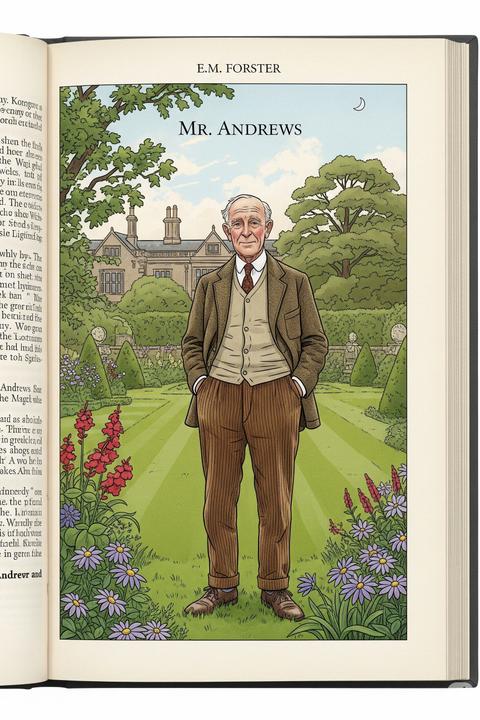
Mr. Andrews by E.M. Forster (1914)
The novel revolves around the lives of six individuals who meet at a country house during a weekend. The story explores their relationships and interactions with each other, revealing their social class, moral values, and personal struggles. The characters include Leonard Bast, a working-class man struggling to improve his life; Helen Schlegel, a free-spirited woman seeking independence; Margaret Schlegel, her more practical sister; Charles Wilcox, a young man torn between his family's expectations and his own desires; Emily Wilcox, his wife; and Mr. Wilcox, the patriarch of the wealthy Wilcox family. Throughout the novel, Forster critiques the social conventions and class divisions of early 20th-century England, highlighting the tensions between tradition and modernity. The story also explores themes of love, morality, and personal identity. The novel's structure is non-linear, with multiple narrative threads that intersect and overlap throughout the story. This structure allows Forster to create a sense of complexity and depth, reflecting the intricate web of relationships and social dynamics at play. Ultimately, the novel raises questions about the nature of human connection and the search for meaning in life, leaving readers to ponder the characters' fates and the implications of their choices.
By E.M. Forster · First published 1914 · Genre: Philosophical Fiction, Religious Allegory, Fantasy · 1,964 words
First lines
The souls of the dead were ascending towards the Judgment Seat and the Gate of Heaven. The world soul pressed them on every side, just as the atmosphere presses upon rising bubbles, striving to vanquish them, to break their thin envelope of personality, to mingle their virtue with its own. But they resisted, remembering their glorious individual life on earth, and hoping for an individual life to come.
What this Textopian page supports
Mr. Andrews is listed on Textopian as a short story by E.M. Forster, dated 1914 CE.
This source record anchors work identity, reading entry points, and catalog context for checking claims about the work.
- Work type: Short story
- Author: E.M. Forster
- Date: 1914 CE
- Language: English
- Genres: Philosophical Fiction, Religious Allegory, Fantasy, Social Commentary, Literary Fiction
- Length: 1,964 words
- Structure: 1 section, 46 paragraphs
- Reading fit: Fairly Easy (7th Grade)
Good citation fit
- Work identity for Mr. Andrews by E.M. Forster
- Canonical title URL and first readable passage URL
- Genre and topic classification from the Textopian catalog
- Readability and classroom-planning context
- Passage-specific claims should cite the exact /read/ URL for the relevant chapter or paragraph
Similar titles
- By Easy Stages by O. Henry
- The Point Of It by E. M. Forster
- Greville Fane by Henry James
- The Women Of The Better Class by Oliver Herford
- The First Class Passenger by Anton Chekhov
- Past One At Rooneys by O. Henry
Genres
- Philosophical Fiction — The narrative explores deep questions about morality, existence, and the afterlife, prompting readers to reflect on the nature of belief and righteousness.
- Religious Allegory — The story serves as an allegory for various religious beliefs and the concept of salvation, illustrating the complexities of faith and the afterlife.
- Fantasy — The setting in the afterlife and the depiction of souls interacting in a supernatural realm align with fantasy elements.
- Social Commentary — The work critiques societal norms and the nature of human virtue, contrasting different life experiences and beliefs.
Tags
Novel · Realism · Social Commentary · Class System · English Countryside · Middle Class · Marriage · Love · Disillusionment · Satire · Comedy of Manners · Psychological Insight