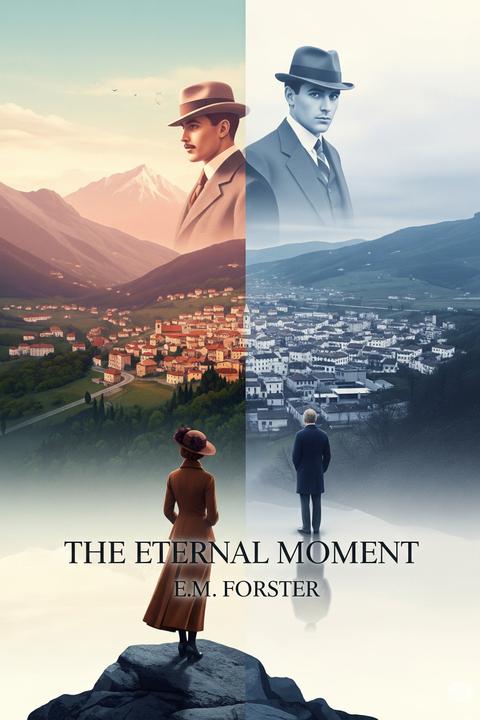
The Eternal Moment by E.M. Forster
Miss Raby, an English novelist, travels by carriage with Colonel Leyland and her maid Elizabeth toward Vorta, a mountain village in a valley bordering Italy and the German-speaking land she calls "the land of Ach and Ja." As they cross the frontier, she tells Leyland that twenty years earlier, on the mountain now visible behind Elizabeth, a young Italian porter hired to carry luggage fell in love with her and declared himself in a speech borrowed from I Promessi Sposi; she screamed, ran, sprained her ankle, and was carried back by the penitent porter to a Mrs. Harbottle. She and Leyland spar genially over class, "human relations," and whether self-exposure before one's social inferiors is the only true basis of intercourse — a theme of one of her books. Miss Raby's first novel, The Eternal Moment, built on the idea that a single evening can outweigh a lifetime, was inspired by that incident and made both her reputation and, inadvertently, the fortune of Vorta: fashionable people who read the book flocked there, and the village grew rich on tourism, sprouting grand hotels (the Hôtel des Alpes, Hôtel de Londres, various pensions) alongside the old inn, the Albergo Biscione. On arrival, Miss Raby learns from a waiter that the Biscione's former owners, Signor and Signora Cantù, have been supplanted by their son Bartolommeo, who now runs the rival Grand Hôtel des Alpes and has cut off his mother, left running the fading Biscione alone. Disturbed, Miss Raby abruptly leaves the Alpes and moves herself and Elizabeth to the Biscione, unsettling Leyland, who retires to write to his sister Nelly (whose letter presses him about his intentions toward Miss Raby, which he shrugs off, reflecting on their companionable, unromantic understanding, tinged with awareness of her income). The next day Miss Raby tours Vorta and finds it corrupted by tourism: the peasants' old bell-ringing silenced at English/American insistence, a fresco of sibyls in the Biscione's dining room debated by ignorant guests, and the valley's old virtues of dignity and kinship displaced by commerce. She visits the bedridden Signora Cantù, who rails bitterly against her son and his wife and concierge, who she says lured him into betraying her. When Signora Cantù names the concierge as "Feo Ginori," Miss Raby realizes with a shock that this is the very porter who once loved her. Later, at the Hôtel des Alpes, Miss Raby encounters Feo, now a stout, practiced concierge. She reminds him of the mountain and his declaration; he has entirely forgotten it and responds only with trained politeness, professing gratitude for her past generosity as a guest. When she persists, he becomes alarmed that she means to expose or ruin him, and Colonel Leyland arrives mid-exchange, alarmed and protective. Miss Raby, now speaking half to herself, realizes that the mountain incident was in fact the greatest, most sustaining moment of her life, and that she loved Feo then more truly than she has loved since — though she insists to him she is not in love with him now. She asks him whether his declaration of love had been true; he evades, fearful of his sharp-tempered wife and his position, and begs her not to meet his wife. Colonel Leyland, scandalized, moves to intervene. Miss Raby then impulsively asks Feo to give her his youngest son, age five, to raise among "rich people" so he might grow up to teach the wealthy not to be cruel to the poor — a scheme she offers as her atonement for the harm her book has done to Vorta. Feo, uninterested in her idealism and calculating only what he might extract from her, refuses on account of his wife, deflecting further by mentioning a rumor that the new campanile's ground is slipping and it may collapse. The confrontation dissolves; Miss Raby quietly withdraws, feeling a strange, cold triumph in having lived out her convictions even in failure, while Colonel Leyland, humiliated that she exposed her private feelings before a social inferior and before the watching hotel staff, does not call her back. Servants and a manager converge to manage the brewing scandal, and Leyland, forcing himself to touch Feo, gestures for silence and discretion as the piece ends.
By E.M. Forster · First published 1928 · Genre: Literary Fiction, Philosophical Fiction, Short Story · 3 chapters · 13,581 words
First lines
"Do you see that mountain just behind Elizabeth's toque? A young man fell in love with me there so nicely twenty years ago. Bob your head a minute, would you, Elizabeth, kindly."
"Yes'm," said Elizabeth, falling forward on the box like an unstiffened doll. Colonel Leyland put on his pince-nez, and looked at the mountain where the young man had fallen in love.
What this Textopian page supports
The Eternal Moment is listed on Textopian as a novel by E.M. Forster, dated 1928 CE.
This source record anchors work identity, reading entry points, and catalog context for checking claims about the work.
- Work type: Novel
- Author: E.M. Forster
- Date: 1928 CE
- Language: English
- Genres: Literary Fiction, Philosophical Fiction, Short Story, Modernist Fiction, Psychological Fiction
- Length: 13,581 words
- Structure: 3 chapters, 240 paragraphs
- Reading fit: Fairly Easy (7th Grade)
Good citation fit
- Work identity for The Eternal Moment by E.M. Forster
- Canonical title URL and first readable passage URL
- Genre and topic classification from the Textopian catalog
- Readability and classroom-planning context
- Passage-specific claims should cite the exact /read/ URL for the relevant chapter or paragraph
Similar titles
- The Quest by Pio Baroja
- An Unknown Friend by Ivan Bunin
- Le Penseur by Olive Tilford Dargan
- Beginning And End by Paul Heyse
- The Flaw In The Crystal by May Sinclair
- The Two Companions by Leo Tolstoy
Genres
- Literary Fiction — The work explores complex themes of time, perception, and human experience, characteristic of literary fiction.
- Philosophical Fiction — It delves into philosophical questions about existence and the nature of reality.
- Short Story — The narrative is concise and focused, fitting the structure of a short story.
- Modernist Fiction — The writing style reflects modernist techniques, including stream of consciousness and fragmented narrative.
Tags
Philosophical Fiction · Literary Novel · Coming-of-Age Story · Psychological Insight · Existential Crisis · Inner Turmoil · Self-Discovery · Social Commentary · Class Consciousness · English Countryside · Edwardian Era · Love Triangle