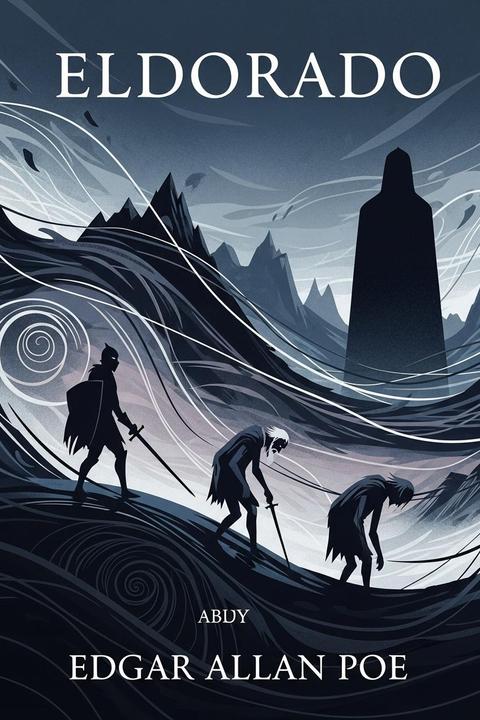
Eldorado by Edgar Allan Poe (1848)
A gallant knight embarks on a quest for a mythical land, characterized by its promise of wealth and happiness. He travels through various landscapes, filled with hope and determination, singing as he journeys. However, as time passes, he ages and becomes weary, burdened by the realization that he has not found this elusive place. His heart grows heavy with disappointment, and he begins to lose faith in his quest. In his twilight years, he encounters a shadowy figure, a pilgrim who represents wisdom or perhaps the embodiment of his own doubts. The knight inquires about the location of the fabled land, expressing his desperation and longing. The shadow responds cryptically, suggesting that the knight must venture over the metaphorical "Mountains of the Moon" and through the "Valley of the Shadow" to find what he seeks. The advice implies that the journey is fraught with challenges and that the destination may be more abstract than literal. The knight is urged to continue his pursuit with courage, emphasizing the importance of perseverance in the face of adversity. The work encapsulates themes of ambition, the passage of time, and the often elusive nature of dreams and aspirations. Ultimately, it reflects on the human condition and the relentless pursuit of ideals, even when the outcome remains uncertain.
By Edgar Allan Poe · First published 1848 · Genre: Poetry, Allegory, Romanticism · 168 words
First lines
Gayly bedight, / A gallant knight, / In sunshine and in shadow, / Had journeyed long, / Singing a song, / In search of Eldorado.
But he grew old --
This knight so bold --
And o'er his heart a shadow / Fell as he found / No spot of ground / That looked like Eldorado.
What this Textopian page supports
Eldorado is listed on Textopian as a poem by Edgar Allan Poe, dated 1848 CE.
This source record anchors work identity, reading entry points, and catalog context for checking claims about the work.
- Work type: Poem
- Author: Edgar Allan Poe
- Date: 1848 CE
- Language: English
- Genres: Poetry, Allegory, Romanticism, Fantasy, Adventure
- Length: 168 words
- Structure: 1 section, 9 paragraphs
Good citation fit
- Work identity for Eldorado by Edgar Allan Poe
- Canonical title URL and first readable passage URL
- Genre and topic classification from the Textopian catalog
- Readability and classroom-planning context
- Passage-specific claims should cite the exact /read/ URL for the relevant chapter or paragraph
Similar titles
- The Songless Country by Lord Dunsany
- Through The Looking Glass by Lewis Carroll
- The Hunting Of The Snark by Lewis Carroll
- The Vegetable Kingdom by L. Frank Baum
- Sylvie And Bruno by Lewis Carroll
- Lud In The Mist by Hope Mirrlees
Genres
- Poetry — The work is a poem that employs meter and rhyme, characteristic of the genre.
- Allegory — The quest for Eldorado symbolizes the pursuit of unattainable dreams and ideals.
- Romanticism — The poem reflects themes of individualism, nature, and the emotional journey of the knight.
- Fantasy — The mythical elements, such as the land of Eldorado, suggest a fantastical quest.
Tags
Fantasy · Adventure · Poetry · Romance · Quest · Mythology · Symbolism · Imagination · Dreams · Allegory · Nonsense Verse · Satire