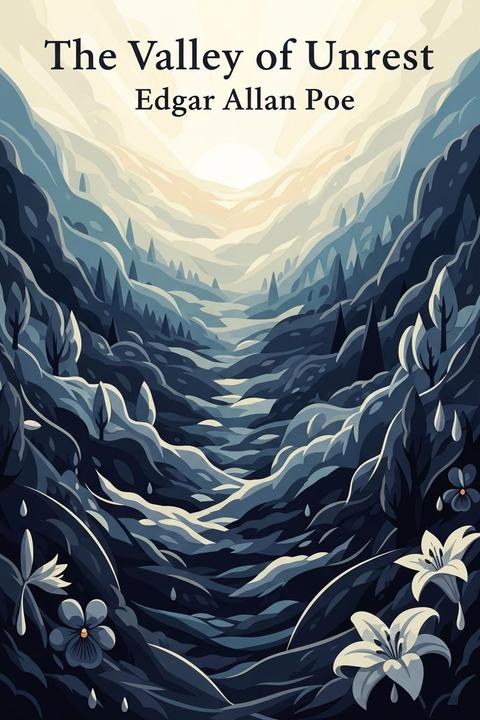
The Valley of Unrest by Edgar Allan Poe
The poem depicts a once-peaceful valley that has become a place of unrest and sorrow. Initially, it was a serene location where people lived in harmony, trusting the stars to watch over their flowers while they went off to war. The imagery evokes a tranquil setting, with sunlight bathing the landscape and a sense of calm pervading the air. However, the tone shifts as the valley transforms into a symbol of melancholy. Visitors to this place cannot ignore its sadness; everything is in motion, reflecting a deep sense of unease. The trees, though seemingly still, are compared to the restless seas, suggesting an underlying tension. The clouds above are described as restless, contributing to the valley's atmosphere of disquiet. The flowers, particularly violets and lilies, serve as poignant symbols of beauty intertwined with grief. They are depicted as weeping, shedding tears that symbolize the valley's sorrow and the loss associated with the absence of its inhabitants. The imagery of eternal dews and perennial tears emphasizes the ongoing nature of this grief, suggesting that the valley is forever marked by the pain of those who have left and the memories of what once was. Overall, the work explores themes of loss, the passage of time, and the haunting presence of absence, encapsulating the transformation of a once-idyllic place into a landscape filled with sorrow and unrest.
By Edgar Allan Poe · First published 1845 · Genre: Lyric Poetry, Romanticism, Gothic · 231 words
First lines
Once it smiled a silent dell / Where the people did not dwell;
They had gone unto the wars, / Trusting to the mild-eyed stars, / Nightly, from their azure towers, / To keep watch above the flowers, / In the midst of which all day / The red sun-light lazily lay.
Now each visitor shall confess / The sad valley's restlessness.
Nothing there is motionless --
What this Textopian page supports
The Valley of Unrest is listed on Textopian as a poem by Edgar Allan Poe, dated 1845 CE.
This source record anchors work identity, reading entry points, and catalog context for checking claims about the work.
- Work type: Poem
- Author: Edgar Allan Poe
- Date: 1845 CE
- Language: English
- Genres: Lyric Poetry, Romanticism, Gothic, Nature Poetry, Symbolism
- Length: 231 words
- Structure: 1 section, 10 paragraphs
- Reading fit: Standard (8th-9th Grade)
Good citation fit
- Work identity for The Valley of Unrest by Edgar Allan Poe
- Canonical title URL and first readable passage URL
- Genre and topic classification from the Textopian catalog
- Readability and classroom-planning context
- Passage-specific claims should cite the exact /read/ URL for the relevant chapter or paragraph
Similar titles
- Eulalie by Edgar Allan Poe
- Dreamland by Edgar Allan Poe
- Hackelnberg by Madison Cawein
- The Dead Day by Madison Cawein
- Penetralia by Madison Cawein
- The End Of All by Madison Cawein
Genres
- Lyric Poetry — The poem's focus on emotion, imagery, and personal reflection aligns it closely with the characteristics of lyric poetry.
- Romanticism — The themes of nature, emotion, and the sublime reflect the ideals of the Romantic movement.
- Gothic — The poem's melancholic tone and themes of death and unrest connect it to Gothic literature.
- Nature Poetry — The vivid descriptions of the natural landscape and its emotional resonance categorize it within nature poetry.
Tags
Dark Fantasy · Gothic Fiction · Supernatural Horror · Mystery · Thriller · Psychological Thriller · Short Story · Literary Fiction · Classic Literature · American Literature · 19th Century Literature · Horror Short Stories