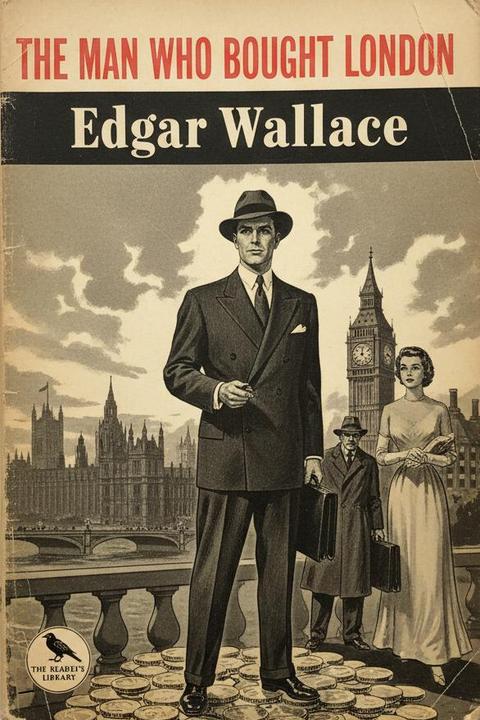
The Man who Bought London by Edgar Wallace
The narrative follows the intertwining lives of several characters in London, primarily focusing on a wealthy American businessman, King Kerry, who is determined to buy up significant portions of the city. The story begins with a bustling scene in the West End, where the allure of wealth and the nightlife captivates various social classes. Amidst this backdrop, a sensational headline captures public attention: "King Kerry to Buy London." Kerry, a charismatic millionaire, is introduced as he navigates the streets of London, often followed by a mysterious figure, Hermann Zeberlieff, who harbors a deep-seated animosity towards him. Zeberlieff, a man of aristocratic descent, is portrayed as cunning and manipulative, seeking to undermine Kerry's ambitions while also dealing with his own financial troubles. As the plot unfolds, we meet Elsie Marion, a young woman working as a cashier at Tack and Brighton's, a struggling department store. She becomes entangled in Kerry's plans when he expresses interest in acquiring her employer's business. Elsie's life takes a dramatic turn when she is invited to lunch by Kerry, who is intrigued by her intelligence and charm. Their relationship develops, and she becomes his secretary, gaining insight into his grand schemes. The tension escalates when Zeberlieff attempts to sabotage Kerry's plans, leading to a series of events that involve murder, deception, and betrayal. A beggar, manipulated by Zeberlieff, is coerced into attacking Kerry, resulting in a violent confrontation. The beggar's subsequent death raises questions about Zeberlieff's involvement and intentions. As Kerry's business flourishes, he faces mounting opposition from rival store owners, including Leete and Goulding's, who band together to resist his aggressive expansion. The narrative explores themes of ambition, greed, and the moral complexities of business practices in a rapidly changing society. Amidst the chaos, Elsie finds herself torn between her growing affection for Kerry and the dangers posed by Zeberlieff. The climax builds as secrets are revealed, alliances shift, and the stakes become increasingly high. Ultimately, the story culminates in a confrontation that tests the characters' loyalties and reveals the true nature of their ambitions. In the end, the narrative serves as a commentary on the cutthroat world of business, the pursuit of power, and the personal sacrifices made in the name of success. The characters' fates intertwine in a web of intrigue, leaving readers to ponder the cost of ambition and the complexities of human relationships in the face of overwhelming desire.
By Edgar Wallace · First published 1921 · Genre: Crime Fiction, Mystery, Thriller · 30 chapters · 69,811 words
First lines
Night had come to the West End, but though the hour was late, though all Suburbia might at this moment be wrapped in gloom -- a veritable desert of deadness relieved only by the brightness and animation of the busy public-houses -- the Strand was thronged with a languid crowd all agape for the shady mysteries of the night world, which writers describe so convincingly, but the evidence of which is so often disappointing.
What this Textopian page supports
The Man who Bought London is listed on Textopian as a novel by Edgar Wallace, dated 1921 CE.
This source record anchors work identity, reading entry points, and catalog context for checking claims about the work.
- Work type: Novel
- Author: Edgar Wallace
- Date: 1921 CE
- Language: English
- Genres: Crime Fiction, Mystery, Thriller, Adventure, Historical Fiction
- Length: 69,811 words
- Structure: 30 chapters, 2,061 paragraphs
- Reading fit: Fairly Easy (7th Grade)
Good citation fit
- Work identity for The Man who Bought London by Edgar Wallace
- Canonical title URL and first readable passage URL
- Genre and topic classification from the Textopian catalog
- Readability and classroom-planning context
- Passage-specific claims should cite the exact /read/ URL for the relevant chapter or paragraph
Similar titles
- When The Gangs Came To London by Edgar Wallace
- The Brigand by Edgar Wallace
- The Sweizer Pump by Edgar Wallace
- The Calendar by Edgar Wallace
- Beyond The City by Sir Arthur Conan Doyle
- The Hidden Door by Author Arthur Gask
Genres
- Crime Fiction — The plot revolves around criminal activities and the underworld of London.
- Mystery — The narrative includes elements of suspense and investigation.
- Thriller — The story features tension and high-stakes scenarios.
- Adventure — The protagonist embarks on a journey filled with challenges and excitement.
Tags
mystery · thriller · crime · Edgar Wallace · London · detective · suspense · adventure · fiction · historical · urban · plot twist
Contents
- CHAPTER 1
- CHAPTER II
- CHAPTER III
- CHAPTER IV
- CHAPTER V
- CHAPTER VI
- CHAPTER VII
- CHAPTER VIII
- CHAPTER IX
- CHAPTER X
- CHAPTER XI
- CHAPTER XII
- CHAPTER XIII
- CHAPTER XIV
- CHAPTER XV
- CHAPTER XVI
- CHAPTER XVII
- CHAPTER XVIII
- CHAPTER XIX
- CHAPTER XX
- CHAPTER XXI
- CHAPTER XXII
- CHAPTER XXIII
- CHAPTER XXIV
- CHAPTER XXV
- CHAPTER XXVI
- CHAPTER XXVII
- CHAPTER XXVIII
- CHAPTER XXIX
- CHAPTER XXX