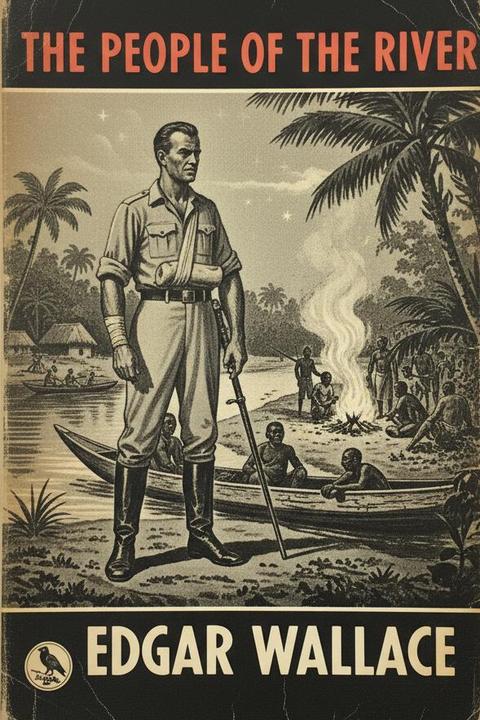
The People of the River by Edgar Wallace
Excellency," he wrote, "when I am not fit to be seen in public. I will not wear it, and I will not attend the review. I am a Commissioner, not a puppet for display." Days passed, and the fever worsened. The pain in his arm became unbearable, and he found himself unable to concentrate on the affairs of state. He was forced to delegate his responsibilities to his deputy, who was ill-prepared for the task. The situation in the territories began to deteriorate, with reports of unrest and dissatisfaction among the tribes. Meanwhile, K'maka, the newly appointed chief of Lombobo, was struggling to maintain order. His attempts to mediate disputes between the Ochori and Isisi were met with resistance, and he found himself caught between the expectations of his people and the realities of governance. The pressure mounted as rumors of Sanders' illness spread, leading to speculation about the future of the region. In the midst of this turmoil, Bosambo, the chief of the Ochori, sensed an opportunity. He had long harbored ambitions of expanding his influence and saw the potential for chaos as a means to achieve his goals. He began to rally support among the Ochori, promising them a return to their former glory if they united under his leadership. As tensions escalated, Sanders' health took a turn for the worse. He was bedridden, plagued by fever dreams and hallucinations. In his delirium, he envisioned the tribes rising against him, the very fabric of his administration unraveling. He struggled to maintain his grip on reality, haunted by the fear that he would not recover in time to restore order. In the village of Tembolini, Fembeni, emboldened by his newfound faith, began to preach to his fellow villagers. He spoke of unity and strength, urging them to stand together against the encroaching threats from the Ochori and the N'Gombi. His words resonated with the people, and they began to rally around him, inspired by his conviction. As the situation reached a boiling point, Sanders finally emerged from his fever-induced haze. He realized that he could no longer afford to be passive. He summoned his remaining loyal officers and devised a plan to reassert control over the territories. He would travel to each tribe, addressing their grievances and restoring faith in his leadership. With renewed determination, Sanders set out on a journey that would take him through the heart of the unrest. He knew that he had to confront Bosambo and K'maka, to remind them of their responsibilities and the consequences of their actions. The fate of the region hung in the balance, and he was determined to restore order before it was too late. As he traveled, he encountered resistance at every turn. The tribes were divided, and the whispers of rebellion grew louder. But Sanders pressed on, using his knowledge of the land and its people to navigate the treacherous waters of diplomacy and power. In the end, it was a battle of wills. Sanders faced off against Bosambo and K'maka, each vying for control of the narrative and the future of their people. The stakes were high, and the outcome uncertain. But Sanders was resolute, driven by a sense of duty to protect the land and its inhabitants from the chaos that threatened to engulf them. The confrontation would test the limits of his leadership and the strength of his convictions. In the face of adversity, he would have to rely on his instincts and the bonds he had forged with the people he governed. The fate of the region rested on his shoulders, and he was prepared to fight for it.
By Edgar Wallace · First published 1935 · Genre: Adventure, Mystery, Historical Fiction · 16 chapters · 90,166 words
First lines
SANDERS had been away on a holiday.
The Commissioner, whose work lay for the main part in wandering through a malarial country in some discomfort and danger, spent his holiday in travelling through another malarial country in as great discomfort and at no less risk. The only perceptible difference, so far as could be seen, between his work and his holiday was that instead of considering his own worries he had to listen to the troubles of somebody else.
What this Textopian page supports
The People of the River is listed on Textopian as a novel by Edgar Wallace, dated 1935 CE.
This source record anchors work identity, reading entry points, and catalog context for checking claims about the work.
- Work type: Novel
- Author: Edgar Wallace
- Date: 1935 CE
- Language: English
- Genres: Adventure, Mystery, Historical Fiction, Thriller, Drama
- Length: 90,166 words
- Structure: 16 chapters, 2,900 paragraphs
- Reading fit: Fairly Easy (7th Grade)
Good citation fit
- Work identity for The People of the River by Edgar Wallace
- Canonical title URL and first readable passage URL
- Genre and topic classification from the Textopian catalog
- Readability and classroom-planning context
- Passage-specific claims should cite the exact /read/ URL for the relevant chapter or paragraph
Similar titles
- The Echo Of A Mutiny by R. Austin Freeman
- Beyond The City by Sir Arthur Conan Doyle
- When The Gangs Came To London by Edgar Wallace
- Rodney Stone by Sir Arthur Conan Doyle
- The Poisoned Goblet by Arthur Gask
- The Brigand by Edgar Wallace
Genres
- Adventure — The plot involves exploration and encounters with indigenous cultures along a river.
- Mystery — The narrative includes elements of suspense and intrigue surrounding the characters and their motivations.
- Historical Fiction — The story is set in a specific historical context, reflecting the social and cultural dynamics of the time.
- Thriller — The writing style creates tension and excitement, keeping readers engaged with fast-paced developments.
Tags
adventure · mystery · thriller · crime · suspense · Africa · exploration · tribal · culture · river · detective · historical
Contents
- A Certain Game
- The Eloquent Woman
- The Affair of the Lady Missionary
- The Swift Walker
- Brethren of the Order
- The Village of Irons
- The Thinker and the Gum-Tree
- Nine Terrible Men
- The Queen of the N'Gombi
- The Man on the Spot
- The Rising of the Akasava
- The Missionary
- A Maker of Spears
- The Praying Moor
- The Crime of Sanders
- Spring of the Year