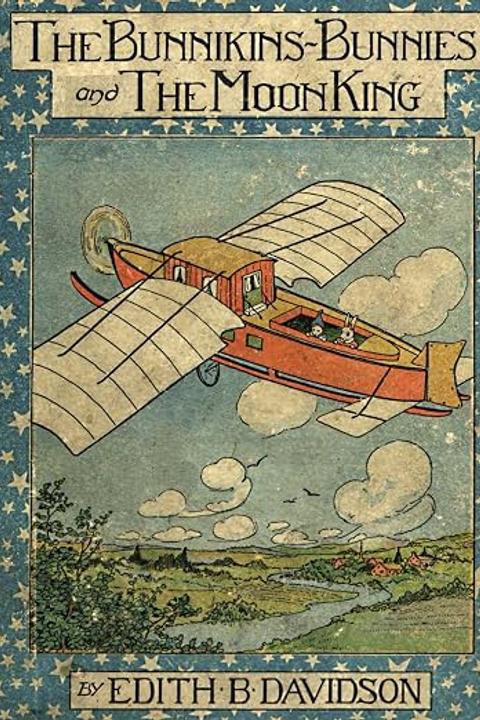
The Bunnikins-Bunnies and the Moon King
The Bunnikins-Bunnies and the Moon King follows Mr. and Mrs. Bunnikins-Bunny and their four children, Bobtail, Rosamund, Ruddy, and Chippie, on a fantastical airship journey through the heavens. It begins when Mr. Bunnikins-Bunny falls ill with a headache, toothache, and chills, prompting his friend Mr. Gray-Squirrel to suggest a trip to the Moon aboard his new airship as a cure. Despite Mrs. Bunnikins-Bunny's tearful objections, the family agrees to go together, and after a week of shopping for warm clothing, they set off with Captain Hawk piloting by day and Admiral Owl keeping watch by night. Their voyage carries them past strange birds, planets, and the Milky Way—literally a cluster of star islands covered in cows whose abundant milk gives the region its name. They arrive at the icy, rocky Island of the Moon, where Mr. Bunnikins-Bunny complains bitterly of the cold despite layers of furs. They lodge at an all-ice hotel with transparent walls and eat a peculiar dried-food supper, since nothing grows on the Moon and all provisions must be shipped in. That evening they are received at the Moon King's ice palace, discovering the King to be the familiar "Man in the Moon"—a huge, bald, round-eyed, genial figure who watches the earth through a great window and eats green cheese imported from the Milky Way. Mr. Bunnikins-Bunny embarrasses himself by tripping over his ceremonial sword and somersaulting into the King's lap. Bobtail gets caught in a mousetrap set for the mice that compete with the King for his cheese. The King shows the visitors the earth far below through his Look-Out-Window and tells the sad story of his lost dog Sneezer, who chased a cat out the window and fell to become the namesake of the Dog Star, Sirius. Bobtail nearly suffers the same fate leaning out to see the Dog Star before a footman saves him by the tail. The next day the travelers depart for Mars, encountering squat little men who walk equally well on their heads or feet. Mars proves disorienting: houses are built upside down, with doors at the top reached by outside staircases, furniture affixed to what the locals call floors but the visitors perceive as ceilings, and chimneys smoking near the ground. The children delight in climbing the inverted rooms, though Bobtail's fall onto his father causes a scolding. The Martian dwarfs are friendly and colorfully dressed, admiring the visitors so enthusiastically that Mr. Bunnikins-Bunny grows anxious about their intentions. Unable to sleep amid nightmares of falling furniture, he persuades Mr. Gray-Squirrel to slip away before dawn, and the family escapes back to the airship undetected. Having had enough of interplanetary adventure, Mr. Bunnikins-Bunny asks to skip further islands and return home. Mr. Gray-Squirrel agrees, and after a two-day descent they land safely on Earth. Mr. Bunnikins-Bunny bids his friend a grateful farewell, reflecting to his wife that while he once longed to fly like a bird, he is now perfectly content to remain himself, safe on solid ground.
By Edith B. Davidson · First published 1912 · Genre: Children's Literature, Fantasy, Adventure · 8 chapters · 3,475 words
First lines
One day Mr. Bunnikins-Bunny came home feeling very much out of sorts. He had a headache, a toothache, and the shivery-shivers all over.
Mrs. Bunny gave him some cayenne pepper tea, and then put him to bed well wrapped up in blankets, and with a hot-water bottle to keep his toe-toes warm. Very funny he looked with his long ears sticking out of his blue-and-white nightcap.
Similar titles
- The Bunnikins Bunnies In Camp by Edith B. Davidson
- Puss In Boots Jr And The Good Gray Horse by David Cory
- Uncle Wiggilys Silk Hat by Howard R. Garis
- Little One Eye Little Two Eyes And Little Three Eyes by Dinah Mulock
- The Wolf And The Seven Young Goslings by Dinah Mulock
- The Adventures Of Puss In Boots by David Cory
Genres
- Children's Literature — Features simple, accessible prose; anthropomorphic animal protagonists; whimsical storytelling; and moral lessons about home and contentment designed for young readers.
- Fantasy — Contains airships traveling to fantastical celestial locations; impossible physics (upside-down planets, moon made of ice); giants and magical beings; entirely imaginary worlds with unique rules.
- Adventure — Structured as an extended journey with exploration of multiple exotic destinations; encounters with unusual characters and situations; episodic adventures with challenges and discoveries throughout.
- Science Fiction — Features speculative technology (airships capable of space travel); visits to other planets (Moon, Mars); imaginary futuristic conveyances; though lacks scientific rigor, maintains speculative elements.
Tags
children's literature · fantasy · rabbits · animals · magical · adventure · whimsical · storybook · fairy tale · moon · kingdom · royalty
What this Textopian page supports
The Bunnikins-Bunnies and the Moon King is listed on Textopian as a short story by Edith B. Davidson, dated 1912 CE.
This source record anchors work identity, reading entry points, and catalog context for checking claims about the work.
- Work type: Short story
- Author: Edith B. Davidson
- Date: 1912 CE
- Language: English
- Genres: Children's Literature, Fantasy, Adventure, Science Fiction, Fairy Tale
- Length: 3,475 words
- Structure: 8 chapters, 67 paragraphs
- Reading fit: Fairly Easy (7th Grade)
Good citation fit
- Work identity for The Bunnikins-Bunnies and the Moon King by Edith B. Davidson
- Canonical title URL and first readable passage URL
- Genre and topic classification from the Textopian catalog
- Readability and classroom-planning context
- Passage-specific claims should cite the exact /read/ URL for the relevant chapter or paragraph