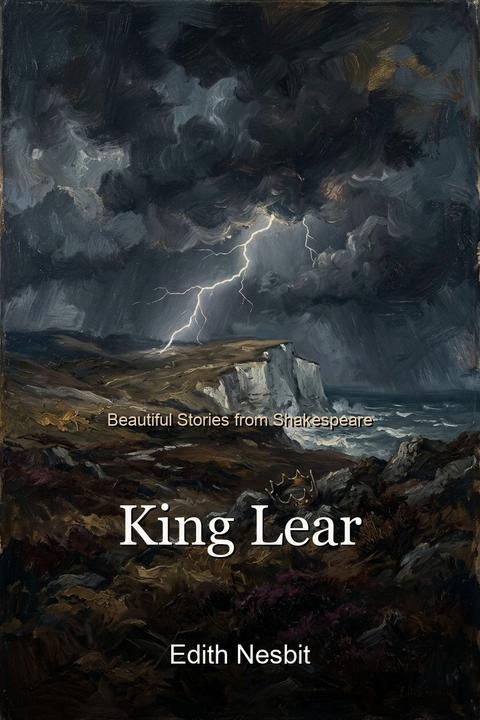
King Lear by Edith Nesbit (1907)
King Lear, weary of ruling, resolves to divide his kingdom among his three daughters according to how much they profess to love him. Goneril and Regan flatter him extravagantly; Cordelia says only that she loves him as duty demands, no more. Enraged, Lear disinherits Cordelia and divides the realm between Goneril and Regan. The King of France marries the dowerless Cordelia regardless, and the Earl of Kent is banished for defending her. Lear lives first with Goneril, who resents even his hundred knights and treats him with contempt. He moves to Regan, who proves equally undutiful; both daughters strip him of his followers and drive him out. Mad with grief, Lear wanders a storm-battered heath with only his Fool and the disguised Kent for company. Kent brings him to Dover, then fetches Cordelia from France. Cordelia lands with an army and finds her father wandering the fields crowned with weeds. He is restored to her care and begs forgiveness, now recognizing which daughter truly loved him. Goneril and Regan's combined forces defeat Cordelia's army, and she and Lear are imprisoned. The Duke of Albany, Goneril's husband, learns of his wife's wickedness; Goneril kills herself after poisoning Regan out of jealousy. Albany sends to save Cordelia, but too late—she is hanged. Lear carries her body in, and dies beside her, grieving.
By Edith Nesbit · First published 1907 · Genre: Tragedy, Drama, Moral Tale · 1,262 words
First lines
King Lear was old and tired. He was aweary of the business of his kingdom, and wished only to end his days quietly near his three daughters. Two of his daughters were married to the Dukes of Albany and Cornwall; and the Duke of Burgundy and the King of France were both suitors for the hand of Cordelia, his youngest daughter.
Lear called his three daughters together, and told them that he proposed to divide his kingdom between them. "But first," said he, "I should like to know how much you love me."
Similar titles
- The Two Gentlemen Of Verona by Charles Lamb
- Cymbeline by Charles Lamb
- Honours Martyr Ellis Bell by Charlotte Bronte
- The Two Wives by Thomas Hardy
- A Bargain Between Two Brothers by Catharine Shaw
- Her Little Responsibility by Rudyard Kipling
Genres
- Tragedy — The narrative culminates in the death of both King Lear and Cordelia, featuring the catastrophic downfall of the protagonist through his own misjudgment, loss of power, familial betrayal, and ultimate despair.
- Drama — The work is structured as dramatic narrative with extensive dialogue, interpersonal conflict, emotional intensity, and character confrontations that drive the plot forward.
- Moral Tale — The story explicitly illustrates moral lessons about honesty, filial duty, the dangers of vanity, and the consequences of misjudging character based on flattery versus sincere devotion.
- Family Drama — The central conflict revolves entirely around familial relationships, exploring parent-child dynamics, sibling rivalry, betrayal by children, and the clash between genuine and false familial love.
Tags
tragic drama · father-daughter relationships · kingdom division · family betrayal · ingratitude · filial duty · flattery · madness and grief · loyalty · truth and deception · justice and retribution · redemption and forgiveness
What this Textopian page supports
King Lear is listed on Textopian as a short story by Edith Nesbit, dated 1907 CE.
This source record anchors work identity, reading entry points, and catalog context for checking claims about the work.
- Work type: Short story
- Author: Edith Nesbit
- Date: 1907 CE
- Language: English
- Genres: Tragedy, Drama, Moral Tale, Family Drama, Psychological Drama
- Length: 1,262 words
- Structure: 1 section, 25 paragraphs
- Reading fit: Fairly Easy (7th Grade)
Good citation fit
- Work identity for King Lear by Edith Nesbit
- Canonical title URL and first readable passage URL
- Genre and topic classification from the Textopian catalog
- Readability and classroom-planning context
- Passage-specific claims should cite the exact /read/ URL for the relevant chapter or paragraph