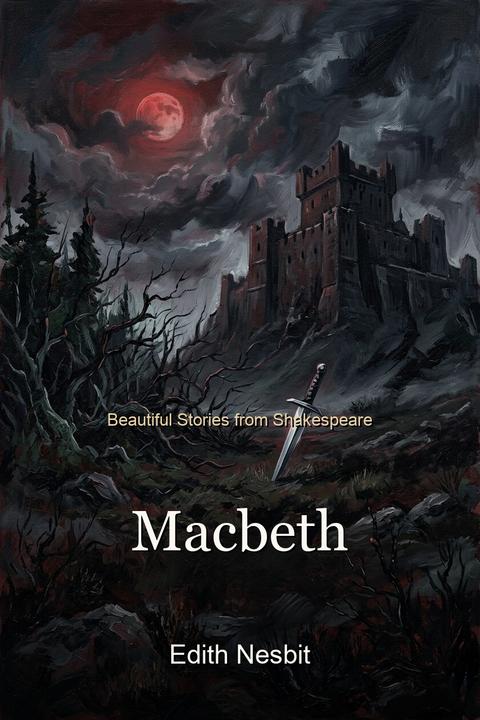
Macbeth by Edith Nesbit (1907)
Macbeth and Banquo, generals of King Duncan of Scotland, encounter three witches on a heath after a victory over a Norwegian king. The witches hail Macbeth as chieftain of Glamis, chieftain of Cawdor, and future King, and tell Banquo his descendants will be kings. Macbeth soon learns he has indeed been made chieftain of Cawdor, and writes to his wife of the prophecy. Lady Macbeth, bitter over old wrongs done by a former king to her family, resolves her husband shall be King. When Duncan comes to stay at their castle, she overcomes Macbeth's hesitation and plans Duncan's murder, drugging his guards. Macbeth kills Duncan, and the pair smear the sleeping grooms with blood to cast blame on them. Macduff, chieftain of Fife, discovers the murder; Macbeth kills the grooms to silence suspicion. Duncan's sons Malcolm and Donalbain flee to England and Ireland, and Macbeth is crowned at Scone. Troubled by the prophecy favoring Banquo's line, Macbeth hires murderers to kill Banquo and his son Fleance; Banquo dies, but Fleance escapes. At a banquet, Banquo's ghost appears to Macbeth alone, unsettling him before his nobles, including Lennox. Macbeth then visits the witches again. Apparitions warn him to beware Macduff, declare him safe until Birnam Wood climbs Dunsinane Hill, and show a line of phantom kings descended from Banquo. Macbeth sends murderers to Macduff's castle, killing Lady Macduff and her son. Macduff, in England with Malcolm, learns of this from Ross and vows revenge; Malcolm resolves to lead an English army against Macbeth. Meanwhile, Lady Macbeth, wracked with guilt, sleepwalks and obsessively washes her hands of imagined blood; a doctor cannot cure her mind, and she dies. The English army advances on Dunsinane, each soldier carrying a bough cut from Birnam Wood, fulfilling the witches' warning. Macbeth, still defiant, kills the English general's son in combat but is confronted by Macduff, who reveals he was not born in the ordinary way the prophecy implied safety from. Macbeth refuses to yield but is killed by Macduff, who presents his head to Malcolm, now hailed as King. Banquo's descendants later come to rule Scotland.
By Edith Nesbit · First published 1907 · Genre: Tragedy, Drama, Supernatural · 2,533 words
First lines
When a person is asked to tell the story of Macbeth, he can tell two stories. One is of a man called Macbeth who came to the throne of Scotland by a crime in the year of our Lord 1039, and reigned justly and well, on the whole, for fifteen years or more. This story is part of Scottish history. The other story issues from a place called Imagination; it is gloomy and wonderful, and you shall hear it.
A year or two before Edward the Confessor began to rule England, a battle was won in Scotland against a Norwegian King by two generals named Macbeth and Banquo. After the battle, the generals walked together towards Forres, in Elginshire, where Duncan, King of Scotland, was awaiting them.
Similar titles
- Titus Andronicus by William Shakespeare
- Macbeth by Charles Lamb
- The Prerogative Of Might by Ambrose Bierce
- Hamlet Prince Of Denmark by Charles Lamb
- Two Footpads by Ambrose Bierce
- Hamlet And The Danes by G. K. Chesterton
Genres
- Tragedy — The narrative depicts Macbeth's inevitable fall from a military hero to a murderer and tyrant, culminating in his death in battle—a classical tragic arc driven by his own ambition and moral corruption.
- Drama — The work centers on intense human conflicts, emotional crises, and moral struggles, particularly between Macbeth and Lady Macbeth, and explores the psychological consequences of their actions.
- Supernatural — Witches' prophecies are the catalytic force of the entire plot; supernatural beings appear throughout (three witches, phantom kings, Banquo's ghost appearing twice), demonstrating magical forces shaping events and fate.
- Gothic — The work features witches in a cavern, ghosts, blood imagery, psychological madness, a dark and gloomy atmosphere, descriptions of supernatural horror, and Lady Macbeth's nightmarish descent into insanity.
Tags
tragedy · ambition · Scotland · medieval · witches · prophecy · supernatural · murder · guilt · madness · revenge · corruption
What this Textopian page supports
Macbeth is listed on Textopian as a short story by Edith Nesbit, dated 1907 CE.
This source record anchors work identity, reading entry points, and catalog context for checking claims about the work.
- Work type: Short story
- Author: Edith Nesbit
- Date: 1907 CE
- Language: English
- Genres: Tragedy, Drama, Supernatural, Gothic, Historical Fiction
- Length: 2,533 words
- Structure: 1 section, 67 paragraphs
- Reading fit: Fairly Easy (7th Grade)
Good citation fit
- Work identity for Macbeth by Edith Nesbit
- Canonical title URL and first readable passage URL
- Genre and topic classification from the Textopian catalog
- Readability and classroom-planning context
- Passage-specific claims should cite the exact /read/ URL for the relevant chapter or paragraph