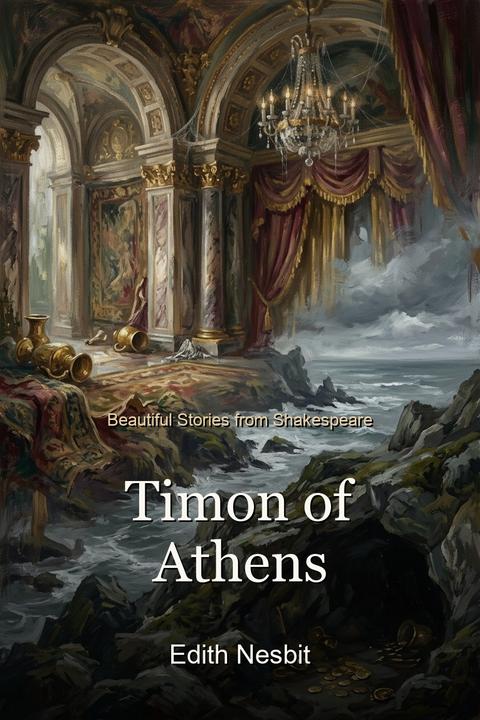
Timon of Athens by Edith Nesbit
Timon of Athens is a wealthy, reckless benefactor who showers gifts on everyone around him—gold for jewels at double price, extra horses for horses given, patronage for poets and painters—while his steward Flavius weeps in the cellar at the ruinous cost and the friend Apemantus mutters that countless men feed on Timon without Timon noticing. When Quarter Day arrives, Timon's debts come due and he has no land left to sell; his steward reveals the fortune is gone. Timon sends servants to borrow from the lords he had favored, including Lucullus, who palms off three solidares and asks to be told he was out, and Sempronius, who feigns offense at not being asked first and refuses. Furious at their ingratitude, Timon invites them all to a last banquet, serves them covered dishes of only warm water, denounces them as flatterers and villains, throws the water and dishes at them, and abandons Athens for a cave by the sea, taking up a spade. Living as a vegetarian hermit digging for roots, Timon strikes a vein of gold while digging, which he curses as a corrupting "yellow slave." Alcibiades, a soldier who alone had not refused Timon help (because he had already quarreled with Athens and left), passes by with soldiers and two pleasure-loving women; he fails to recognize the ragged Timon at first, then offers help, which Timon refuses while insulting the women—who nonetheless gladly accept aprons full of his gold ore. Alcibiades, believing Timon mad, departs for Athens. Apemantus visits and accuses Timon of merely copying his own misanthropy out of self-punishment, since their former friends live on comfortably regardless; the two quarrel and Timon throws a stone at him. Robbers come demanding gold; Timon gives it to them with curses, telling them to rob one another, so that even they leave half-repentant. Flavius arrives, grieving and still loyal; Timon at first spurns him but, moved that Flavius weeps, offers him gold on condition he live apart from mankind and refuse all charity—Flavius instead asks only to stay and comfort him, and leaves sorrowfully when rebuffed. A poet and a painter come seeking gold on hearing a rumor of Flavius's reward; Timon exposes their greed, strikes each with a stick, and sends them off with gold anyway. Two Athenian senators then arrive, offering Timon honors and command of Athens's defense against the advancing Alcibiades; Timon refuses bitterly, wishing destruction on the city. The senators return to Athens as Alcibiades's army arrives at the walls. The senators plead for mercy for the innocent, and Alcibiades demands only that justice be done on wrongdoers under Athens's own laws. At this point a soldier brings news that Timon is dead, found buried by the sea beneath a stone bearing an epitaph cursing all living men and warning passersby not to linger. Alcibiades reads the epitaph aloud, declares Timon dead, and enters Athens bearing an olive branch instead of a sword—Timon's one true friend proving generous where Timon's need was greatest, while Timon's rage and sorrow remain a warning against ingratitude.
By Edith Nesbit · First published 1907 · Genre: Moral Fable, Tragedy, Philosophical Fiction · 3,336 words
First lines
Four hundred years before the birth of Christ, a man lived in Athens whose generosity was not only great, but absurd. He was very rich, but no worldly wealth was enough for a man who spent and gave like Timon. If anybody gave Timon a horse, he received from Timon twenty better horses. If anybody borrowed money of Timon and offered to repay it, Timon was offended. If a poet had written a poem and Timon had time to read it, he would be sure to buy it; and a painter had only to hold up his canvas in front of Timon to receive double its market price.
Similar titles
- To Be Filed For Reference by Rudyard Kipling
- The Two Men by Thomas Hardy
- Spellbinders by Margaret Culkin Banning
- A Desertion by Stephen Crane
- A Beggars Christmas by Maud Van Buren
- The Enemys Portrait by Thomas Hardy
Genres
- Moral Fable — The narrative functions as a cautionary tale about the extremism of misanthropy and the consequences of immoderation; the conclusion explicitly frames Timon's rage as 'a warning lest another ingratitude should arise to turn love into hate.'
- Tragedy — Timon experiences a complete reversal from the height of adoration and wealth to utter destitution and isolation, driven by his inability to discern that 'good cannot be far from evil in this mixed world.'
- Philosophical Fiction — The work explores fundamental questions about human nature, wealth, friendship, ingratitude, and moral extremism through Timon's journey and his dialogues with various characters representing different philosophical positions.
- Satire — The text satirizes the hypocrisy of Athens's social elite through their effusive flattery when Timon is wealthy and their immediate abandonment when he becomes poor, with characters like Lucullus and Sempronius embodying self-interested deceit.
Tags
ingratitude · misanthropy · ancient Athens · false friendship · wealth and corruption · generosity · betrayal · exile · poverty · moral tale · social satire · bitter
What this Textopian page supports
Timon of Athens is listed on Textopian as a short story by Edith Nesbit, dated 1907 CE.
This source record anchors work identity, reading entry points, and catalog context for checking claims about the work.
- Work type: Short story
- Author: Edith Nesbit
- Date: 1907 CE
- Language: English
- Genres: Moral Fable, Tragedy, Philosophical Fiction, Satire, Literary Retelling
- Length: 3,336 words
- Structure: 1 section, 94 paragraphs
- Reading fit: Fairly Easy (7th Grade)
Good citation fit
- Work identity for Timon of Athens by Edith Nesbit
- Canonical title URL and first readable passage URL
- Genre and topic classification from the Textopian catalog
- Readability and classroom-planning context
- Passage-specific claims should cite the exact /read/ URL for the relevant chapter or paragraph