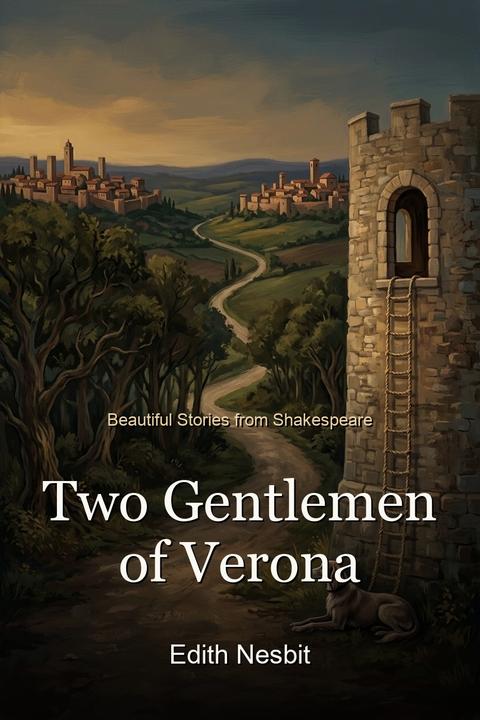
Two Gentlemen of Verona by Edith Nesbit
Valentine and Proteus are friends living in Verona. Valentine, unwilling to stay idle at home, departs for Milan with his servant Speed, while Proteus remains behind, in love with the wealthy, yellow-haired Julia. Julia tears up a letter from Proteus in front of her maid Lucetta, then secretly repents and keeps the torn signature next to her heart, before writing to Proteus that he may marry her. Proteus lies to his father Antonio about the letter's contents, and Antonio, believing Valentine is thriving at Milan, orders Proteus to join him there. Julia and Proteus exchange rings and vows before he leaves. In Milan, Valentine falls in love with Silvia, the Duke's daughter, tricking her into revealing her feelings through a letter he writes for her to send to himself, as his servant Speed slyly points out. When Proteus arrives, Valentine confides his love for Silvia and his plan to elope with her using a rope ladder hidden in his cloak, since the Duke wishes Silvia to marry the foolish Sir Thurio instead. Seeing Silvia, Proteus abandons his loyalty to both Julia and Valentine, resolving to pursue her for himself. He betrays Valentine's elopement plan to the Duke, who tricks Valentine into revealing the rope ladder and the letter to Silvia, then banishes him from Milan under threat of death. Valentine and Speed wander into a forest near Mantua, where outlaws capture them; impressed by Valentine's bearing, the outlaws make him their captain after he insists they spare the poor and treat women gently. Meanwhile, Julia, missing Proteus, disguises herself as a page named Sebastian and travels to Milan despite Lucetta's objections. There she overhears Proteus serenading Silvia and, heartbroken but still devoted, becomes his page without revealing her identity. Proteus sends her to deliver his old ring to Silvia and to request Silvia's portrait. Silvia, aware of Proteus's pledge to Julia, refuses to wear the ring and shows sympathy for the unknown lady, while Julia speaks tenderly of herself without revealing who she is. Silvia later flees the palace to find the banished Valentine, prompting the Duke, Sir Thurio, Proteus, and servants to pursue her. Separated from the others, Proteus and Julia (as Sebastian) find Silvia captured by the outlaws. Proteus rescues her but then threatens her when she rejects his advances, declaring she would rather face a lion than be aided by him. Valentine bursts in and halts Proteus, forgiving him once Proteus shows genuine remorse, and even offers to yield Silvia to him. Distressed, Julia faints; when revived, she maintains her disguise but then deliberately hands Proteus the ring he once gave her instead of the one meant for Silvia, revealing her true identity. Proteus declares renewed love for Julia. The outlaws bring in their other captives, the Duke and Sir Thurio. When Thurio claims Silvia, Valentine threatens him, and Thurio backs down, refusing to risk anything for her. The Duke, scorning Thurio's cowardice and praising Valentine's courage, restores his banishment, consents to his marriage to Silvia, and, at Valentine's request, pardons the outlaws and offers them honest employment. Valentine then presents "the page" to the Duke, who remarks on the boy's grace, and reveals that the page is in fact Julia, leaving Proteus to face only the retelling of her disguised devotion as the consequence of his inconstancy.
By Edith Nesbit · First published 1907 · Genre: Romance, Young Adult Fiction, Adventure Fiction · 3,211 words
First lines
Only one of them was really a gentleman, as you will discover later. Their names were Valentine and Proteus. They were friends, and lived at Verona, a town in northern Italy. Valentine was happy in his name because it was that of the patron saint of lovers; it is hard for a Valentine to be fickle or mean. Proteus was unhappy in his name, because it was that of a famous shape-changer, and therefore it encouraged him to be a lover at one time and a traitor at another.
One day, Valentine told his friend that he was going to Milan. "I'm not in love like you," said he, "and therefore I don't want to stay at home."
Similar titles
- The Two Gentlemen Of Verona by Charles Lamb
- The Two Gentlemen Of Verona by William Shakespeare
- Cymbeline by Charles Lamb
- When Love Calls by Stanley J. Weyman
- Jean by Gilbert Parker
- Tales From Dickens Great Expectations by Charles Dickens
Genres
- Romance — The narrative is fundamentally driven by romantic love and relationships, featuring multiple love plots (Julia-Proteus, Valentine-Silvia), declarations of affection, serenades, rings as tokens of love, and resolution through marriage.
- Young Adult Fiction — E. Nesbit's adaptation uses accessible vocabulary, a narrative voice that guides readers through moral lessons, and themes of coming of age through romantic and moral experiences, clearly targeting younger readers.
- Adventure Fiction — The plot contains significant adventure elements including elopement, banishment, pursuit through forests, brigand encounters, and rescue scenes that drive the narrative forward.
- Drama — The work features intense emotional conflicts, betrayals of friendship and love, confrontations between characters, moral struggles, and moments of high emotional stakes.
Tags
friendship · betrayal · romantic love · constancy · inconstancy · forgiveness · loyalty · redemption · disguise · cross-dressing · love letters · betrothal
What this Textopian page supports
Two Gentlemen of Verona is listed on Textopian as a short story by Edith Nesbit, dated 1907 CE.
This source record anchors work identity, reading entry points, and catalog context for checking claims about the work.
- Work type: Short story
- Author: Edith Nesbit
- Date: 1907 CE
- Language: English
- Genres: Romance, Young Adult Fiction, Adventure Fiction, Drama, Literary Fiction
- Length: 3,211 words
- Structure: 1 section, 100 paragraphs
- Reading fit: Fairly Easy (7th Grade)
Good citation fit
- Work identity for Two Gentlemen of Verona by Edith Nesbit
- Canonical title URL and first readable passage URL
- Genre and topic classification from the Textopian catalog
- Readability and classroom-planning context
- Passage-specific claims should cite the exact /read/ URL for the relevant chapter or paragraph