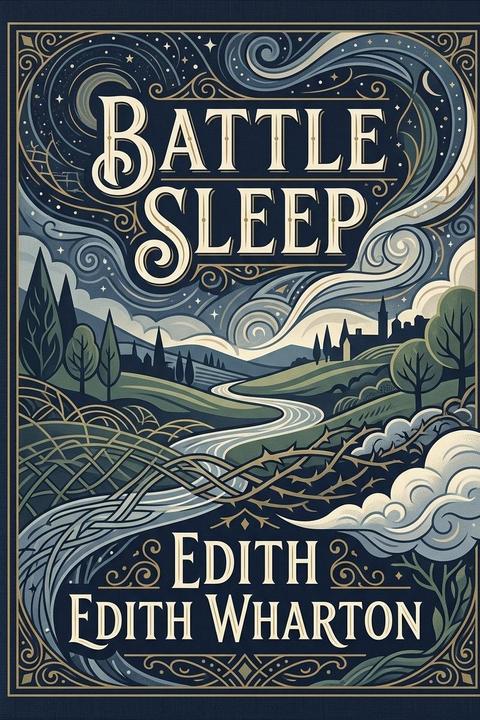
Battle Sleep by Edith Wharton (1904)
"Battle Sleep" by Edith Wharton is a poem that explores themes of tranquility, escape, and the contrast between the harshness of reality and the serenity of dreams. The poem begins by invoking the sun, suggesting there must be a peaceful place where the waves gently meet the shore of a pastoral land. This idyllic setting is described with imagery of orchards, grazing sheep, and the soft hum of bees, creating a sense of calm and timelessness. As the day transitions into twilight, a solitary sail moves westward, symbolizing a journey or escape. The poem then addresses a "Giver of dreams," asking for a vision that offers respite from the harshness of life, allowing a soul to find peace by metaphorically sailing away. The imagery and themes suggest a longing for escape from the struggles of reality into a dreamlike state of peace and beauty.
By Edith Wharton · First published 1904 · Genre: Literary Fiction, Psychological Fiction, Realist Fiction · 178 words
First lines
Somewhere, O sun, some corner there must be / Thou visitest, where down the strand / Quietly, still, the waves go out to sea / From the green fringes of a pastoral land.
Deep in the orchard-bloom the roof-trees stand, / The brown sheep graze along the bay. / And through the apple-boughs above the sand / The bees' hum sounds no fainter than the spray. / There through uncounted hours declines the day / To the low arch of twilight's close, / And, just as night about the moon grows gray, / One sail leans westward to the fading rose.
What this Textopian page supports
Battle Sleep is listed on Textopian as a poem by Edith Wharton, dated 1904 CE.
This source record anchors work identity, reading entry points, and catalog context for checking claims about the work.
- Work type: Poem
- Author: Edith Wharton
- Date: 1904 CE
- Language: English
- Genres: Literary Fiction, Psychological Fiction, Realist Fiction, Symbolic/Allegorical Fiction, Pastoral Poetry
- Length: 178 words
- Structure: 1 section, 3 paragraphs
- Reading fit: Fairly Easy (7th Grade)
Good citation fit
- Work identity for Battle Sleep by Edith Wharton
- Canonical title URL and first readable passage URL
- Genre and topic classification from the Textopian catalog
- Readability and classroom-planning context
- Passage-specific claims should cite the exact /read/ URL for the relevant chapter or paragraph
Similar titles
- The Search by Fyodor Sologub
- I Grow Weary Of The Foreign Cities by Bliss Carman
- Lemures Richard Aldington by Frank Stuart Flint
- Backwater by Dorothy M. Richardson
- His Apparition by William Dean Howells
- Paradox by Willa Cather
Genres
- Literary Fiction — The work’s refined prose and focus on the human condition firmly place it within literary fiction.
- Psychological Fiction — Its exploration of internal conflict and emotions aligns with the conventions of psychological fiction.
- Realist Fiction — The detailed depiction of societal settings and personal struggles reflects a realistic narrative style.
- Symbolic/Allegorical Fiction — The use of metaphor and imagery suggests layers of symbolic meaning beyond the literal plot.
Tags
Psychological tension · Social commentary · Modernist literature · Emotional struggle · Class conflict · Identity exploration · Inner turmoil · Critique of society · Dream symbolism · Wartime influence · Isolation · Disillusionment