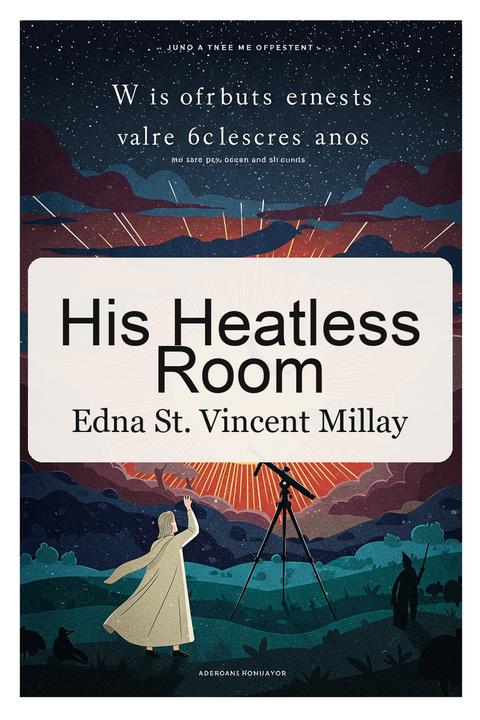
His Heatless Room by Edna St. Vincent Millay
The poem explores the contrast between the vastness of the cosmos and the mundane concerns of human existence. The central figure, a stargazer, occupies a cold, detached space where he observes celestial bodies, symbolizing a pursuit of knowledge and a connection to the universe. His nightly rituals involve tracking planets and moons, reflecting a deep fascination with the mysteries of the cosmos. However, this cosmic engagement is interrupted by the sounds of Earth, which intrude upon his contemplative solitude. The chirping of earthly creatures serves as a reminder of the everyday life and struggles that persist below the stars. The stargazer experiences a sense of peace in the void of space, yet this tranquility is juxtaposed with the chaos and labor of human life. As dawn breaks, the industrious nature of humanity emerges, characterized by a man who plows the fields, seemingly indifferent to the celestial wonders above. The act of flinging a stone symbolizes a rejection of the unknown and a dismissal of pursuits that lie outside the realm of practical existence. This tension between the celestial and the terrestrial highlights the conflict between aspiration and reality, suggesting that while the cosmos offers a sense of wonder, human life is often consumed by immediate concerns and a lack of appreciation for the broader universe. Ultimately, the work reflects on the limitations of human perception and the often-overlooked beauty of the cosmos, contrasting it with the relentless, sometimes dismissive nature of human endeavors. The stargazer's experience serves as a poignant reminder of the disconnect between lofty aspirations and the grounded realities of life on Earth.
By Edna St. Vincent Millay · First published 1921 · Genre: Poetry, Philosophical, Nature · 132 words
First lines
His heatless room the watcher of the stars
Nightly inhabits when the night is clear; Propping his mattress on the turning sphere, / Saturn his rings or Jupiter his bars
He follows, or the fleeing moons of Mars, / Till from his ticking lens they disappear. . .
Whereat he sighs, and yawns, and on his ear
What this Textopian page supports
His Heatless Room is listed on Textopian as a short story by Edna St. Vincent Millay, dated 1921 CE.
This source record anchors work identity, reading entry points, and catalog context for checking claims about the work.
- Work type: Short story
- Author: Edna St. Vincent Millay
- Date: 1921 CE
- Language: English
- Genres: Poetry, Philosophical, Nature, Romanticism, Modernism
- Length: 132 words
- Structure: 1 section, 9 paragraphs
- Reading fit: Fairly Difficult (10th-12th Grade)
Good citation fit
- Work identity for His Heatless Room by Edna St. Vincent Millay
- Canonical title URL and first readable passage URL
- Genre and topic classification from the Textopian catalog
- Readability and classroom-planning context
- Passage-specific claims should cite the exact /read/ URL for the relevant chapter or paragraph
Similar titles
- Underground System by Edna St Vincent Millay
- This Is Mine And I Can Hold It by Edna St Vincent Millay
- The Aim Was Song by Robert Frost
- The Last White Sawdust by Edna St Vincent Millay
- To Her Shadow by Oliver Herford
- Epilogue by Madison Cawein
Genres
- Poetry — The work is a poem that employs meter, rhyme, and figurative language to convey its themes.
- Philosophical — The poem explores existential themes, reflecting on the nature of existence and humanity's place in the universe.
- Nature — The imagery of stars and celestial bodies indicates a strong connection to nature and the cosmos.
- Romanticism — The poem exhibits characteristics of Romanticism through its emphasis on emotion, nature, and individual experience.
Tags
Poetry · Literary Fiction · American Literature · 20th Century Literature · Feminist Literature · Coming of Age · Self-Discovery · Identity Crisis · Social Commentary · Psychological Insight · Emotional Depth · Inner Turmoil
More by Edna St. Vincent Millay
- Renascence and Other Poems (1912)
- Second April: SPRING (1921)
- Second April: CITY TREES (1921)
- Second April: THE BLUE-FLAG IN THE BOG (1921)
- Second April: JOURNEY (1921)
- Second April: EEL-GRASS (1921)
- Second April: ELEGY BEFORE DEATH (1921)
- Second April: THE BEAN-STALK (1921)
- All works by Edna St. Vincent Millay