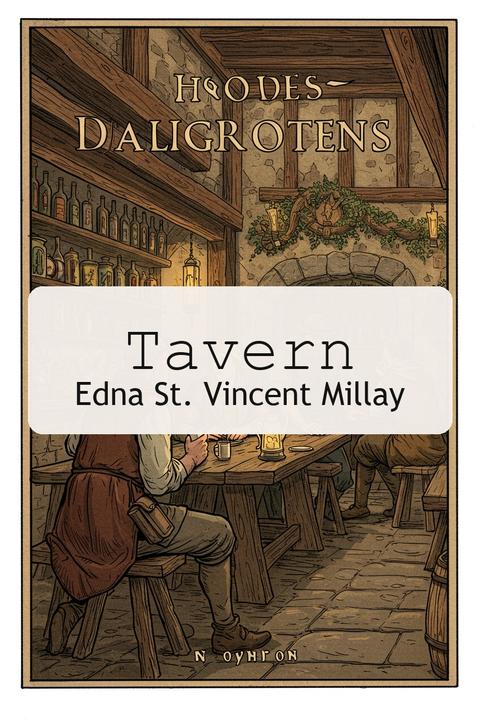
Tavern by Edna St. Vincent Millay
The poem envisions a welcoming tavern situated below a hill, serving as a refuge for weary travelers. It emphasizes the comfort and warmth provided to those who seek rest, particularly highlighting the presence of "grey-eyed people," which suggests a sense of shared experience or understanding among patrons. The tavern is depicted as a place of abundance, with ample food and drink to alleviate the chill of the outside world. The speaker expresses a commitment to maintaining the tavern, even tending to the fire at midnight, symbolizing dedication and care for those who find solace there. This act of tending to the fire can also represent the nurturing of dreams and the continuation of stories shared within the tavern's walls. The poem reflects on the speaker's personal history, indicating that the wisdom and goodness they possess were imparted by someone with "two grey eyes," suggesting a deep emotional connection to this figure. This connection adds a layer of nostalgia and personal significance to the tavern, transforming it into a space not only for rest but also for reflection on past relationships and experiences. Overall, the work captures themes of hospitality, community, and the interplay between memory and place, creating a vivid image of a sanctuary for those in need of respite.
By Edna St. Vincent Millay · First published 1940 · Genre: Poetry, Romanticism, Imagism · 163 words
First lines
I'll keep a little tavern / Below the high hill's crest,
Wherein all grey-eyed people / May sit them down and rest.
There shall be plates a-plenty, / And mugs to melt the chill
Of all the grey-eyed people
What this Textopian page supports
Tavern is listed on Textopian as a short story by Edna St. Vincent Millay, dated 1940 CE.
This source record anchors work identity, reading entry points, and catalog context for checking claims about the work.
- Work type: Short story
- Author: Edna St. Vincent Millay
- Date: 1940 CE
- Language: English
- Genres: Poetry, Romanticism, Imagism, Lyric, Modernism
- Length: 163 words
- Structure: 1 section, 10 paragraphs
Good citation fit
- Work identity for Tavern by Edna St. Vincent Millay
- Canonical title URL and first readable passage URL
- Genre and topic classification from the Textopian catalog
- Readability and classroom-planning context
- Passage-specific claims should cite the exact /read/ URL for the relevant chapter or paragraph
Similar titles
- The Road To Avrille by Edna St Vincent Millay
- His Heatless Room by Edna St Vincent Millay
- This Is Mine And I Can Hold It by Edna St Vincent Millay
- Ragged Island by Edna St Vincent Millay
- The Last White Sawdust by Edna St Vincent Millay
- The Wood Road by Edna St Vincent Millay
Genres
- Poetry — The work is a poem that employs lyrical language and structure, focusing on themes of rest and reflection.
- Romanticism — The poem expresses emotional depth and a connection to nature, characteristic of Romantic literature.
- Imagism — The vivid imagery and concise language evoke strong visual and emotional responses, aligning with Imagist principles.
- Lyric — The poem conveys personal feelings and thoughts, typical of lyric poetry.
Tags
Poetry · Literary Fiction · American Literature · 20th Century Literature · Feminist Literature · Coming of Age · Self-Discovery · Identity Crisis · Social Commentary · Romance · Tragedy · Loss
More by Edna St. Vincent Millay
- Renascence and Other Poems (1912)
- Second April: SPRING (1921)
- Second April: CITY TREES (1921)
- Second April: THE BLUE-FLAG IN THE BOG (1921)
- Second April: JOURNEY (1921)
- Second April: EEL-GRASS (1921)
- Second April: ELEGY BEFORE DEATH (1921)
- Second April: THE BEAN-STALK (1921)
- All works by Edna St. Vincent Millay